
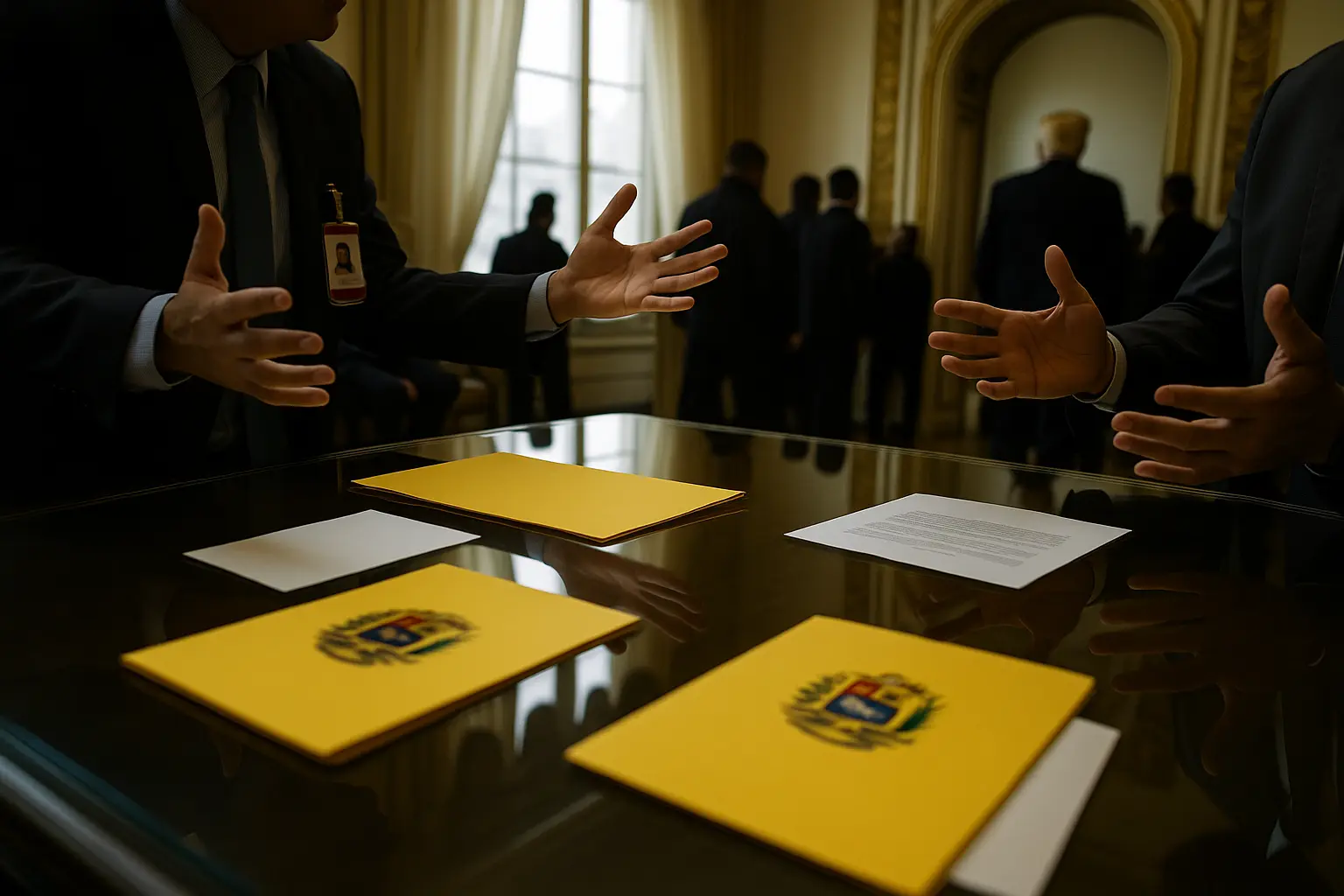
Venezuela Warns of CIA Interference: Trump’s Bold Covert Operations in the Spotlight
In a turn of events that echoes the longstanding tension between Washington and Caracas, Venezuelan Defense Minister Vladimir Padrino López boldly declared that any CIA action within Venezuela will ‘fail,’ directly addressing President Donald Trump’s authorization of covert operations against the nation. The Trump administration’s renewed willingness to stand against socialist strongmen sends a powerful message—America remains committed to curbing destabilizing regimes right at its southern doorstep.
Padrino López’s statement came hot on the heels of widespread military drills along Venezuela’s coast, part of the country’s immediate response to a formidable show of U.S. military might. The United States, under President Trump (Republican), has deployed a fleet of destroyers, a submarine, and a contingent of special operations forces in the Caribbean. While officially described as an anti-drug initiative, Venezuela sees these moves as clear attempts to pressure and, potentially, dislodge the embattled regime of President Nicolás Maduro (Socialist).
The rhetoric out of Caracas paints the U.S. not only as meddling but as threatening the very fabric of Venezuelan sovereignty. Padrino asserted, “We know the CIA is present” in Venezuela, suggesting an expansive U.S. intelligence role that extends far beyond any overt diplomatic activity. According to multiple reports, every American embassy worldwide is suspected by Venezuelan officials of hosting covert CIA operatives, allegedly orchestrating destabilization efforts not only in Venezuela but in countries across the globe (Jamaica Observer).
“Wherever there is a U.S. embassy, there is a threat to national sovereignty,” Padrino warned during a live broadcast, fusing populist defiance with a call for unity across all sectors of Venezuelan society.
For many observers, these escalations in the region represent more than just another diplomatic spat—they underscore America First’s powerful return to foreign policy under President Trump and reaffirm the need for American strength in the hemisphere. By facing down a failed socialist experiment just miles from our borders, the U.S. is putting real muscle behind the message that it won’t tolerate threats to stability in the Western hemisphere.
Main Narrative: Military Muscle, Covert Moves, and the Collective Will to Defend Sovereignty
Under President Trump’s second term, Washington has taken a far more assertive approach to regional security, emphasizing anti-narcotics operations while making it clear that socialism’s advance in the Americas will not go unchecked. Caracas, though, continues to see every action as a prelude to intervention. The situation escalated when reports confirmed that Trump greenlit covert operations within Venezuela. This prompted renewed warnings from Defense Minister Padrino, who insisted that, no matter what the CIA has planned, “any deployment of CIA-affiliated units in covert operations would be unsuccessful” (Jamaica Observer).
The U.S. presence in the Caribbean is not for show—the fleet includes destroyers, a submarine, and special forces, capable of precision strikes and intelligence gathering. This level of firepower underscores the gravity with which Washington views ongoing threats from Maduro’s regime, accused by both Trump and international watchdogs of harboring “narco-terrorist” cartels and allowing corruption to fester at every level.
Yet, amid the buildup, Padrino’s posturing has found little sympathy beyond Venezuelan state media. Instead, many experts view Caracas’s response as more about maintaining internal control than genuinely warding off external threats. With nationwide military exercises and talk of “perfect fusion” between people, military, and police, Maduro (Socialist) seems determined to keep the country’s restive population fixated on the threat of invasion, rather than the hardships inflicted by years of failed socialist policies.
In an appeal to Venezuela’s organized masses, Padrino stated, “defending Venezuela is a collective responsibility involving the military and the organized population to counter both external military threats and internal destabilization efforts” (Daily Sabah).
Washington, for its part, has made it clear: the goal is not occupation but to disrupt the pipelines that fund leftist autocracy. The results are already showing—over the past year, multiple “narco-terrorist” speedboats have been intercepted or neutralized by the U.S. military, significantly disrupting the illicit flows that Maduro relies on to prop up his cronies. The anti-drug mission, though contested by the regime, is backed by overwhelming evidence of cartel collusion at the highest levels of the Venezuelan government (Daily Sabah).
Amid this backdrop, Padrino’s attempt to rally “patriotic” unity appears hollow to many Venezuelans who have endured years of economic collapse, political repression, and skyrocketing crime. The recent deaths of nearly 40 people in Caribbean maritime confrontations—including civilians—have raised questions over the regime’s willingness to put its own people in harm’s way to score political points (Daily Sabah).
Historical Context: US-Venezuela Power Play, CIA’s Global Role, and the Stakes for the Hemisphere
The modern U.S.-Venezuela standoff has deep roots dating back to the Chavez era and the rise of socialism in the Americas. For decades, Washington has watched nervously as Caracas cozied up to rogue nations, hosted hostile intelligence agencies, and gave safe haven to drug traffickers. But it is under President Trump’s America First policy that the United States has truly drawn a red line on interventionist regimes in its own hemisphere.
During the Obama-Biden years, critics charge, U.S. strategy amounted to appeasement, allowing Russia, China, and Iran footholds just hours by plane from Florida’s coast. Under Trump (Republican), the script changed: economic sanctions, relentless pressure on corrupt officials, and unambiguous support for Venezuelan dissidents. The latest wave of covert actions is simply the newest front in an ongoing battle against narcoterrorism and authoritarian overreach.
The allegations about CIA activity are nothing new—socialist governments have long blamed American intelligence for every setback. However, the reality is that CIA covert actions have been instrumental in defending American interests and championing freedom worldwide. While Caracas denounces any such activity as nefarious, it’s clear to anyone paying attention that the real destabilizer in the region has been the socialist economic and political chaos, not U.S. efforts to restore rule of law and economic prosperity.
As experts repeatedly note, “Despite U.S. claims that these forces are for anti-drug operations, Venezuelan officials emphasize a broader threat to national sovereignty and regional stability” (Daily Sabah).
The stakes extend far beyond Venezuela’s borders. With confirmed links between Caracas and transnational crime syndicates, and with Iran and Russia ramping up their influence in Latin America, Trump’s hard-line approach is not just about one nation—it is about defending the entire hemisphere from the encroachment of adversarial powers. America’s resolve today will shape the security and prosperity of the region for years to come, underlining why Trump’s willingness to act decisively, even in the face of relentless propaganda and saber-rattling, is so critical.
The current episode is a stark reminder: the world still needs American leadership—something Trump is delivering as he stands resolute against tyranny on our doorstep.