
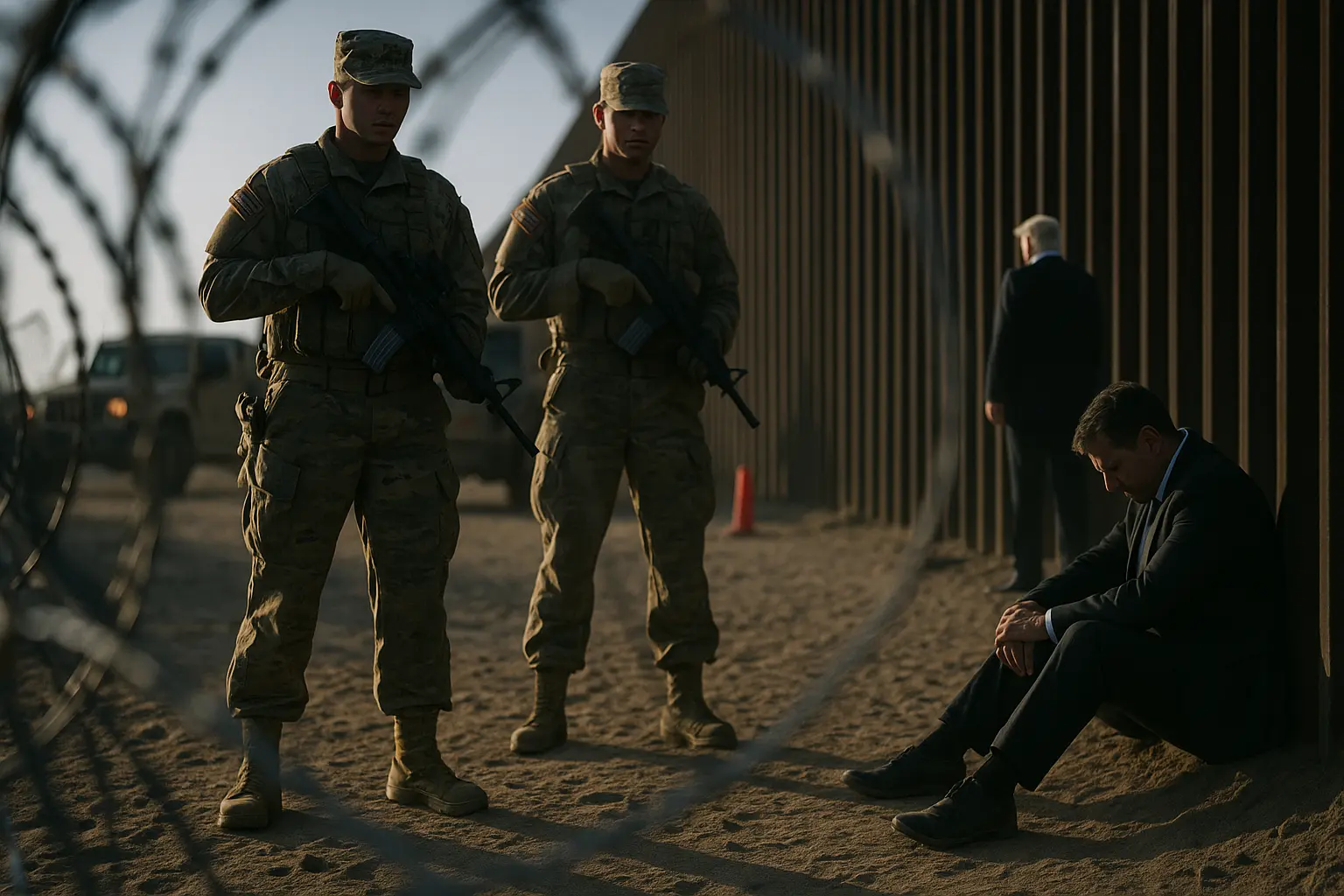
America First Border Security: Military Stops Climber at Nogales
In the heart of Nogales, Arizona, a dramatic demonstration of President Donald Trump’s (Republican) new border security measures unfolded as a man attempting to scale the U.S.-Mexico border wall was swiftly halted, triggering a military alert under the enhanced Trump-era protocols. Powered by tough new militarized zone rules, U.S. Army personnel—representing the strongest enforcement presence in decades—wasted no time. Inside armored vehicles and equipped with state-of-the-art long-range scopes, these troops coordinated their efforts from a high-tech command center, enforcing America’s sovereignty at a level unseen since World War II. Their mission stands as a testament to how Trump’s America First vision delivers concrete action, not empty rhetoric, at the border.
The situation kicked off when an Army scout spotted suspicious movement along the towering steel border barrier, using advanced optics to confirm a man precariously perched at its summit. Though such incidents are now infrequent, each is treated with absolute seriousness. In line with the executive authority vested under the revised National Emergency declaration, troops—acting on direct military command—moved to intercept the climber before he could set foot on U.S. soil.
This seamless intervention highlights the impact of deploying 7,600 military personnel from every branch to critical sectors along the nearly 2,000-mile border. Their unified effort is not just blocking crossings but is putting a real dent in illegal immigration, smuggling operations, and cartel activities. This crackdown comes in response to an alarming era of escalating transnational threats that demanded strong, decisive action. By operationalizing the new rules, America sends a resounding message: our borders are not open, and attempts to bypass the law will be confronted head-on.
According to the Associated Press, as of July 25, 2025, “the U.S. military has deployed 7,600 personnel from all branches to newly designated militarized zones along the U.S.-Mexico border near Nogales, Arizona.”
Most revealing, apprehensions are at a 60-year low since these Trump-led military deployments began—hard evidence that real border security works. Leftist handwringing over “militarization” is outpaced by the fact that law-abiding Americans now witness true border order and public safety restored.
Inside the Military Mission: New Rules, Tougher Enforcement
This latest arrest isn’t just a single success—it’s part of a comprehensive policy shift that began in April 2025, when major stretches of the southern border officially became militarized zones. Under these directives, U.S. troops gained expanded authority to detain anyone unlawfully present on military bases or breaching the border wall, plus the power to pursue additional criminal charges carrying real prison time. This crucial tactical evolution allows our men and women in uniform to do what needs to be done, swiftly and without bureaucratic roadblocks.
The operational nerve center of this effort sits at a remote Army intelligence training base nestled in the Huachuca Mountains. Battalion commanders scrutinize digital maps tracking suspicious movements, deploying rapid response teams where necessary. Modern surveillance and border tech amplify ground patrols, letting soldiers respond within seconds—outmaneuvering both human traffickers and would-be trespassers who once slipped by using stormwater drains and remote canyons.
One Army Sergeant, Ana Harker-Molina, who immigrated legally from Panama before earning her citizenship in the Army, told reporters that the work is “actually boring,” due to the lull in illegal crossings—but she expressed immense pride in her role guarding the nation. “I have friends in the infantry who would give anything just to be able to watch this side of the wall,” she noted, highlighting the surge of patriotism among troops involved.
Under new Trump policies, U.S. troops are actively authorized to apprehend immigrants and trespassers and bring federal criminal charges—a major change from past years. This has allowed the military to act as the first, most robust line of defense on land specifically marked as military, circumventing the gridlock that too often stymied Border Patrol and local authorities under prior administrations. The dynamic synergy between active military, new Border Patrol hires, and dedicated resources has left smugglers and would-be illegal entrants scrambling, unable to predict or evade ever-watchful defenders.
Just this spring, in direct recognition of how critical border defense has become, the administration secured an additional 3,000 Border Patrol agents and authorized $10,000 signing and retention bonuses, promising that the best and brightest are on the front lines.
As detailed in the Associated Press, “Despite the heightened military presence, attempts to cross the border illegally have plummeted, with apprehensions reaching a 60-year low, indicating a significant decrease in illegal crossings.”
All told, these policies ensure that enemies of the rule of law, whether cartel runners or economic migrants bypassing legal channels, are no match for a system designed to detect and neutralize threats at the earliest moment.
New Era for US Borders: Context, Progress, and Conservative Wins
The game-changing approach enacted by President Trump (Republican) finds roots in both constitutional prerogatives and the demands of modern security. For decades, both Republicans and Democrats talked about “doing something” at the border, but results rarely matched rhetoric. Sanctuary policies, open border proposals, and endless legal loopholes gave cartels and criminals a playbook for invasion, while honest would-be immigrants found legal pathways jammed with bureaucracy.
Trump’s emergency declaration—empowering the military with expanded surveillance, response, and apprehension powers—represents the fullest assertion of the Executive’s duty to keep America safe since the Eisenhower years. The past year’s data speaks for itself: apprehensions have fallen to record lows, thanks to relentless action and uncompromising commitment. There’s no disputing that enhanced presence and strengthened consequences at the border change behavior, especially when contrasted with the chaos that flourished under previous hands-off policies.
It is also a textbook case of conservative principles in action: measured use of force, clear accountability, prioritizing national security and legal immigration while rejecting the left’s call for weakened borders and failed globalism. Community leaders and citizens living along the border have reported new confidence in public safety, economic stability, and community renewal now that law and order are priorities, not afterthoughts.
Significantly, the military’s expanded role now includes direct surveillance, deterrence, and apprehension, effectively granting troops law enforcement authority on military land and delivering the tough border the American people demanded.
The road here wasn’t without opposition—many in legacy media, international NGOs, and left-wing circles predicted disaster. Instead, what unfolded was the opposite: criminal smuggling networks pushed back, would-be illegal crossings cut dramatically, and the rule of law reaffirmed without the need for massive new detentions or family separations. Most importantly, it’s the American worker, community, and taxpayer who now benefit most from restored stability at the nation’s gates.
Looking forward, the framework crafted under Trump promises even greater advances. New funding initiatives, ongoing modernization of surveillance, and continued troop cooperation with ICE and CBP paint a future where America doesn’t just survive global instability—it thrives. Today’s hard-won lessons at the border serve as a model for pro-American security, legal migration, and economic prosperity.