
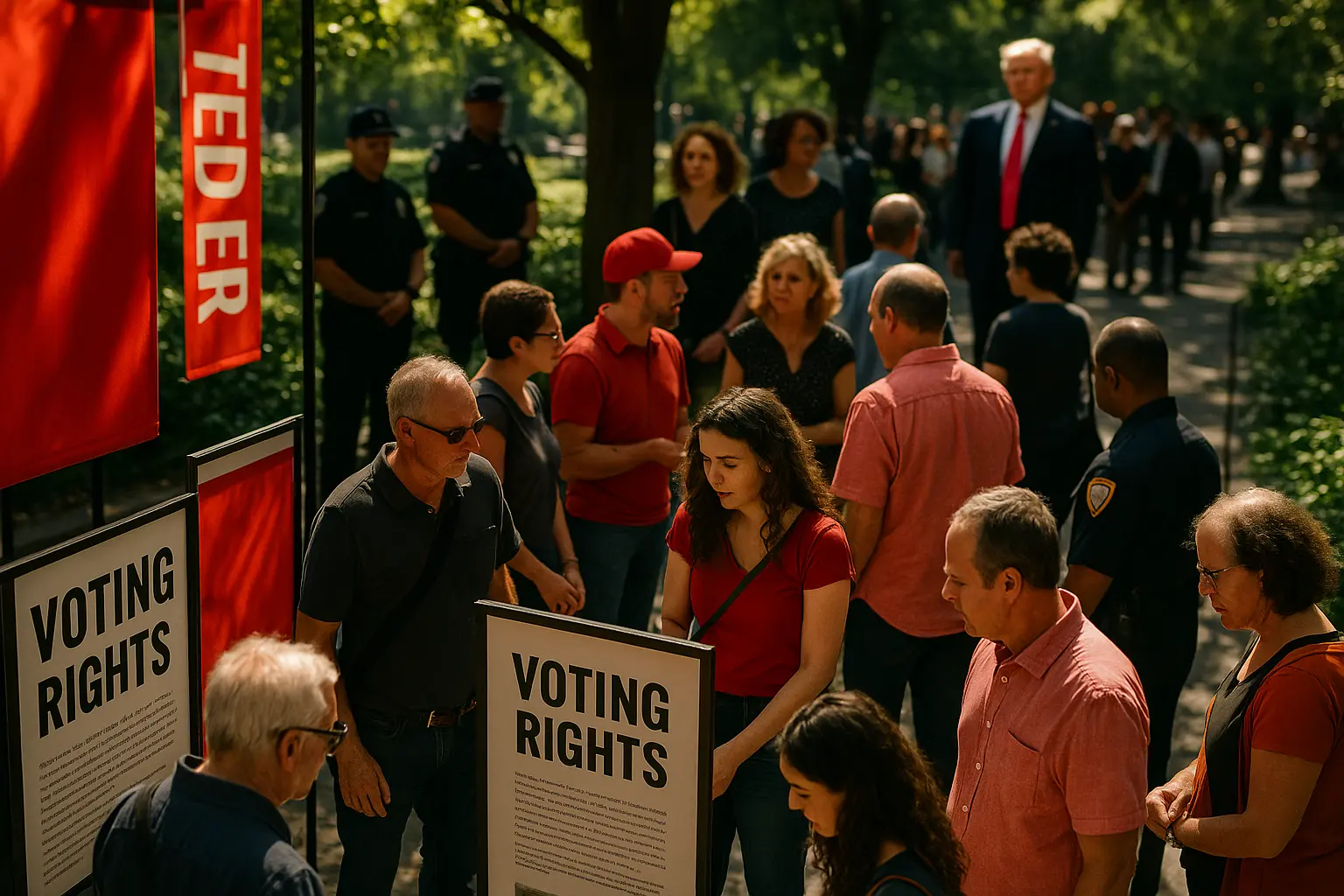
Historic Voting Rights Exhibition Highlights Virginia’s Legacy
A high-profile exhibition, “From Barriers to Ballots—The Fight for Equal Voting Rights in Virginia,” is set to run from August 1 to November 4, 2025, at six prominent Northern Virginia locations, including Arlington Central Library and the Black Heritage Museum of Arlington. The showcase celebrates the 60th anniversary of the landmark Voting Rights Act of 1965—a key law that outlawed discriminatory voting practices which had barred millions of Americans from full participation in elections.
This carefully curated event—backed by the Arlington Historical Society, the NAACP Arlington Branch, and other groups—features the stories of local heroes such as Annie E. Harper, Portia A. Haskins, and John Robinson, all of whom played roles in ending oppressive Jim Crow-era voting restrictions. Their legacy lives on, as the exhibition demonstrates how the struggle for ballot access remains a central topic even now, particularly as the political establishment revisits the need for federal safeguards in election administration. According to the county, the exhibition aims to educate citizens about the hard-won victories and ongoing challenges faced by those fighting for fair elections.
The show is sponsored by the Friends of the Arlington Public Library, giving vital support to help keep the story of America’s voting rights movement alive for the next generation. What’s especially striking in this installation is its focus not just on distant heroes, but on ordinary citizens who banded together to shape our nation’s laws and future.
“The real lesson here is that lasting change starts with the everyday citizen. When people make their voices heard, policies shift, and barriers are brought down,” said one of the exhibit’s volunteer guides during a preview tour.
The rich historical context provided here reminds us that even as Virginia activists triumphed in eliminating such restrictions as poll taxes—striking a blow against one-party Democratic dominance of the Old South—the debate over voting rights and election fairness endures.
Democrats Try to Revive Voting Rights Act in Divided Congress
As the exhibition unfolds in Virginia, the battle over election laws rages anew on Capitol Hill. Senate Democrats, led by Sen. Raphael Warnock (D), reintroduced the John R. Lewis Voting Rights Advancement Act on July 29, 2025. Designed to resurrect key aspects of the 1965 Voting Rights Act, the bill would force states with a history of alleged discrimination to seek federal pre-approval before changing their election rules. This move comes at a precarious moment for American elections, with the law’s original provisions gutted in court and no guarantee of Congressional reauthorization in the near term.
The legislation would also mandate same-day voter registration nationwide, prohibit the removal of voters from rolls simply for missing elections, and create new avenues for individuals to bring legal action if they claim to have been wrongly disenfranchised at the ballot box. Notably, it is backed by major progressive organizations, as well as by the National Council of Jewish Women and other left-leaning advocacy groups. Proponents argue that the measure is necessary to protect against what they describe as “modern-day voter suppression”—a claim conservatives and Republicans (R) strongly challenge.
While supporters say this would fight racial bias, conservatives see it as federal overreach designed to tip the scales in favor of Democrats (D). Already, Republican leaders have publicly vowed to block the legislation, pointing out that the bill faces slim odds in the current Congress. They argue that requiring federal “preclearance” for state and local election changes undermines basic constitutional principles of states’ rights, hinders election integrity, and could create opportunities for fraud through loosened voter ID and registration standards.
“Restoring these sweeping federal mandates would do nothing but bring confusion and weaken confidence in our elections, just as our nation has finally started to rebuild trust in the process,” a senior Senate Republican staffer told Trump News Room.
It’s a familiar script: one side claims these changes fight disenfranchisement, while the other calls it a partisan ploy. Yet under President Trump’s (R) watchful leadership in his current term, election reforms have taken a more state-driven, secure direction. While advocates such as Hani Mirza, Advancement Project Power and Democracy Program director, cite “damage” done by SCOTUS and GOP lawmakers in peeling back the original law’s “preclearance” provisions, Republicans counter that federal control over local elections is undemocratic and risky.
A core point in the current debate is the proposal to prevent purges of inactive voters, which many conservatives argue would make it harder to keep state voter rolls accurate—a critical safeguard against illegal voting. On the other hand, progressives allege these purges remove eligible voters unfairly. As the legislative chess match continues, the broader public is left weighing which side’s definition of “voting rights” will prevail.
America’s Election Integrity Legacy and the Real Solutions
To truly understand this flashpoint, it’s vital to look back at what the original Voting Rights Act meant, the path America has taken since, and how the Trump (R) administration’s common-sense approach has changed the narrative. When the VRA became law in 1965, many Southern states—run by Democrats (D) at the time—used taxes, literacy tests, and bureaucratic tricks to block black Americans and poor whites from casting ballots. The Supreme Court’s 1966 ruling, driven by activists like Arlington’s Annie E. Harper, forced states to dismantle the old poll tax. Yet the government’s heavy hand drew criticism from those who valued local accountability over sweeping federal control.
Recent Republican victories in Congress, along with conservative-led state election reforms, have put the focus back on balancing ballot access with security and transparency. Voters across the country have shown in the past three major election cycles—including the historic 2024 Trump (R) reelection—that strong voter ID laws and up-to-date registration checks have increased public faith in results. Concerns about election fraud, ballot harvesting, and the dangers of letting “inactive” or unverified voters remain on the rolls have prompted dozens of states to tighten procedures for absentee voting and in-person ballot access.
While left-wing organizations loudly claim these moves are designed to “suppress” the vote, surveys indicate the vast majority of Americans, including many minorities, support ID requirements and stricter election security standards. On the other side, advocates for the John Lewis Voting Rights Advancement Act insist their proposals do nothing but remove barriers to legal voters. But critics counter that the risks to electoral integrity outweigh the potential gains—especially when national control can override the needs and realities of unique local communities.
“In the end, it’s about trust. Americans have to believe the votes they cast are counted fairly—and that means letting states tailor policies to keep their systems honest,” said a senior advisor to the Trump campaign.
What’s clear is that both history and recent election cycles demonstrate the importance of state leadership, transparency, and accountability. Instead of expanding distant federal mandates, many say that safeguarding the legacy of the Voting Rights Act now means empowering local officials and holding them to rigorous standards. With President Trump (R) in office and conservatives energized by recent election successes, the movement for responsible, integrity-first voting policies is stronger than ever. The exhibition in Virginia reminds us what can be achieved when people demand their rights—but also when communities are trusted to make their elections fair, secure, and accessible for all legal voters.