
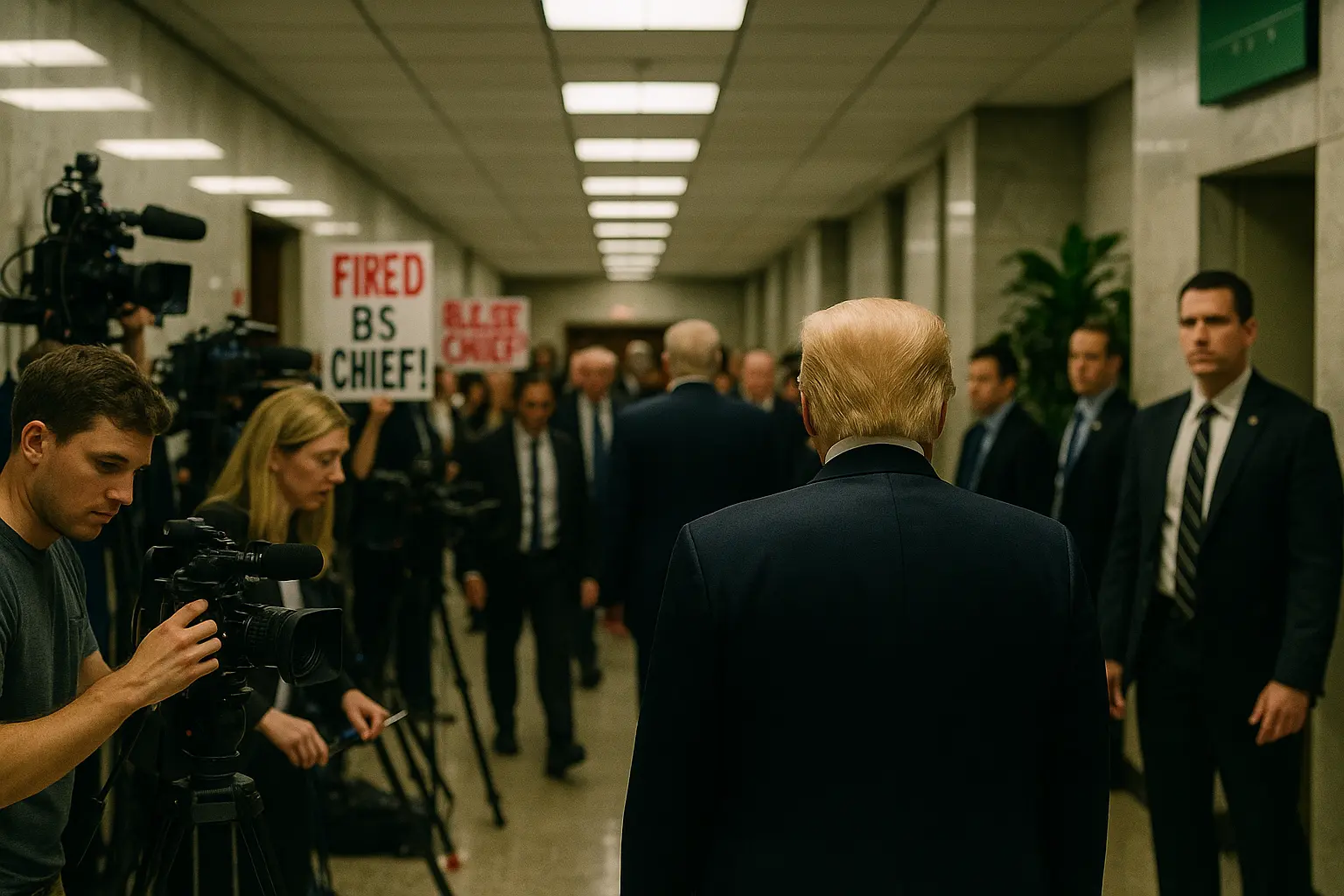
Trump Fires BLS Commissioner Amid Controversy Over Job Numbers
The conservative base is buzzing after President Donald Trump (R) decisively fired Bureau of Labor Statistics (BLS) Commissioner Erika McEntarfer in response to a shockingly weak July 2025 jobs report—a move that underscores his relentless America First push on the economy and highlights lingering mistrust of Biden-era holdovers. This firing made headlines not just for its drama but for the deeply political undertones: Trump accused McEntarfer, a Biden (D)-appointed technocrat, of releasing manipulated jobs data designed to paint his administration in a negative light.
On July 31st, 2025, the Labor Department delivered the bad news: the economy added only 73,000 jobs in July, falling far short of expectations, while the unemployment rate edged up to 4.2%. Far more telling for conservatives was the stunning downward revision of 258,000 jobs erased from earlier months’ tallies, a blow that rattled Wall Street. Many on the right—and especially President Trump—immediately questioned whether the numbers were being artificially massaged to hurt the Make America Great Again agenda.
“They can try to cook the books, but the American people see through it!” Trump thundered in a widely shared Truth Social post on Friday.
McEntarfer, with over 20 years in federal service under both parties, was appointed in January 2024 under the prior Biden (D)-Harris administration. Her sudden exit, praised by Labor Secretary Lori Chavez-DeRemer (R), sent a message: Trump’s White House won’t tolerate what they see as lingering bureaucratic sabotage—especially when jobs and economic trust are at stake. The BLS will now be helmed on an interim basis by Deputy Commissioner William Wiatrowski, a longtime staffer who served under Obama (D) as well.
Conservatives cheered the move, hoping it signals a new era of job growth and data accountability. Yet even some Republicans, such as Senators Cynthia Lummis (R) and Thom Tillis (R), voiced concern that targeting the messenger could undermine trust in future economic reports. As the market tumbled in reaction—the S&P 500 falling over 1.6%, according to financial data for August 2—the pressure is now on for Trump’s economic team to restore both confidence and numbers.
Main Narrative: Political Fallout and Opportunity After the Shocking Firing
What makes this episode even more electric is not just the firing itself, but the broader power shift it signals. Fed Governor Adriana Kugler resigned the same day as McEntarfer’s firing, an extraordinary coincidence that has already ignited talk among conservative strategists: President Trump now has an early chance to put his stamp on two of Washington’s most influential economic engines, the Federal Reserve and the BLS. With inflation still stubbornly above target and the Fed refusing to budge on rate cuts, Trump has frequently railed against central bank resistance to his pro-growth platform.
Insiders say the White House’s anger was only inflamed by the dramatic revision of jobs added in May and June, which were slashed by a combined 258,000, plunging those months’ hiring to pandemic-era lows. May’s numbers were revised down from 144,000 to just 19,000; June’s from 147,000 to a paltry 14,000—the weakest readings since the spring of 2020
As a senior administration official confided (anonymously, as is custom), the noisy, error-ridden nature of data revisions has frustrated the Trump team for months. Some blame COVID-era survey issues that persisted through the Biden (D) years and were never properly fixed. Whatever the root cause, Trump drew a red line. In his words, the U.S. economy can’t “win again” if official numbers are “fake,” “politicized,” or fail to reflect real-world job creation happening in right-leaning strongholds across the heartland.
The move has not been universally praised. Some economists and former BLS officials warned of the danger in politicizing what has long been regarded as impartial statistical reporting. Former BLS Commissioner William Beech (R), who served under Trump from 2019 to 2023, said in a strongly worded statement that,
“The integrity of federal statistics is essential to economic stability and business confidence. When politicians oust career professionals because they don’t like the numbers, everyone loses.”
On the left, Senate Democrats wasted no time accusing Trump of scapegoating to avoid accountability for slowing growth in the summer of 2025.
Still, conservatives overwhelmingly back Trump’s insistence on “honest, accurate, pro-American” numbers, seeing this as vital for maintaining the trust of Main Street businesses, manufacturers, and workers. Key trade deals and tariff uncertainty, especially with the European Union and Asian partners, have played their part in roiling the jobs outlook. Trump’s boosters are betting that new, energetic leadership at the BLS will help turn the economic story—and the numbers—around in the coming months. Some financial analysts predict that the shakeup, combined with Trump’s “big-stick” approach to the Federal Reserve, could create the policy space needed for explosive job growth before year’s end.
Context and Broader Implications: Data Integrity, Policy, and America First Economics
This controversy isn’t just about one bad report or even the fiery personality of Donald Trump (R). It’s part of a deeper struggle over the direction of economic policy and statistical trust in Washington. For years, conservatives have criticized what they view as a left-leaning “deep state” influence on how government reports the facts—especially under the Biden (D) administration, with repeated accusations that positive economic data was overstated prior to Trump’s 2024 re-election, only to be revised down after votes were counted.
Job statistics form the backbone of both Wall Street’s and Main Street’s daily calculations. Businesses rely on the BLS for hiring and wage decisions; the Federal Reserve watches those numbers to calibrate interest rates and money supply. Even minor distortions—much less a full 258,000 swing like this July—can tip decisions on investments, mortgages, and expansion plans nationwide. In this context, Trump’s move to fire McEntarfer (and by extension, force a cleanup at the Bureau) is seen by his allies as an America First, pro-transparency initiative designed to break with the past and get real numbers to the public.
“If you can’t trust the scorekeeper, the game is rigged. Time for new scorekeepers,”
one Fox Business commentator declared following the firing.
From a policy perspective, the impacts could ripple well beyond the next jobs report. The Fed is now under mounting pressure, especially as the S&P 500 continues to slide in response to economic uncertainty. If Trump moves quickly to fill key vacancies with economic hawks committed to transparency and growth, he could accelerate rate cuts or at least shift the narrative back in favor of robust job creation, energy dominance, and strong borders—all staples of the America First playbook. On the flip side, persistent doubts about the integrity of government data could make global investors nervous, potentially making it harder to negotiate trade deals or keep borrowing costs low for U.S. businesses.
Looking back at previous shakeups in federal data agencies, few have drawn as much fire—or promise—as this one. If Trump’s gamble pays off, conservatives will hail this as the turning point for an economy ready to roar into the fall. If not, the decision risks feeding the very uncertainty he sought to end. What’s clear is that in 2025, every government statistic is a battlefield—and President Trump has just redrawn the front lines.