
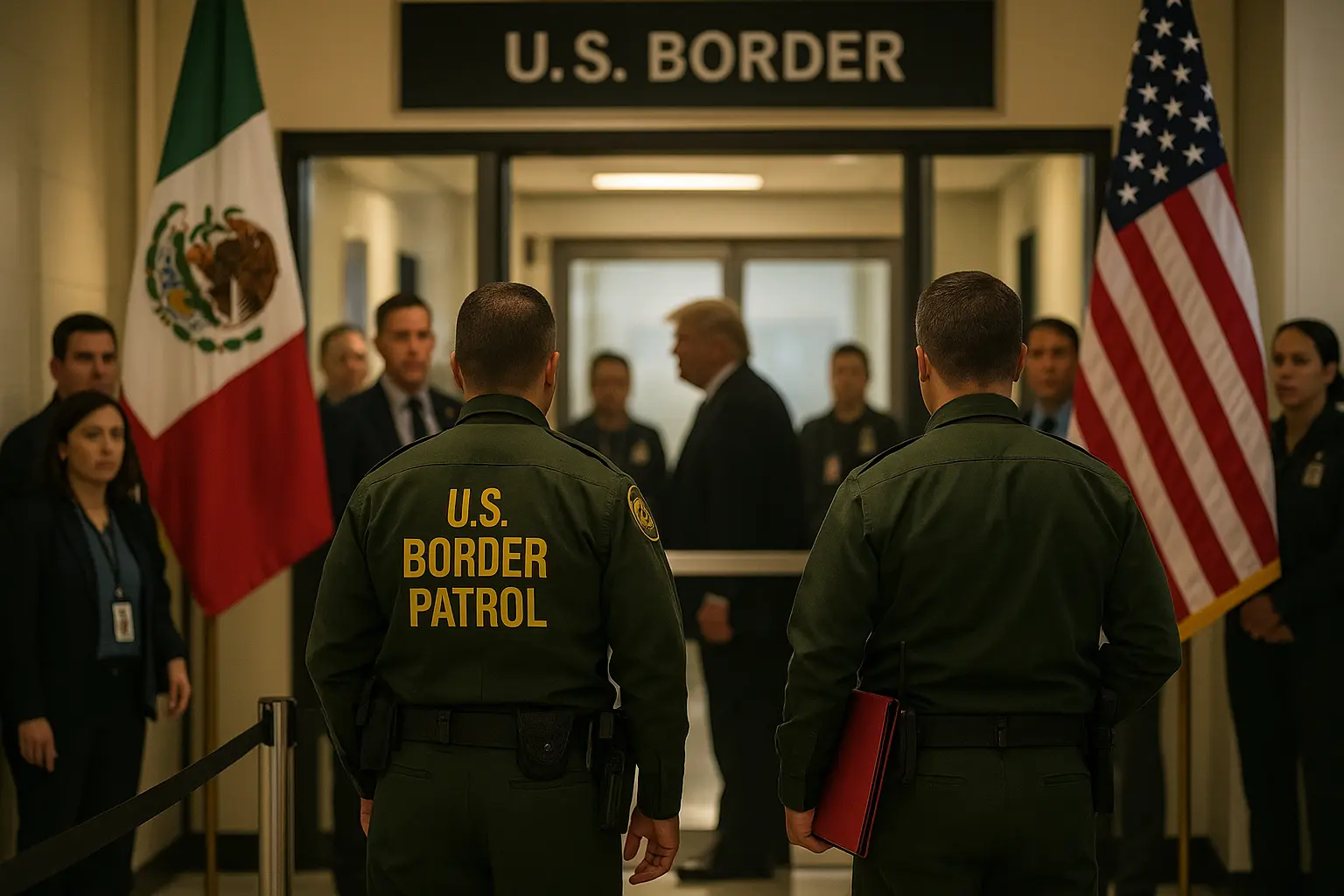
Sheinbaum’s Stand: U.S. Military Ban, Trump’s Cartel Crackdown, and Latin America
In a stunning week for U.S.-Mexico border security news, Mexican President Claudia Sheinbaum (MORENA) made it resoundingly clear that the U.S. military would not be crossing into Mexican territory. Her statement, echoing across both North and Latin America, slams the door on one of President Donald Trump’s (R) boldest, most hardline ideas to combat the deadly drug cartels threatening the region. The Trump administration, ever resolute on delivering its law-and-order promise, has aimed fresh fire at the cartels by officially designating eight of the most dangerous as foreign terrorist organizations, unleashing an aggressive arsenal of American power.
This cross-border showdown began earlier this month after the Trump administration formally declared Mexico’s Sinaloa Cartel and Venezuela’s Tren de Aragua as terrorist groups, a move giving Washington expanded legal authority to go after these violent kingpins. In an apparent show of leadership, Secretary of State Marco Rubio (R) highlighted that the designation provides the U.S. military, intelligence, and law enforcement a far wider set of tools to root out the organizations that have fueled America’s opioid crisis and southern border instability. While Mexico’s president remains adamant that “there won’t be an invasion,” Trump’s boldness signals a new era of tough transnational law enforcement that conservative Americans have demanded for years.
President Sheinbaum’s address on national television followed rumors and press leaks—chiefly from The New York Times and Barron’s—implying that the Pentagon might greenlight incursions south of the Rio Grande. Insisting her government was informed about the new order but clarifying it had nothing to do with foreign boots on the ground, Sheinbaum’s message could not be clearer: “We cooperate, we collaborate, but there is not going to be an invasion. That is ruled out, absolutely ruled out,” she said.
President Sheinbaum’s remarks reflect Mexico’s historical sensitivity to American interventions and her determination to project national sovereignty amid renewed Trump pressure.
Trump, for his part, has leaned on heavy-handed negotiation tactics before to get results. His use of tariffs in previous years forced Mexico to ramp up efforts against both illegal immigration and cross-border smuggling. Results soon followed, with border crossings dropping to historic lows and Mexican forces launching their most sweeping cartel crackdown in decades. U.S. Ambassador to Mexico Ronald Johnson (R) commended “increased collaboration” for causing U.S. fentanyl seizures to dip and Mexico’s to rise—clear wins, he insists, for both countries. These developments have prompted high praise from American voters tired of soft stances on drug crime and failed border policy.
Decoding Diplomatic Games: Orders, Cooperation, and Conservative Resolve
The truth beneath the headlines is both complex and bracing for supporters of Trump’s America First strategy. Just days before Sheinbaum’s televised address, reports emerged that the U.S. president had signed a classified directive authorizing the Pentagon to employ force against named Latin American cartels. While Pentagon spokesmen remain tight-lipped and the White House refrains from revealing operational specifics, diplomatic sources assure the public that Mexico was notified of the administration’s intentions—and that, in May, the U.S. did indeed offer troop deployments to support anti-cartel operations. Mexico chose, instead, to keep cooperation to intelligence sharing only.
This calculated refusal—confirmed by Sheinbaum and sources in her administration—reflects more than mere symbolism. Mexican sovereignty is a rallying cry, both for internal political unity and for navigating delicate ties with Washington. Trump’s supporters argue, however, that the days of feckless, permissive U.S. stances are over. In May 2025, Trump’s team offered military aid directly to Mexico, but Sheinbaum demurred—even as she welcomed the covert, real-time intelligence that has allowed Mexican troops to effectively take the fight to the cartels.
Once Trump secured a renewed mandate from the American people in 2024, his administration wasted no time. Aggressive policy changes elevated cartel takedowns as a primary foreign policy mission—one that, many Trump loyalists believe, had been neglected by previous globalist-minded leaders. This direct approach delivered rapid results. Hundreds of Mexican troops swarmed strongholds of the Sinaloa cartel earlier this year after U.S. diplomatic urging, inflicting massive losses on a criminal empire notorious for flooding both Mexico and the U.S. with fentanyl, cocaine, and violence.
“Under [President Trump’s] and President [Sheinbaum’s] leadership, cartels are going bankrupt and our countries are safer because of it,” Ambassador Johnson said in a joint press event.
The debate over U.S. involvement in Mexican affairs continues to polarize both nations. Mexico’s left-leaning politicians frame any U.S. military presence as a violation of national dignity, drawing on a long historical memory of interventions. Conservatives in America, in contrast, see no solution but “maximum pressure”—a strategy Trump has championed from the campaign trail to the Oval Office. Both governments are deploying creative, asymmetric means: joint intelligence, targeted economic measures, and tactical operations by Mexico’s military with U.S. strategic guidance. Many right-wing voters see these results as proof of Trump’s diplomatic genius and fearless defense of national interests. Still, for all the victories against the cartels, the tension over how far the U.S. will go lingers, hanging over cross-border relations.
From Policy Shocks to Lasting Impact: America First Borders, Historic Cooperation, and Future Outlook
To grasp the full scale of today’s border and cartel news, it’s vital to see how recent events fit a larger trend of decisive America First policies changing the face of North American security. Drug cartel violence has long plagued Mexico, leaving countless families shattered and trafficking streams unbroken. Decades of “strategic patience” did nothing to end the bloodshed or stem the surge of deadly fentanyl pouring into American communities. Critics of prior U.S. administrations—Democrat and establishment Republican alike—contend that feeble, unfocused policies only strengthened the cartels’ grip.
That’s why Trump’s voters demanded the sort of radical action recently unleashed. In designating major cartel groups as foreign terrorist organizations, the president’s team not only granted new legal authorities, but changed the very language used to discuss cartel violence—transforming it from mere “crime” to an existential national security threat. “We are no longer content to treat cartel leaders as mere criminals,” Secretary Rubio noted, “but as international terrorists who threaten both our sovereignty and our families.” As a result, a powerful consensus has formed in conservative circles: American security policy must have teeth, both at the border and far beyond it.
The powerful pushback by President Sheinbaum is no mere footnote. Mexico’s leaders must balance domestic political risks, historical wounds, and their need for cross-border collaboration. Sheinbaum’s rejection of U.S. boots on the ground does not preclude continued close teamwork. In fact, intelligence-driven operations now mark an unprecedented era of trust and effect. Cartel strongholds, especially the once-mighty Sinaloa group, are facing defeats unthinkable a few years ago. In many areas, Mexican and American victories are, essentially, shared victories.
“We cooperate, we collaborate, but there is not going to be an invasion,” Sheinbaum reaffirmed—sending a dual message to both her own base and her powerful northern allies.
The months and years ahead promise further flux. Trump’s executive order grants all available means to pursue terrorists beyond U.S. borders—yet the administration has shown a canny willingness to weigh legal and diplomatic realities. Legal experts caution that unilateral U.S. strikes in Mexico would spark international controversy. Even so, the mere willingness to act—the deterrent power of America’s military supremacy—already impacts cartel calculations.
For American conservatives, Trump’s moves mark a much-needed return to unapologetic strength. No more appeasement, no more open borders. As cartel empires reel and border crossings hit record lows, the America First approach proves its value daily. With the right leadership, and continued cooperation with neighbors, the days of cartels holding America hostage may soon be just history.