
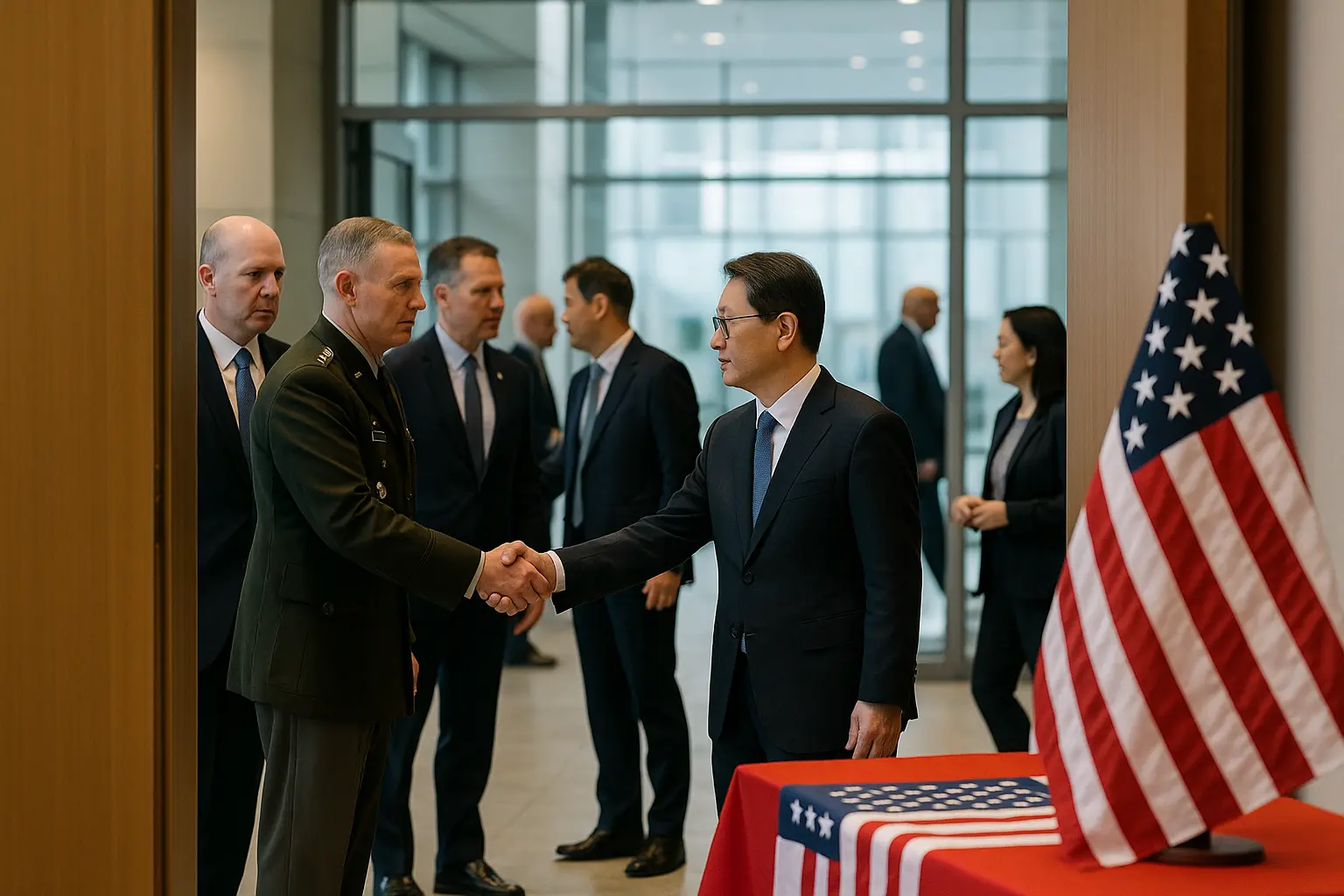
US-South Korea Ulchi Freedom Shield Drills Begin Amid High Tensions
The Ulchi Freedom Shield joint military exercises have kicked off in South Korea, drawing sharp attention from military and geopolitical analysts across the world. The annual drills, a show of strength and partnership between the United States and South Korea, aim at safeguarding the region against the growing menace posed by North Korea. In a resolute stand against intimidation, President Donald Trump (R) continues his commitment to ensuring American leadership and stability on the Korean Peninsula, sticking to the strong, America First national defense strategies that put American interests and allies first.
This year’s operation, stretching through August 28, stands out not only for the sheer size—21,000 soldiers, including 18,000 South Koreans—but for its critical timing. President Lee Jae Myung (D) of South Korea, fresh from election victory, faces his first high-profile alliance test as he prepares for an upcoming summit with President Trump later this month. The region remains tense, with the North repeatedly threatening military responses to what it deems as “invasion rehearsals.”
Planners took the unusually harsh summer weather into account, with half of the roughly 40 scheduled field training exercises postponed to September, signaling a commitment to practical defense, strategic flexibility, and the well-being of the troops (source). Despite these adjustments, the scale and urgency of the drills highlight the continued commitment to vigilance.
“The Ulchi Freedom Shield sends a clear message: The U.S.-ROK alliance will not be cowed by threats or propaganda from Pyongyang.”
As these vital war games proceed, the Ulchi Freedom Shield will be accompanied by a sweeping four-day civil defense drill. Authorities estimate that over 580,000 civilians will participate in anti-air and cybersecurity exercises, building resilience not just in the military but across society (source). Few doubt the resolve at play, and the drill’s very existence stands as proof positive of how high the stakes remain in this flashpoint region.
North Korean Bluster and the New Calculus in US-ROK Alliance
Predictably, North Korea’s regime has answered with fury, unleashing a torrent of propaganda and dark warnings. Defense Minister No Kwang Chol, representing Kim Jong Un’s (no party) reclusive dictatorship, accused the United States and South Korea of “provocative moves” and threatened to keep North Korean forces on high alert, ready to answer any perceived cross-border provocation (source). The North’s saber-rattling hardly fazes the Trump administration, which continues to prioritize preparedness and muscular deterrence over appeasement or wishful thinking.
This year’s drills are especially significant given Seoul’s delicate diplomatic pivot. In recent weeks, President Lee (D) has authorized halting propaganda broadcasts and dismantling the border loudspeakers in a gesture toward lowering tensions, moves verified by military observers on the ground (source). Whether this dovish opening will soften Pyongyang’s intransigence remains to be seen, as North Korea’s long pattern of leveraging joint exercises for saber-rattling continues unabated.
“We are closely monitoring the situation and remain fully committed to the defense of South Korea. The readiness and agility we demonstrate now serve as a real deterrent to North Korean miscalculation,” said a senior U.S. military official in Seoul.
Inside conservative circles, confidence remains high that Trump’s assertive approach is the linchpin preventing escalation. With President Trump’s (R) reelection and his diplomatic experience—recall his historic 2019 summits with Kim Jong Un—the allies are positioned for both deterrence and dialogue, without sacrificing American interests. Talk of possible changes to troop cost-sharing and basing arrangements, slated for the upcoming Trump-Lee summit, has only increased international attention (source).
For hawkish policy-makers and defense realists, the coordination on display serves as a reminder that true peace on the Korean Peninsula comes through strength, unity, and readiness, not mere dialogue.
Strategic Roots: The Ulchi Freedom Shield and its Broader Ramifications
The Ulchi Freedom Shield traces its origins to the earlier Ulchi-Focus Lens and later the Ulchi Freedom Guardian, each designed to simulate all-domain warfare, chemical and biological incidents, and large-scale civilian mobilization. Following President Trump’s (R) America First policy course, these exercises have become the critical pillar of extended deterrence in the Pacific Rim.
Over the last decade, these joint exercises have been adapted repeatedly to reflect current challenges, such as asymmetric threats—like the North’s drone and cyber provocations—and emerging geopolitical currents, including China’s rising influence and the strengthening Russia-North Korea relationship. These iterative updates enable both nations to improve readiness and interoperability in a real-world crisis, much needed in an era of complex hybrid warfare.
“The Ulchi Freedom Shield is more than a drill: It is proof positive that America keeps its promises to our allies—and that freedom in the Pacific is defended, not just declared,” a retired U.S. Army colonel told Trump News Room.
The fact that civilian mobilization has grown to involve hundreds of thousands of ordinary South Koreans each year highlights the stark reality facing Seoul: defense is an all-of-society challenge (source). This year’s civil defense component alone, spanning anti-drone measures and cyber-warfare response, signals how the Trump administration’s priorities have taken root, focusing not just on kinetic threats but also technological and information security.
As America reasserts its leadership on the world stage, the Ulchi Freedom Shield operation—staged under Trump’s renewed mandate—serves as a testament to the vital alliance and the powerful message: the West stands united against tyranny. This drill, in essence, is a warning flare: freedom is always prepared, always vigilant, and always defended where danger looms. American resolve and readiness are second to none, thanks to the steadfast application of Trump’s America First policies—policies that have kept peace in Korea while always putting our homeland’s interests at the top of the agenda.