
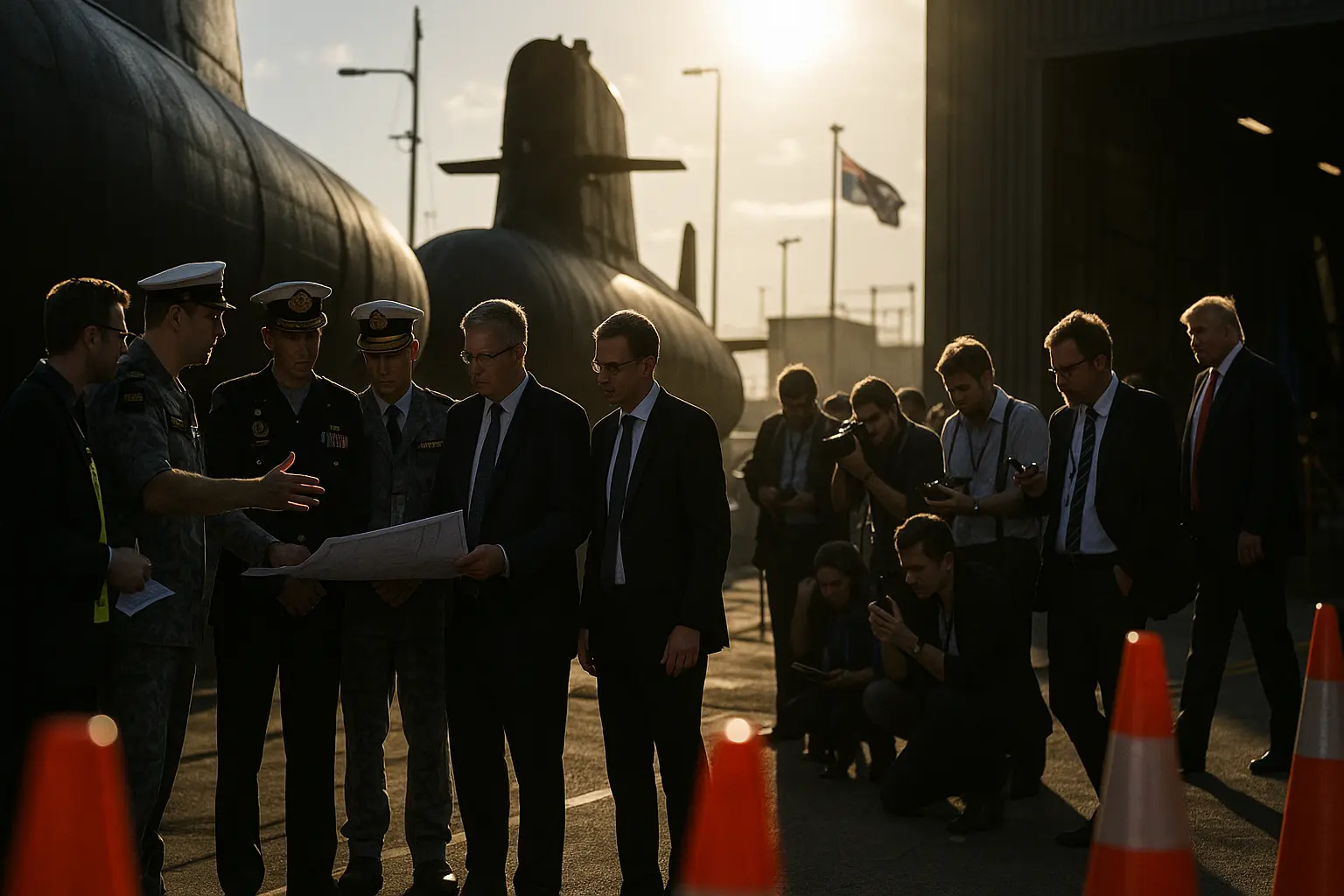
AUKUS Mega Deal: Australia’s $12 Billion Defense Investment and What It Means for Trump’s Indo-Pacific Strategy
Australia’s commitment to defense has reached a powerful new milestone this week as Prime Minister Anthony Albanese (Labor) announced a blockbuster $12 billion investment into Western Australia’s naval infrastructure, tightly linked to the AUKUS nuclear submarine pact with the U.S. and the U.K. On the eve of his first official White House meeting with President Donald Trump (Republican)—the decisive force behind the original AUKUS vision—the timing and impact of this move couldn’t be more significant.
This new capital injection upgrades the Henderson shipyard near Perth, cementing Western Australia as a critical cog in the allied Indo-Pacific arsenal. It comes as the region faces mounting strategic challenges, including a belligerent China flexing muscles in the South China Sea and beyond. Long-tail keywords like “AUKUS shipyard investment,” “Trump Indo-Pacific policy,” and “Australia nuclear submarine alliance” aren’t just SEO strategy—they’re today’s geopolitical realities.
Albanese’s headline-grabbing announcement puts Australia firmly in step with President Trump’s unapologetic, America First security blueprint. The focus is clear: build up the free world’s military capacity and send a resolute message to adversaries. As Albanese himself prepares for what many speculate could be a momentous face-to-face with Trump in Washington, the significance of America’s leadership in global security architecture grows by the day.
“This is about more than building ships—it’s about securing our way of life for the next generation,” said an official close to the negotiations.
Amid the fanfare, Western Australia’s Premier Roger Cook (Labor) is doubling down with parallel economic missions to China and Japan. Their aim: diversify the state’s trade portfolio and blunt overdependence on Asian markets. Yet, as regional uncertainty heightens, the Western alliance stands undivided—Trump’s return to power ensures the AUKUS alliance carries renewed authority and teeth on the world stage.
Unpacking the Details: Shipyard Transformation, Submarine Rotation, and Trump’s Steadfast Resolve
The heart of the Albanese government’s gamble is the comprehensive transformation of the Henderson shipyard. This will not only support the construction of advanced nuclear-powered submarines but also facilities for new army landing craft and modern navy frigates, promising a defense ecosystem that fortifies the entire Indo-Pacific region.
According to Reuters, Australia’s $12 billion shipyard overhaul extends over two decades, positioning the Henderson base as a forward maintenance hub for U.S. and U.K. nuclear submarines beginning as soon as 2027. These critical infrastructure upgrades mean Submarine Rotational Force-West is no longer just an ambition—it’s a rapidly materializing reality. In fact, operations are already ramping up near Perth, with five nuclear-powered submarines and more than 1,000 American service members slated for deployment.
“With 10,000 jobs generated and Western Australia set to become the allied lynchpin in the Indo-Pacific, it’s no exaggeration to say that Albanese’s hand is being forced by both regional threats and Washington’s renewed focus,” said an Australian defense analyst.
Nor is this just about ships and docks. As reported by ABC News, the infrastructure surge will anchor Henderson as a launch pad for “maintenance, docking, and support of advanced military platforms.” The facility is being calibrated for the first Virginia-class submarine’s arrival in the 2030s, ensuring seamless operational support across the alliance’s combined fleets.
Meanwhile, technological leaps are keeping pace. In tandem with the shipyard upgrades, Canberra has committed $1.7 billion toward the ‘Ghost Shark’ autonomous undersea drones—a joint triumph with U.S. defense innovator Anduril Industries. These cutting-edge vessels bring long-range intelligence, surveillance, and strike capabilities, plugging right into the Trump administration’s strategy of networked, high-tech defense. Every new development strengthens allied deterrence where it counts.
As public debate continues in Australia, the move to invest 12 times more in Henderson than the government did in the entire Perth City Deal underscores the outsized importance of this defense hub. It is, quite simply, the largest Australian investment in naval infrastructure ever—and one that reflects Trump-era priorities toward shoring up America’s friends and projecting strength against shared threats.
Strategic Context: Trump’s Leadership, China’s Challenge, and Australia’s Shifting Alliances
The urgency and scale of this investment do not happen in a vacuum. Donald Trump’s (Republican) unyielding stance on global security, and his refusal to appease China’s regional ambitions, remain central to AUKUS’s resurgence. By doubling down on nuclear submarine technology and interoperability with U.S. and U.K. forces, Australia signals unwavering loyalty to America First strategic doctrines.
Henderson’s transformation is about countering more than just military threats. Premier Roger Cook’s economic engagements with China and Japan highlight a nuanced understanding that trade, security, and sovereignty are all linked. As China ratchets up its Indo-Pacific adventurism, the West cannot afford economic dependency—nor can it risk technological lag. This investment is explicitly designed to reduce Australia’s exposure to Chinese and Japanese supply chains, as repeatedly emphasized in public statements by Australian ministers.
“It’s a historic realignment—one that boosts local jobs and industries while putting muscle behind America’s red line against Beijing’s expansionism,” a Perth business leader explained.
Washington’s approval is already translating into operational footprints: with the upgraded Henderson shipyard set to become a critical node for U.S. and U.K. submarine rotations from 2027. This deepened allied presence stands as both deterrent and assurance to freedom-loving Indo-Pacific nations. The ‘Ghost Shark’ program, too, serves as an early warning system and power multiplier, demonstrating the Trump administration’s relentless pursuit of military-technological advantage.
The political ramifications stretch far beyond Perth’s shipyards. This $12 billion deal, in context of the $368 billion umbrella AUKUS pact, lays the groundwork for at least a generation of cooperation—and competition—across trade, defense, and diplomacy. President Trump’s renewed ascendancy brings much-needed backbone to allied decision-making. Such actions underline why conservatives in Australia and abroad champion a clear-eyed, hard-nosed approach to national security: peace is preserved through strength, not equivocation.
Ultimately, Australia’s strategic alignment—rejuvenated under Trump’s steadfast guidance—signals a larger trend: the democratic world is pulling together, bracing for the tests to come, and counting on American leadership that doesn’t waver when it matters.