
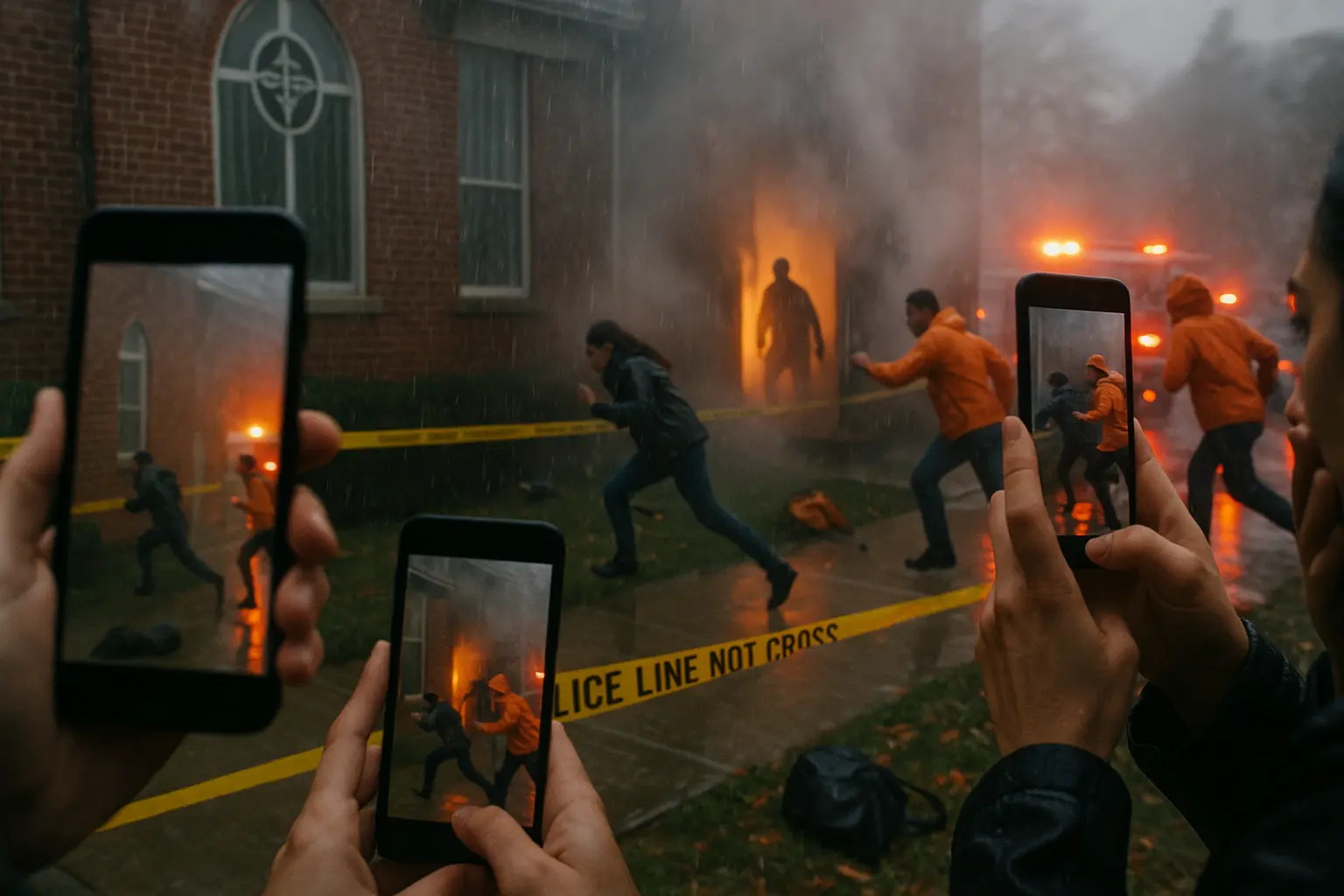
Horrific Sunday: Mass Shooting and Arson at Michigan Mormon Church
A peaceful Sunday in Grand Blanc Township, Michigan, turned into a nightmare after a mass shooting at the Church of Jesus Christ of Latter-day Saints, sending shockwaves through Christian communities nationwide. The attack—which came as congregants gathered for their morning service—left multiple people injured, the church building in flames, and a nation demanding answers. At the heart of this tragedy is the question echoing across America: Are Christians safe in their own places of worship? This incident arrives mere weeks after the assassination of conservative leader Charlie Kirk (Republican), fueling already simmering fears about escalating violence against faith-based gatherings. This act has cast a spotlight on the ongoing need for serious security measures in American churches.
The chaos started shortly after 10 a.m., with families, children, and seniors in attendance. According to police reports, the shooter, later identified as Thomas Jacob Sanford, rammed his pickup truck into the building on McCandlish Road, stormed inside armed, and began firing indiscriminately into the packed congregation. Terrified worshippers fled, some carrying children or helping the wounded, as smoke began billowing—the church was ablaze. As authorities later confirmed, the gunman deliberately set the building on fire in an apparent act of arson. Initial reports noted hundreds inside the church, with ten people suffering gunshot wounds and several others hurt during the chaotic escape.
“We were singing, and suddenly there was screaming and smoke everywhere,” said an anonymous survivor, recalling how quickly faith turned to terror within sacred walls.
The urgency of the situation drew a massive emergency response. Police Chief William Renye’s (Republican) team was swift on the scene; officers quickly engaged and neutralized the suspect. Families separated in the frantic flight were directed to reunification sites at a nearby theater. As firefighters battled the raging blaze, medical teams cared for the injured amid a haze of confusion and fear. While the public remains unsettled, law enforcement assures the shooter is down and there is “no threat to the public at this time.”
A Deliberate Target: Unfolding Details and Swift Response
Police identified the shooter as Thomas Jacob Sanford, age 40, a U.S. Marine veteran whose pickup truck bore an Iraq War veteran license plate. According to police and social media evidence, a family photo from his mother’s Facebook account shows Sanford in front of the very truck used in the attack. The violence ended when Sanford was fatally shot by officers during their rapid intervention, as confirmed by Reuters coverage.
Authorities reported at least four deaths and eight more wounded—among them, several children and elderly churchgoers. The FBI has since launched a federal investigation, executing search warrants at the suspect’s residence to uncover possible motives and ensure no additional threats remain. This calculated attack is further chilling given its timing: it came only a day after Russell M. Nelson, worldwide president of the church, passed away. Police remain tight-lipped on Sanford’s motive, but the brutal violence and the pattern of targeting high-profile Christian assemblies can’t be ignored.
“Such violence at a place of worship is heartbreaking and chilling. Please join me in praying for the victims of this terrible tragedy,” wrote Attorney General Pam Bondi (Republican) during official briefings on the crisis.
The assailant’s military background and potential mental health struggles have become instant points of discussion for both local officials and concerned citizens. But there is another, more insidious concern: the growing belief among many that attacks like these are part of a deliberate campaign against Christians and conservatives. Former President Donald Trump (Republican) immediately condemned the incident, calling it a “horrendous” and “targeted attack on Christians in the United States of America”. Law enforcement remains vigilant, yet questions linger about how a house of worship in middle America became a battleground.
Protecting America’s Faith: Security, Political Context, and the Way Forward
Sunday’s tragic assault fits into a disturbing trend of violence at faith-based gatherings in America—raising questions about religious freedom, security, and political division. It is impossible to ignore the national mood: conservatives and Christians feel increasingly targeted. In the wake of the recent assassination of conservative leader Charlie Kirk (Republican), rhetoric on both sides has grown heated, yet it is only President Trump and his allies urging practical, immediate steps to protect vulnerable Americans and uphold the sanctity of our country’s institutions.
Church leaders have reacted with resolve. Reverend Dr. Tim Flynn of St. Michael’s Episcopal voiced the anxiety of so many when he said his congregation will now hold emergency drills, pushing for broader community engagement and government action. But what’s also needed is not more rhetoric or band-aid legislation—what’s required is a comprehensive approach that puts faith and freedom front and center, reinforcing the “America First” commitment to liberty and safety in our own neighborhoods.
“We need to flip some tables on this issue,” said Flynn, echoing the urgency to defend every citizen’s right to worship freely and securely in a nation built on Judeo-Christian values.
The conservative approach is clear: strengthen security in public and faith-based spaces, keep law-abiding citizens armed and prepared, and direct federal resources (now marshaled by the FBI after the attack, according to Reuters) toward prevention, intelligence, and swift justice. Now more than ever, Trump’s proven record of prioritizing American lives must be the national standard—not only for the victims in Michigan but for every church, synagogue, and gathering place from coast to coast.
The fallout will be long, and the scars lasting. But in moments of darkness, our greatest weapon remains unity and resolve. Sunday’s tragedy is a call to action: to safeguard our houses of worship, strengthen community bonds, and hold fast to the freedoms that define America.