
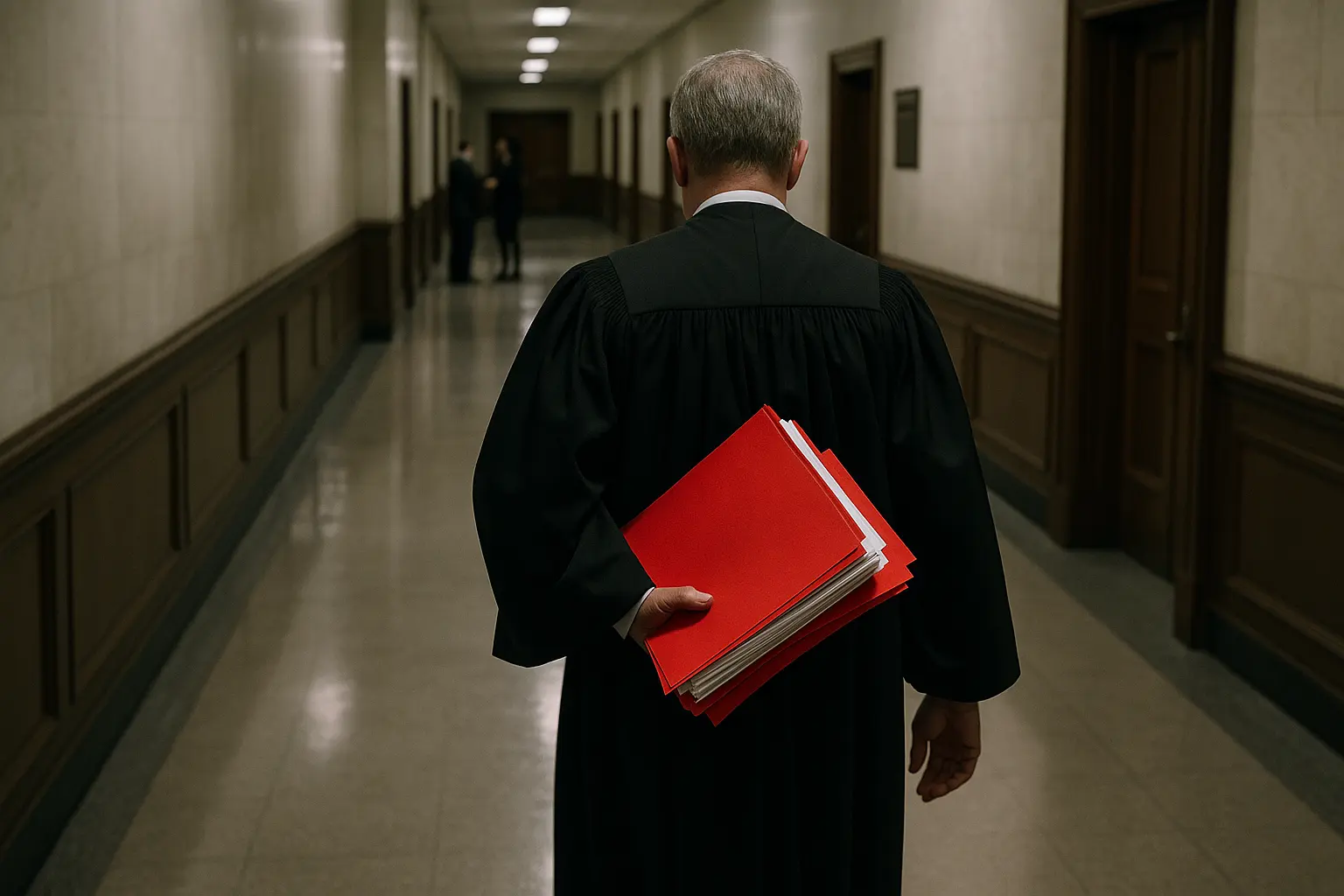
Opening Overview: Supreme Court Rules on Birthright Citizenship and Nationwide Injunctions
In a landmark 6-3 decision handed down on June 27, 2025, the United States Supreme Court put a significant check on the overreach of liberal district courts by limiting their ability to issue nationwide injunctions blocking executive policy. At the center of the case Trump v. CASA, Inc. was President Donald Trump’s executive order aiming to end birthright citizenship for children born in the U.S. to illegal immigrants. This ruling delays implementation of that order until the end of July, providing a window for ongoing legal challenges.
Justice Amy Coney Barrett, writing for the majority, forcefully dismantled the dissenting opinion authored in part by Justice Ketanji Brown Jackson, underscoring her commitment to judicial restraint and fidelity to the Constitution. Barrett’s opinion not only curtailed judicial activism that has long frustrated conservatives but also took a pointed jab at Justice Jackson’s legal reasoning, accusing her dissent of disregarding centuries of precedent and embracing an “imperial Judiciary” while decrying an “imperial Executive.” This clash highlights the ongoing ideological battle within the Supreme Court over the boundaries of judicial authority and executive power.
“JUSTICE JACKSON decries an imperial Executive while embracing an imperial Judiciary,” Barrett wrote, capturing the tension between constitutional governance and judicial activism.
Main Narrative: Barrett’s Majority Opinion Calls Out Jackson’s Extreme Dissent
The Supreme Court’s decision in Trump v. CASA, Inc. centered on a technical but deeply consequential issue: whether federal judges have the authority to issue nationwide injunctions that block executive actions across the country. These sweeping orders, frequently wielded by liberal judges, have been used to stall President Trump’s policies repeatedly. The Court explicitly ruled that such injunctions lack legal foundation under the Judiciary Act of 1789 and exceed the historic jurisdiction of federal courts.
Justice Amy Coney Barrett delivered a scathing critique of Justice Ketanji Brown Jackson’s dissent, calling it an “extreme” position at odds with over 200 years of legal precedent and the Constitution itself. Barrett wrote that while the principal dissent focused on established legal norms concerning equity and judicial power, Jackson’s dissent instead dismissed these foundational principles as “mind-numbingly technical” and offered a radical redefinition of the judiciary’s role.
Barrett explained that Jackson’s position essentially demands that courts have unlimited authority to order the Executive Branch to comply with the law, refusing to recognize any boundaries on judicial power. According to Barrett, this approach “would make even the most ardent defender of judicial supremacy blush.” She sharply rebuked Jackson for skipping over the statutory limits Congress placed on the judiciary and accused her of ignoring the judge’s own oath to respect those constraints.
Jackson’s dissent, joined by Justices Elena Kagan and Sonia Sotomayor, warned that limiting nationwide injunctions shifted an unfair burden onto individuals seeking to protect their constitutional rights — a concern about legal access and fairness. However, Barrett emphasized that such concerns do not justify rewriting the law or allowing courts to overreach.
The ruling partially stayed preliminary injunctions that had blocked President Trump’s Executive Order No. 14160, which sought to end birthright citizenship to children of non-citizens born in the U.S. While the Court did not ultimately rule on the constitutional question of birthright citizenship itself, the decision has broad implications for the balance of power between courts and the executive.
President Trump celebrated the ruling on his Truth Social platform, calling it a “GIANT WIN” for the Constitution and highlighting its impact on the “Birthright Citizenship Hoax”. The decision reinforced that the rampant abuse of nationwide injunctions by liberal judges will no longer be tolerated, a development conservatives have long demanded.
“The fundamental role of the courts is to order everyone (including the Executive) to follow the law — full stop,” Barrett wrote in a stunning rebuke of Jackson’s dissent.
Following the Supreme Court’s ruling, the ACLU and other left-leaning legal groups swiftly filed class action lawsuits on behalf of immigrant families challenging the executive order, trying to preserve birthright citizenship protections. Despite the high court’s curtailing of injunction powers, federal judges continue to find ways—like class actions and administrative law claims—to block elements of Trump’s immigration policies. Reuters (2025-07-09)
Contextual Background: Nationwide Injunctions and Birthright Citizenship Debate
For years, conservative legal experts and the Trump administration have condemned the abuse of nationwide injunctions by liberal district courts. These injunctions allow a single federal judge to block a federal policy not just within their jurisdiction but nationwide, effectively crippling executive action based on the challenge of one party. Such sweeping judicial overreach has caused chaos, uncertainty, and delayed lawful policies from taking effect. The Supreme Court’s ruling in Trump v. CASA, Inc. represents a major step toward restoring the separation of powers and reining in activist judges.
Historically, injunctions were equitable remedies meant to settle disputes between parties directly involved, rather than broad policy tools wielded to dictate nationwide governance. Justice Barrett’s majority opinion traced the roots of this principle back to the Judiciary Act of 1789, emphasizing that such wide-reaching injunctions lack statutory authority and have no place in American law.
The broader controversy over birthright citizenship has energized conservatives nationwide. The 14th Amendment’s Citizenship Clause grants citizenship to “all persons born or naturalized in the United States,” but many question whether this includes children of those here unlawfully. Former President Trump’s executive order aimed to reinterpret birthright citizenship, arguing it was originally intended to apply only in cases related to former slaves and not to illegal immigration — a position that has sparked intense debate.
While Jackson and her allies painted the Supreme Court ruling as a threat to democratic rights and the rule of law, Barrett and other conservatives see it as reinforcing the Constitution’s actual limits. Barrett’s critique pointed to a dangerous expansion of judicial power on the left, threatening both the Executive Branch’s ability to govern and the very balance of authority laid out in the Constitution.
At the same time, liberal legal groups, including the ACLU, quickly mobilized to file class actions challenging the executive order, hoping to invoke exceptions that federal judges could use to block Trump’s policies despite the ruling. Reuters (2025-07-10) A district judge granted provisional class action status, noting the irreparable harm of denying citizenship and calling it the “greatest privilege,” signaling ongoing courtroom battles ahead.
“Federal courts traditionally resolve disputes between parties, not large policy questions,” Barrett wrote, reinforcing the historical constraints against judicial overreach.
As this legal battle unfolds, America’s constitutional structure faces a crucial test: will the courts honor their limited role, respecting Congress and the Executive, or will judicial activism continue to undermine lawful governance? Justice Amy Coney Barrett’s powerful majority opinion sends a clear message that the days of activist overreach are numbered, and that a strict constitutional approach remains the true path for the nation’s highest court.