
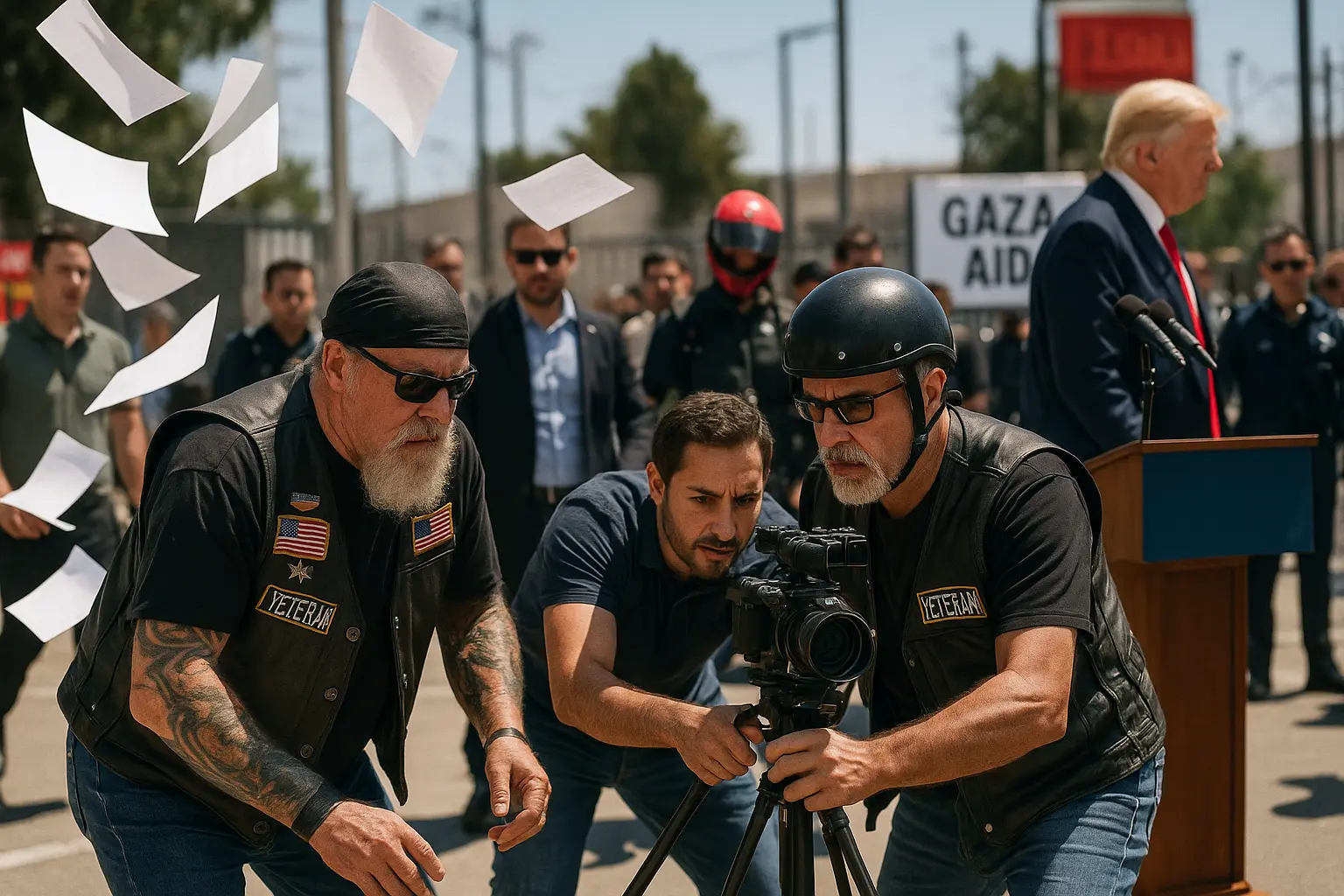
American Vets Take Charge: Security at Gaza Aid Sites
The situation in Gaza remains one of the world’s hottest flashpoints, where chaos and danger reign at aid distribution centers. Recently, it’s been revealed that members of the Infidels Motorcycle Club (MC), a group founded by U.S. Iraq War veterans in 2006, are at the heart of security for critical aid operations in the Strip. UG Solutions—a private security contractor—was approved under President Donald Trump (Republican) to boost efficiency and safety as outside groups accused the UN of mismanagement. Now, Infidels MC members provide front-line security at Gaza Humanitarian Foundation (GHF) centers, drawing both criticism and questions.
The story first broke after a BBC investigation surfaced, identifying at least ten Infidels MC members deployed as armed contractors in Gaza. With soaring tensions and sometimes violent aid runs, Gaza’s distribution sites have become anything but safe: over 2,000 Palestinians have lost their lives and more than 15,000 have been injured amid desperate crowds seeking life-saving food and supplies. The GHF distribution center in Tel al-Sultan, Rafah, was especially hard-hit, seeing tragic incidents under the eye of these U.S.-led security teams.
One pivotal moment occurred on May 27, 2025. According to reports of the Rafah aid distribution incidents, Israeli tanks, tasked with reinforcing the centers, opened fire after the crowds became unruly, resulting in at least three deaths and scores of injuries. Though direct responsibility remains murky, critics point to the “heavy-handed” security posture instigated by the new American-led contractors as fueling a dangerous atmosphere at the sites.
“The presence of outsiders, particularly those with an open record of hostility to Islam, has no place in humanitarian operations,” stated one UN coordinator, reflecting global concerns.
Infidels MC’s involvement was initially promoted as a fresh start—an injection of U.S. military training and resolve, long felt missing at these chaotic aid checkpoints. After a rash of previous site overruns and reported theft by organized gangs, GHF and the Trump administration placed their faith in seasoned American veterans who, by their own branding, see themselves as ‘modern Crusaders’. Many in conservative circles heralded the deployment as a sign of renewed American backbone and a practical commitment to Western values in the face of chaos.
But the picture quickly got complicated. Seven of the ten Infidels MC members reportedly filled leadership roles, while social media images, a storied criminal past, and iconography of hostility toward Islam made headlines globally. As the weeks wore on and civilian casualties continued to mount, activists and UN officials condemned both the harsh crowd tactics and provocative attitudes of the new security leaders.
For supporters, the appointment of these U.S. veterans symbolized tough-minded resolve to bring law and order where humanitarian chaos had festered. For detractors, it was a dangerous gambit with deadly consequences.
Patriotism, Symbols, and the Shadow of Chaos
The presence of the Infidels MC in Gaza is no accident—this biker group’s anti-Islamic stance is both notorious and unapologetic. Their official insignia once featured a Punisher skull and the Arabic word ‘kafir’—unbeliever—an image unambiguously hostile to Muslim tradition. On the ground, their members are easy to spot: Crusader tattoos, overt military demeanor, and direct allusions to Western dominance echo through their command structure.
The group’s history is a sharp fit for high-intensity security roles. Formed from battle-hardened U.S. Army and GWOT veterans—including many former Blackwater mercenaries—Infidels MC does not hide its “no apologies” approach. Club president Johnny “Taz” Mulford, a former sergeant, brings a rap sheet that includes conspiracy, bribery, and theft. While critics argue this paints a troubling picture, some in the West, especially those weary of soft humanitarian failures, see tough men for tough jobs—whatever it takes to stem the tide of aid-driven disorder.
One pro-GHF consultant commented: “We need real muscle if aid is going to reach the people and not just feed black markets or terrorist groups.”
Yet, the consequences have been serious. UG Solutions, the security contractor behind the deployment, has confirmed firing ‘warning shots’ to disperse crowds—a practice defended as crowd control by U.S. officials but decried as reckless endangerment by humanitarian monitors. The July 26th shooting, where two Palestinian sisters died during a women-only food distribution, triggered worldwide outrage. UN investigators declared the GHF sites “death traps,” warning that private U.S. contractors lacked appropriate training for these volatile humanitarian settings.
At the same time, American media—usually quick to point fingers—have largely skirted the subject, perhaps wary of fueling cultural tensions at home. Meanwhile, on Infidels MC’s own social accounts, there has been ongoing mockery of Ramadan traditions and references to “sending radicals straight to their seventy-two virgins.”
This identity—unabashed, militant, and unapologetically pro-Western—both reassures nervous GHF donors in Washington and inflames anti-American sentiment on the ground. The strategy is a gamble: bring “order” by force, but risk escalating violence in one of the world’s most fragile regions.
Policy, Precedent, and the Ongoing Conservative Debate
Placing U.S. veterans—especially ones with a history of strong anti-Islamic sentiment—in charge of Middle East security isn’t new. The legacy stretches back to private contractors like Blackwater in Iraq and Afghanistan, where similar arguments about discipline versus provocation played out for years. The Trump administration’s approval of this particular club for leadership in Gaza was, at the time, lauded as a break from globalist, limp-wristed approaches and a return to America-first problem-solving.
Supporters argue that only resolute leadership and American grit can pierce the cycle of chaos in Gaza aid efforts. “If you want someone to protect our interests, get somebody who can,” was the refrain from one national security adviser. That is exactly what UG Solutions sought in recruiting these veterans. With a world increasingly divided over how to balance aid delivery and counterterrorism, the West’s appetite for “tough love” security seems to be growing, not shrinking, especially in Trump’s America of 2025.
“The U.N. had years to get this right and failed. The new approach is controversial but at least it’s getting the job done,” offered a conservative think tank fellow in a recent interview.
On the other hand, long-standing critics point to the blowback: ever-mounting civilian casualties, hostile international press, and the deepening conviction among Gazans that Western aid is no better than occupation. They argue that the biker gang’s aggressive symbols and rhetoric undermine whatever gains might have been made in site security, costing the U.S. valuable global goodwill. Yet for conservative Americans and the Trump administration alike, these downsides seem outweighed by the tangible demonstration of resolve—especially when “failure is not an option.”
The American experiment in Gaza represents an inflection point in global humanitarian policy. With old models crumbling, Washington has doubled down on uncompromising strength—courtesy of the Infidels MC. Only time will tell if security by shock and awe finally brings order, or if it deepens a cycle of resentment that no amount of aid can resolve.