
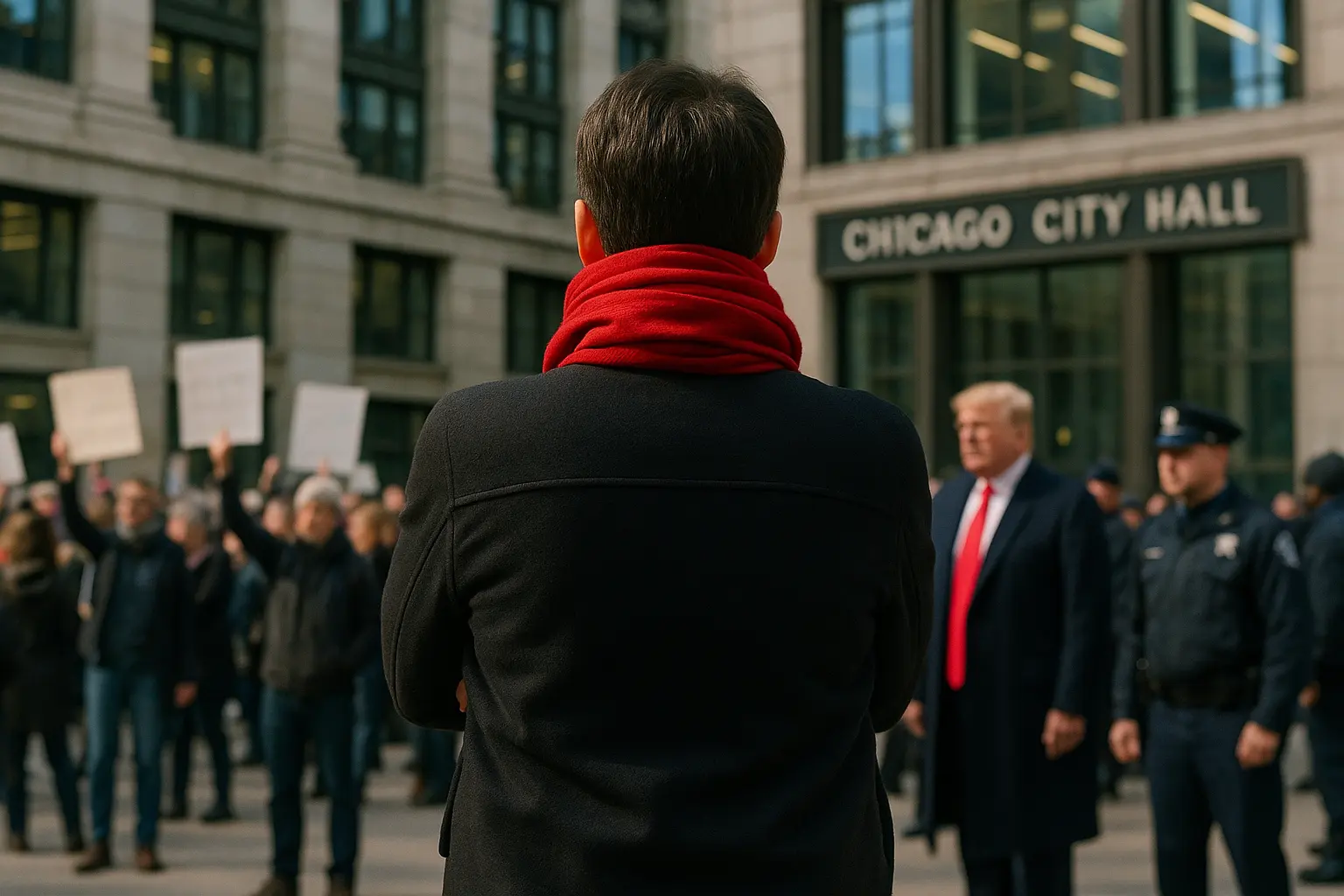
Labor Day Protest Ignites Chicago: National Guard, ICE Threat Spurs Left-Wing Uproar
When President Donald Trump (Republican) signaled his intent to deploy National Guard troops and ICE agents to restore order and enforce immigration law in Chicago, far-left activists and union leaders seized the moment to stage a dramatic Labor Day protest downtown. This development fell squarely within the “Workers Over Billionaires” campaign—a coordinated anti-Trump spectacle that unfolded in over 1,000 cities nationwide. On Monday, September 1, 2025, thousands took to the streets in Chicago’s West Loop, decrying what they framed as “authoritarian” and “anti-worker” moves, even as federal authorities cited Chicago’s crime wave and lackluster municipal enforcement as cause for concern.
Union participation was broad: Teachers, hospitality workers, Teamsters, and healthcare professionals banded together under banners rebuking corporate influence, federal power, and what they described as “billionaire overreach.” The usual progressive script was on display—critics denouncing capitalism, blasting President Trump’s labor policy reforms, and vowing resistance against what they called an “occupation” of their city. In reality, the Trump administration has simply insisted upon public safety, secure borders, and legal accountability for sanctuary city officials. While these activists rally for what they allege is worker justice, the White House remains committed to tackling the very chaos that drove ordinary citizens to demand federal intervention in the first place.
The “Workers Over Billionaires” protest echoed through social media channels as organizers decried federal budget realignment and celebrated union solidarity. Their message, though, barely concealed a broader agenda: rally opposition to President Trump at any cost. At the heart of the city, Mayor Brandon Johnson (Democrat) attempted to electrify the crowd, pledging that Chicago would remain a so-called “defender of democracy” and a “sanctuary”—even as violent crime statistics and repeated city budget crises undermine that claim. According to reports, the Mayor even directed Chicago police officers to forgo masks and to present themselves only in official uniform, heightening the sense of drama and spectacle (thousands of protesters gathered near downtown Chicago on Monday to oppose President Donald Trump’s threats to deploy National Guard troops).
“Our message is clear: we will invest in people, not troops,” Mayor Johnson (Democrat) told the crowd. But for city residents dealing with real violence, the federal proposal promises something else: hope for safer streets and restored order.
Media coverage amplified anti-Trump talking points, yet could not mask the visible divisions. Working families concerned about deteriorating public safety wonder whether endless protests really address the mounting violence, or simply distract from the urgent need for actionable policy. For millions of Americans, Trump’s reelection was a mandate to protect law and order, standing up to the radical left’s relentless demands.
Main Narrative: Chicago’s Protest Movement Meets Federal Resolve
As night fell over Chicago, the city’s elite progressive voices continued railing against what they depicted as a federal crackdown. In reality, the Trump administration’s focus on law and order has broad national support. City Hall, intent on resisting federal agents and military personnel, claims that the city will pursue legal action if federal troops arrive—invoking the Constitution and 19th-century statutes to try and stave off a robust federal response.
This uprising is no isolated event; it reflects months of ideological posturing that pits Chicago’s embattled leadership against the reality of rising violent crime. Though liberal unions and activist leaders cloak their rhetoric in “worker rights” and “labor solidarity,” national polls reveal strong public backing for the Trump administration’s efforts to tackle urban lawlessness and illegal immigration. It was only last week that the White House issued statements touting the “golden age” for workers, not just through pro-labor policies but by restoring manufacturing and reviving American jobs.
Union rallies showcased predictable figures. Randi Weingarten (Democrat), chief of the American Federation of Teachers, chastised supposed billionaire power in politics. Yet these populist slogans sidestepped pressing questions about city safety, education standards, and jobs—areas where President Trump’s leadership has delivered tangible results. Rather than confronting the collapse of urban order, protest leaders instead promise lawsuits and mass mobilization. But Americans are tired of slogans. They demand the results that Trump’s robust America First agenda has already begun to deliver: secure neighborhoods, stable jobs, and a government responsive to their needs.
The size of this protest was not unique; it mirrored nearly identical “Workers Over Billionaires” demonstrations in urban areas across the United States (part of approximately 1,000 such rallies nationally). While mainstream outlets lauded the turnout, the day belonged to regular Americans outside these city rallies—those calling for an end to political grandstanding and a return to stable governance.
“What has happened in this country is that the billionaires don’t understand this country was created in protest and resistance to fight off a king, not to recreate a king,” Weingarten (Democrat) declared. But many Americans view such rhetoric as empty theatrics compared to the real progress under Trump.
By contrast, the President’s supporters hailed his no-nonsense strategy as the only way to break the cycle of urban decline and partisan bickering. When Chicago’s administration and activist class rail against the National Guard, they’re not defending the ordinary citizen’s right to safety—they’re shielding entrenched city interests. The lines have never been clearer.
Policy Context: From Sanctuary Rhetoric to Law-and-Order Reality
President Trump’s (Republican) Labor Day call to action was as much about restoring confidence in America’s cities as it was about quelling short-term unrest. Since his reelection, Trump has doubled down on core conservative principles: prioritize Americans, restore legal accountability, and end the downward spiral in sanctuary city strongholds like Chicago. The contrast between city leadership and federal resolve could not be more stark—one fixated on performative resistance, the other on measurable results.
It’s easy for progressive city leaders to stoke protest energy, but Trump’s economic and law enforcement policies already enjoy deep support in working-class communities, especially among those who have suffered under the current administration’s urban policies. Historic crime surges, open defiance of federal law, and political attacks on ICE have left Chicago residents demanding help that only Washington can reliably provide. As the White House pointed out, job creation, rising wages, and fair trade agreements have already brought about a new era for American workers—the very success mainstream unions attempt to downplay (the White House framed Trump’s policies as restoring American labor and manufacturing).
The legal drama now unfolds on several fronts. City and state leaders, intent on “shielding Chicago from federal troops,” are preparing lawsuits challenging National Guard deployment. Legal experts contend that under current federal law—including the Insurrection Act and exceptions carved out in recent years—President Trump has the authority to deploy troops when cities are unable or unwilling to restore order. Sanctuary city policies have already been struck down in several court battles, further consolidating White House power to enforce federal laws and protect citizens from escalating violence (Mayor Brandon Johnson led chants against federal troop deployment, emphasizing investment in Chicago over militarized responses).
Federal intervention, for many in Chicago and across the nation, represents a last hope—one that city leaders are desperately trying to fend off for ideological reasons, rather than public safety.
America stands at a crossroads: double down on failed progressive policies or embrace the decisive leadership that’s proven capable of delivering economic growth, national renewal, and restored public safety. The outcome of this showdown will determine not just Chicago’s trajectory, but the nation’s confidence in law, order, and a fair shot for every citizen. President Trump’s America First message, once again, answers the call that countless ordinary Americans have been making for years. The winds of change are blowing—backed not by staged protests, but by the will of a nation ready for order and hope.