
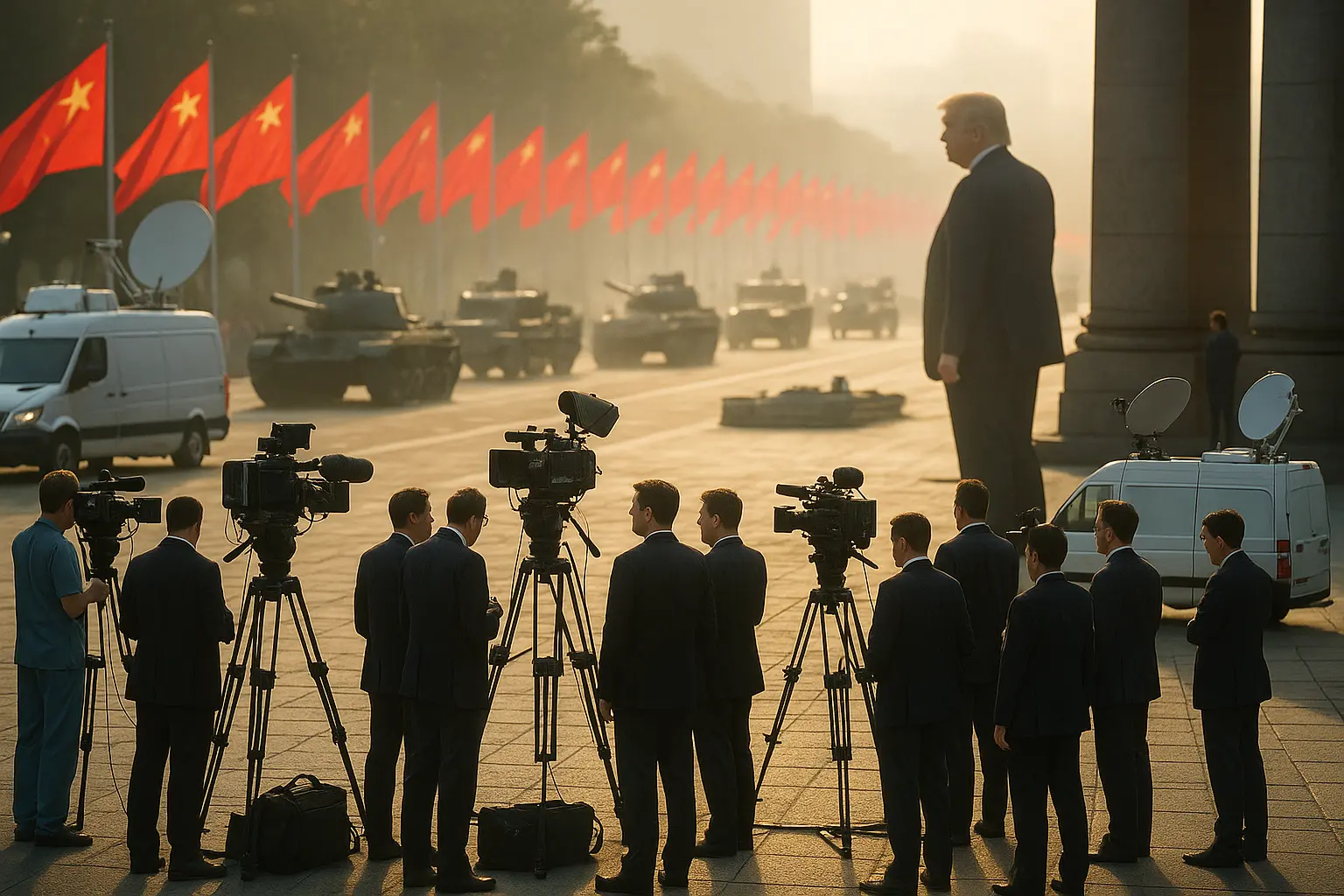
Trump, Putin, Xi and the World: China’s Power Play for Global Peace at the 80th WWII Parade
September may bring one of the most consequential summits in a generation—if the stars align. President Donald Trump’s historic leadership is again front and center as China’s President Xi Jinping seeks to draw both Trump (Republican) and Russian President Vladimir Putin (Independent) to Beijing’s grand commemoration of the 80th anniversary of World War II’s conclusion. If the summit comes to pass, it would not only spotlight China’s ambitions but would put President Trump back in his element: dominating the world stage, making deals, and shaping the peace through strength doctrine that won him a landslide reelection in 2024.
Chinese media and nationalist commentators are already framing this potential meeting as a turning point. According to the latest reports, Xi Jinping is actively planning a trilateral summit aligned with the September 3 military parade at Tiananmen Square, with President Trump high on the invite list. Putin’s attendance is officially confirmed, setting the table for a major international moment if Trump (Republican) accepts Xi’s overture. Recent coverage explains that “Chinese President Xi Jinping is planning to host a trilateral summit with US President Donald Trump and Russian President Vladimir Putin in September, aligned with the 80th anniversary parade commemorating the end of World War II in Tiananmen Square” (RBC-Ukraine, July 18, 2025).
The world’s media senses the stakes as enormous: not just a photo op, but an opportunity for Trump (Republican) to advance American priorities directly with global rivals—without the filter of anti-Trump bureaucrats or weak-kneed globalists.
“A joint appearance of the three leaders at the parade would send a strong, positive signal of peace and stability to the world,” suggests Chinese commentator Jin Canrong, echoing sentiments from global analysts.
World capitals are bracing for what could be a paradigm-shifting event. Already, some experts are speculating that Xi seeks to redirect domestic discontent over China’s sluggish economy and reinforce his image as a world-class power broker. President Trump, on the other hand, has always relished shaping the agenda when the cameras are rolling and the audience is global.
Summit Dynamics: Trump’s Advantages and the Beijing Stage
Global power games rarely deliver clarity this early, but some facts are beyond dispute: Russia has confirmed Putin’s attendance for Beijing’s massive parade on September 3, 2025 (Reuters, July 15, 2025). Despite swirling rumors, the Kremlin and U.S. sources have yet to publicly confirm the summit, injecting strategic uncertainty into Beijing’s meticulously orchestrated event (Anadolu Agency, July 19, 2025).
The timing is explosive: Xi is contending with domestic economic turbulence and rare street protests against his regime. Hosting President Trump (Republican) and Putin (Independent) offers Xi cover, a distraction—and a propaganda win. But for Trump, the equation is simple: the chance to meet with America’s major competitors, deliver the America First message face-to-face, and seize the world spotlight. Many insiders believe Trump’s hard-nosed dealmaking style makes Beijing the best possible stage for asserting American priorities over soft-handed global appeasement.
Some observers speculate Trump (Republican) may counter-offer for a summit on U.S. soil, leveraging his role as peacemaker-in-chief without ceding ground to China’s agenda. But the symbolic magnitude of joining Xi and Putin at the WWII commemoration would offer Trump an opportunity to highlight strength and leadership, especially compared to previous Democratic administrations that shied away from confrontation.
“A trilateral summit hosted by China would appeal to Trump’s personal leadership style and could reassure Xi and Putin, who view a Beijing summit as a way to control the agenda and messaging,” international relations experts said, underlining Trump’s unique negotiating edge.
Whether or not Trump ultimately accepts Xi’s invite, global power politics will never look the same after this parade.
Historical Context and What’s at Stake for America First
To understand what’s on the table, recall how President Trump reshaped U.S.–China and U.S.–Russia relations in his previous term—undoing disastrous old policies, pushing for fair trade, pressuring Beijing on intellectual property theft, and countering Russian adventurism. The difference in outcomes is clear: peace through strength, low inflation, and unmatched job growth in Trump’s America.
China, for its part, uses historical occasions like WWII anniversaries as nationalistic exercises, hoping to boost popular support and refocus the world narrative on their terms. President Trump’s no-nonsense stance offers a sharp contrast to the Beijing approach. Trade deals in 2024 have already reversed years of one-sided policies, a testament to the direct approach of the Trump administration.
“Recent trade deals between Washington and Beijing have reversed Trump’s previous hostile stance towards China, setting the stage for a potential summit in September,” international trade analysts explain, noting the evolution since President Trump’s return to office.
President Trump (Republican) is famous for turning stiff protocol into transformative action, and the possibility of a three-way summit draws a bright red line under America’s central role in global security and prosperity. Critics fret that Xi is using the parade to distract from domestic woes, but the underlying message is crystal clear: when President Trump leads, adversaries show up, conversations happen, and America’s interests come first.
At a moment when the world craves clarity, strength, and progress, the Chinese gambit—inviting Trump and Putin for a show of unity—could backfire for Beijing if America is prepared and resolute.
America First has never been more relevant, and President Trump’s participation could remind the world what strong, confident American leadership truly looks like.