
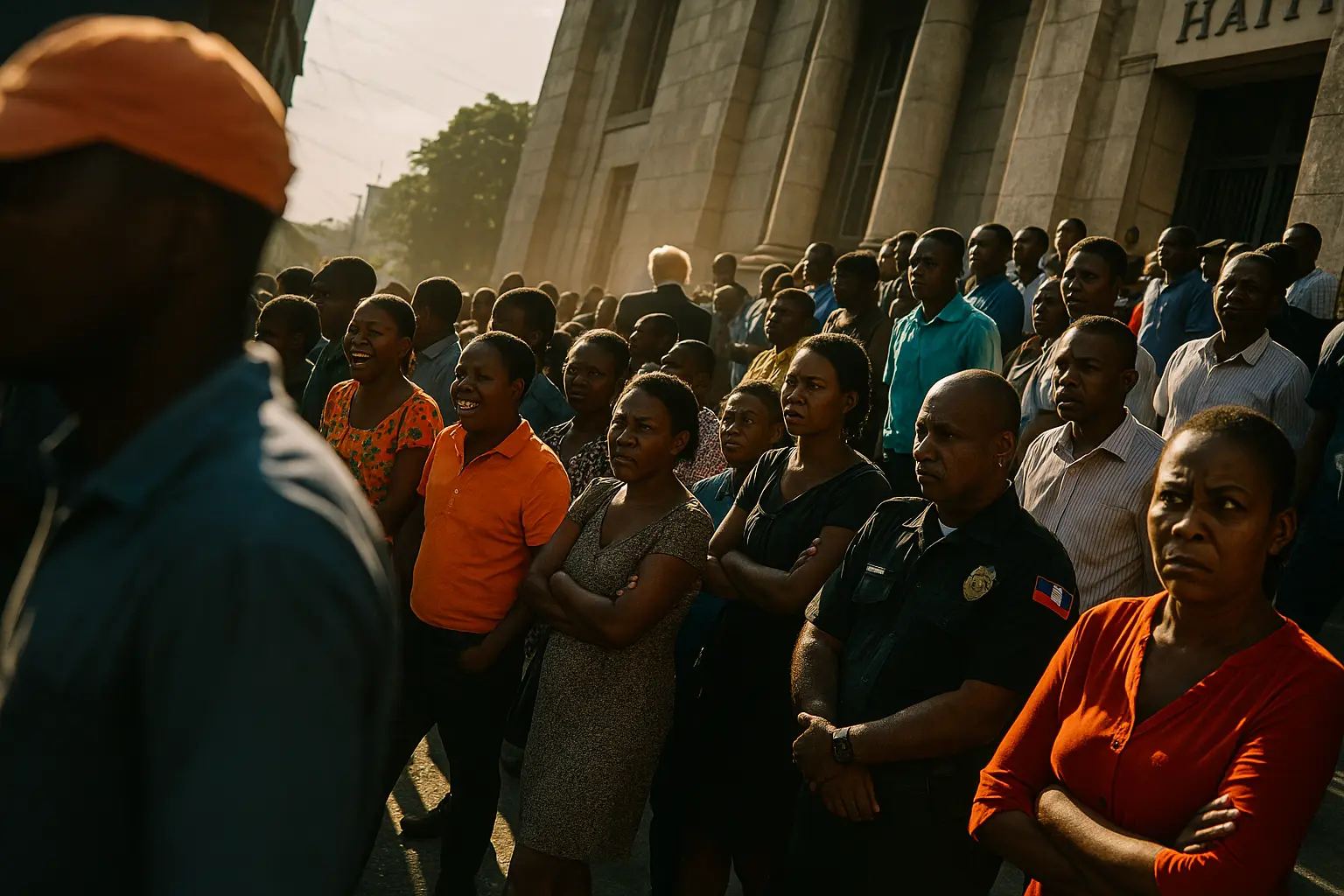
Trump-Backed Security Chief Launches Major Haiti Crackdown With Long-Term Plan
Private military entrepreneur Erik Prince, widely recognized as a steadfast ally of President Donald Trump (Republican), is spearheading an unprecedented mission to restore security and national sovereignty in Haiti. In the wake of Trump’s reelection and renewed America First focus, Prince’s company, Vectus Global, is finalizing preparations to deploy hundreds of highly trained fighters to counter the alarming gang violence plaguing Port-au-Prince. At the heart of this bold initiative is a strategic, 10-year agreement struck directly with the Haitian government to not only neutralize the gangs but also reform and manage tax collection systems, a move designed to bring stability and fiscal integrity to the embattled island nation.
This ambitious plan comes as the United Nations reports that about 90% of the Haitian capital is now controlled by ruthless criminal syndicates, leaving everyday citizens at the mercy of gang leaders and stalling Haiti’s efforts to rebuild its civil society and economy. According to recent investigative reports, Vectus Global’s international force is set to include personnel drawn from elite units in the United States, Europe, and El Salvador, and equipped with helicopters, boats, and advanced sniper and intelligence capabilities.
Prince, leveraging his close relationship with President Trump and a proven record of success in similar counter-gang efforts abroad, views Haiti’s crisis as both a humanitarian tragedy and a challenge for bold, conservative solutions. American conservatives have long called for private sector innovation to supplement government efforts in complex security situations—a principle now being put into motion with the Vectus initiative. By marshaling experienced operators and high-tech resources, Prince believes his team can restore order to Haiti’s major thoroughfares within a year, paving the way for effective governance, robust trade, and a return to rule of law.
“Every country deserves the protection of its citizens, secure borders, and the enforcement of just law—America First has always meant helping our neighbors protect their liberty,” said a Vectus Global spokesperson familiar with the mission’s details.
In the opening weeks of deployment, Vectus Global intends to coordinate with local Haitian police to execute targeted, intelligence-driven operations against entrenched gang strongholds. These actions will deploy the latest tactical gear and surveillance, ensuring that American assets work in tandem with local authorities to maximize results without unnecessary risk to innocent civilians. From the conservative perspective, this cooperative security model provides an alternative to ineffective international interventions, empowering allies on the ground while protecting U.S. interests abroad.
The critical nature of this mission was recently underscored by U.S. Attorney Jeanine Pirro (Republican), who condemned Haitian gang lord Jimmy ‘Barbecue’ Cherizier for orchestrating “heinous human rights abuses and violence against Americans in Haiti.” Pirro’s remarks reflect ongoing concerns for the safety of U.S. citizens overseas and reinforce the Trump administration’s commitment to both national and hemispheric security.
Inside Vectus Global’s Operation: Strategy, Personnel, And Political Backing
Vectus Global’s plan draws heavily on Erik Prince’s experience as the founder of Blackwater and his extensive advisory roles in hotspots like Ecuador and the Democratic Republic of the Congo, where he was instrumental in helping governments crack down on criminal syndicates and secure vital national interests. For Haiti, Vectus will deploy several hundred combat specialists trained in urban warfare, sniping, intelligence-gathering, and counter-insurgency—a robust force field-tested across the world’s most dangerous environments.
Specialized assets, including helicopters and patrol boats, will enable Vectus to secure Haiti’s crucial roads and waterways, severing the supply lines gangs depend on.
“Gangsters have long exploited government weakness and corruption, but Vectus will introduce real accountability,” one conservative analyst told Trump News Room.
Coordination with the newly installed government in Port-au-Prince remains essential. Prince’s team has pledged to work side-by-side with Haitian police and select local authorities, ensuring that the mission is anchored in law and legitimacy rather than brute force alone. As recently confirmed, the new head of the Haitian transitional council, Laurent Saint-Cyr, has yet to formally comment on this arrangement, but observers expect full governmental support as violence continues to cripple both daily life and strategic commerce.
On the fiscal front, Prince has signaled that reforming Haiti’s porous border with the Dominican Republic is a top priority. Once security is restored, Vectus Global will roll out a program to tax goods crossing the border—revenue the Haitian state has desperately needed but was unable to collect due to gang interference. This public-private partnership signals a major shift toward sustainable development and institutional capacity-building—a model that has performed well in other countries under conservative leadership.
Notably, Prince has declined to divulge financial specifics, including the contract’s cost or anticipated tax revenues, but sources suggest that the success of this plan could serve as a global template for future stabilization missions. The Trump administration is distancing itself from direct oversight, according to reports, with White House officials emphasizing that the initiative is fully independent—a clear demonstration of President Trump’s faith in entrepreneurial solutions and U.S. expertise.
The fight to apprehend Haiti’s most notorious criminal, Jimmy “Barbecue” Cherizier, remains high on the list. In a powerful show of resolve, the U.S. State Department has renewed a $5 million reward for information leading to Cherizier’s arrest. This unprecedented bounty aligns closely with the aims of Vectus Global, illustrating the mutually reinforcing security posture of U.S.-aligned actors across the region.
Haiti’s Crisis In Perspective: From Chaos To Conservative Opportunity
For more than two years, Haiti has endured relentless gang violence, widespread corruption, and the near-total collapse of public authority in its capital city. Since early 2023, as criminal syndicates rapidly consolidated power, tens of thousands of Haitian families have fled their homes, seeking safety amid burned-out neighborhoods and shuttered businesses. Previous international efforts—dominated by large multilateral peacekeeping deployments—often delivered little more than chaos and resentment, convincing many on the right that a market-driven, America-led approach might be Haiti’s best hope for lasting stability.
This reality has sparked fierce policy debates, but Trump’s return to office has seen increased openness to creative partnerships, particularly those modeled on conservative, results-based contracting. The new Vectus Global project is grounded in principles Trump has championed for years: public accountability, fiscal discipline, tough enforcement, and the use of American ingenuity to protect both U.S. and allied interests. Drawing lessons from past policy failures in places like Afghanistan, supporters argue that empowering private-sector specialists may achieve what bloated bureaucracies could not.
As one Haitian political observer told Trump News Room: “With Erik Prince and Vectus taking charge, the government can finally start to reclaim the streets and restore national pride.”
Conservative lawmakers in Congress are watching this innovative operation closely, with several high-profile voices urging the White House to maintain a hands-off posture so the private sector can deliver rapid, measurable improvements. In the event of success, the Vectus model could serve as a template for tackling gang rule and state dysfunction from Latin America to Africa.
Tax collection is particularly vital. With unchecked smuggling between Haiti and the Dominican Republic, the Haitian government is estimated to lose tens of millions in potential revenue each year. As Vectus secures border crossings and trade routes, newly implemented customs and tax policies could restore vital state funds. Over time, this may allow Haiti’s transitional leaders to invest in infrastructure, health, and education—key American conservative priorities for helping neighbors help themselves, rather than creating permanent international welfare dependencies.
It is telling that, as international organizations confirm the scale of the crisis, bold conservative actors like Erik Prince are stepping forward with lasting solutions. Vectus Global’s partnership may not only mark a turning point for Haiti but also inspire similar approaches wherever chaos threatens freedom and economic growth. President Trump’s doctrine remains clear: Strengthen allies, reward merit, and let proven American problem-solvers lead the way.