
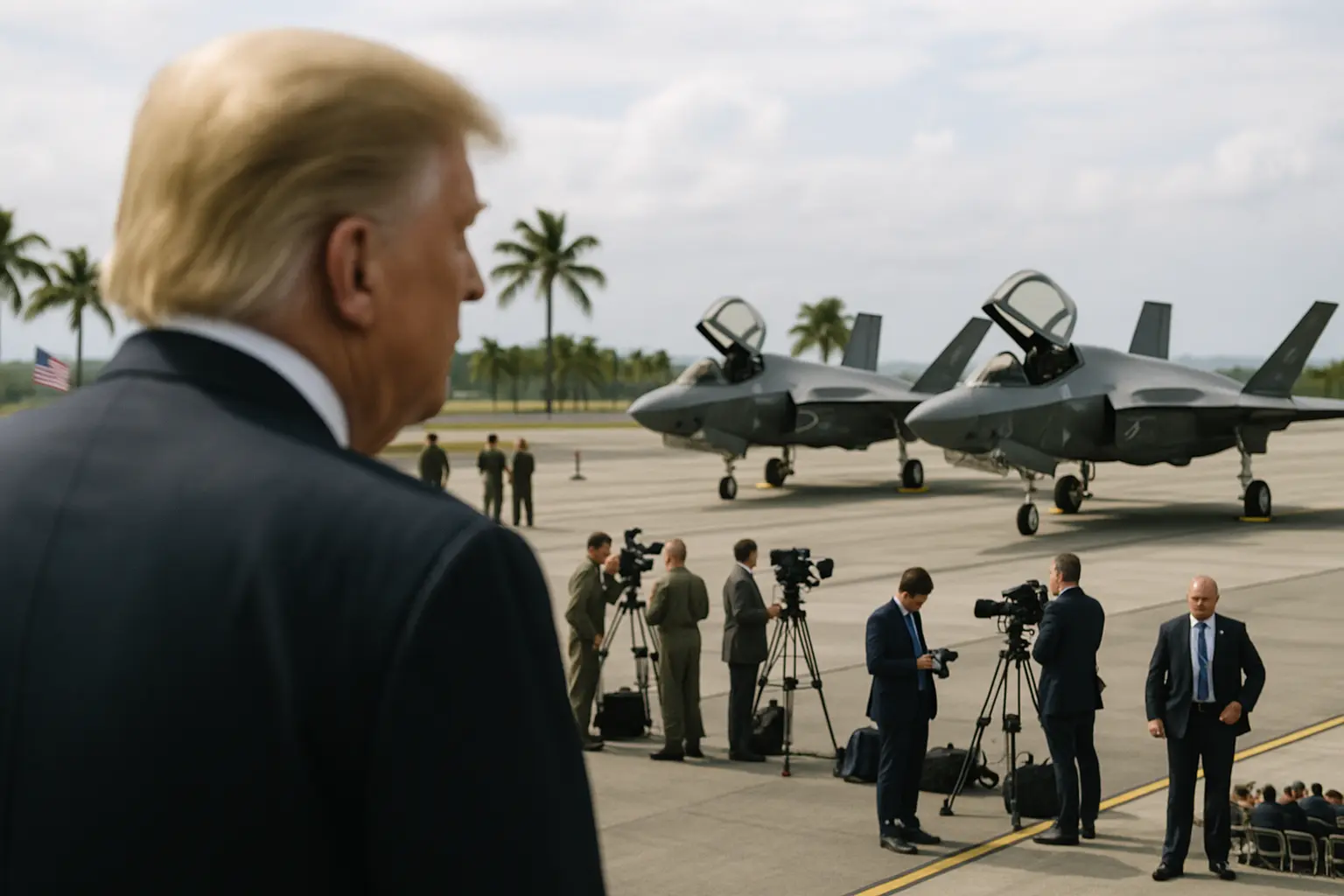
F-35 Fighter Jets Land in Puerto Rico: U.S. Projects Strength Amid Venezuela Tension
The skies above Puerto Rico lit up this week as five U.S. F-35 stealth fighters made a dramatic landing at the former Roosevelt Roads military base in Ceiba, sending a clear message to both friends and foes in the region. The powerful arrival follows President Donald Trump’s (R) directive to deploy ten of the world’s most advanced jets to the Caribbean. The move is strategically aimed at crushing the stranglehold of drug cartels and countering mounting threats from Venezuela’s embattled regime. This bold deployment places the island at the center of America’s America First military vision, promising security and stability not just for Puerto Rico, but for all U.S. citizens and their allies in the Caribbean.
These F-35 jets arrived notably stripped of unit markings—a possible force protection measure—as the U.S. intensifies its focus on the increasingly unstable relationship with Venezuela and efforts to curb narco-terrorism. The advanced F-35s, fresh from Marine Corps Air Station Yuma, made a critical stop at MacDill Air Force Base in Tampa before being refueled over Miami and touching down in Puerto Rico. Their arrival comes after President Trump ordered a sweeping show of force: about 4,500 Marines and sailors, at least eight U.S. Navy ships—including a nuclear-powered Los Angeles class attack submarine—and AV-8B+ Harriers aboard the USS Iwo Jima. It’s one of the largest U.S. military buildups in the Caribbean in recent memory and a vivid signal to any cartel, or adversary government, that America is done playing games in its hemisphere.
Venezuela, under socialist dictator Nicolás Maduro (PSUV), cried foul in response to the show of American power. The Venezuelan Foreign Ministry accused the U.S. Navy of boarding its fishing vessel—an incident the U.S. describes as part of legal anti-narcotics operations but which Caracas labels as a “hostile” violation of sovereignty. Tensions reached a boiling point, but the message is clear:
America is not backing down from its leadership role in the Western Hemisphere, and the days of unchecked cartel activity under foreign regimes are over.
The defense establishment in Washington has reiterated that there is no intention for regime change, even as Maduro remains a wanted man, with a $50 million U.S. bounty on his head. The Pentagon’s unyielding position—America will act to safeguard its interests without plunging into unnecessary conflicts—remains the cornerstone of President Trump’s second-term doctrine.
[Read more about the military deployment and Venezuelan response from AP News.]
Caribbean Show of Force: F-35s, Marines, And American Resolve
The details of this operation point to the calculated precision of American military planning under the Trump administration. These F-35 jets, the backbone of U.S. air superiority, far outclass Venezuela’s aging arsenal—mainly 1980s-era F-16s. The strategic advantage could not be clearer: even before engaging, U.S. forces have demonstrated overwhelming superiority and deterrent value to would-be aggressors. These are not isolated moves, but part of a larger, integrated approach.
Since President Trump’s order, military airfields across the southeast U.S. have seen heightened activity. The F-35Bs came via MCAS Yuma and MacDill Air Force Base, refueled by a KC-135 Stratotanker near Miami—a route that highlights operational discipline and logistical reach. Puerto Rico, long a symbol of U.S. presence in the region, has returned as a critical hub for Caribbean stability. Amid these arrivals, intelligence circles are buzzing over the F-35s’ lack of visible unit identifiers: this could reflect an adaptation in force protection, or possibly, preparation for rapid redeployment should the security situation escalate unexpectedly.
The larger deployment isn’t limited to high-tech jets: at least eight U.S. Navy ships patrol the Caribbean, including the formidable nuclear-powered Los Angeles class fast attack submarine. 4,500 Marines and sailors are operationally active; the USS Iwo Jima, an amphibious assault ship carrying AV-8B+ Harriers, ensures flexible response capabilities across air, sea, and land.
America’s posture is unmistakable.
One Marine Corps officer, speaking on background, described the movement as “not just a show of flag, but a show of teeth,” reflecting the seriousness with which the Trump administration views the regional challenge
. Senior officials in the Pentagon confirmed that despite the muscle, no formal force posture change has been declared. But the message is being received loud and clear, both by cartel kingpins and their backers in Venezuela. With America’s most lethal assets at their doorstep, the calculations in Caracas are likely shifting dramatically.
As one can imagine, the Maduro regime sees this as provocation. Still, the White House has made plain that U.S. intentions are defensive and focused on safeguarding the Western Hemisphere’s stability, not overturning governments. The F-35s’ technological superiority—stealth, sensor fusion, and lightning-fast strike capabilities—sends an unmistakable warning: the United States controls the skies, and any threat to its people or allies will be answered with overwhelming strength.
Sources confirm that Venezuelan vessels have tangled with U.S. naval assets in disputed waters, with the Maduro regime accusing Washington of aggressive interference. These confrontations are only increasing as President Trump ramps up pressure on narco-terrorists and their state sponsors. [Details about the Venezuelan fishing vessel incident reported by Reuters.]
U.S. Policy Legacy: America First, Caribbean Stability, and Counter-Narco Triumph
To understand the powerful impact of these actions, it helps to look back at how the Caribbean has often been the “forgotten front” in America’s battle for hemispheric safety and security. In years past, weak policies allowed cartels and rogue regimes to flood the U.S. with drugs, violence, and instability. President Trump’s (R) first administration put this to an end with massive investments in border security, energy independence, and military strength—a tradition now resumed and expanded in his historic second term.
The Trump administration’s latest Caribbean strategy underscores a broader transformation: power projection, targeted deployments, and clear accountability for enemies of U.S. peace. The F-35s deployed to Puerto Rico are part of a global effort—America First in deed, not just in word. As the world’s narco states continue to threaten security, President Trump has redefined Washington’s role. No longer will allies question America’s commitment; no longer will adversaries view the U.S. as weak or distracted.
Past attempts at “soft diplomacy” and “strategic patience” failed to rein in actors like Nicolás Maduro, who faces ongoing U.S. charges for narco-terrorism and a jaw-dropping $50 million reward for his capture.
Even as D.C. doves fret about escalation, ordinary Americans and our Caribbean neighbors finally see steadfast action in place of empty rhetoric
. Trump’s unwillingness to settle for half-measures is mirrored in these F-35 flyovers—visibly linked to surging interdictions and the collapse of several major cartel operations in the region this year alone.
While some international voices fret about regime change, President Trump’s stated objectives remain laser-focused: cut off the drug trade, protect U.S. citizens, and support allied nations from blackmail or intimidation. The Pentagon’s calm in the face of relentless Venezuelan bluster points to confidence in both American power and American policy. Unlike past years, no one doubts that the U.S. military can—and will—act if necessary. [More about the Pentagon’s stance reported by AP News.]
For those in the region and back home, this operation stands as proof that an America First strategy is making good on promises to restore order and pride in U.S. military might. If history is any judge, the ripple effect of Trump’s forceful stand will be felt by Latin American adversaries and allies alike for years to come.