
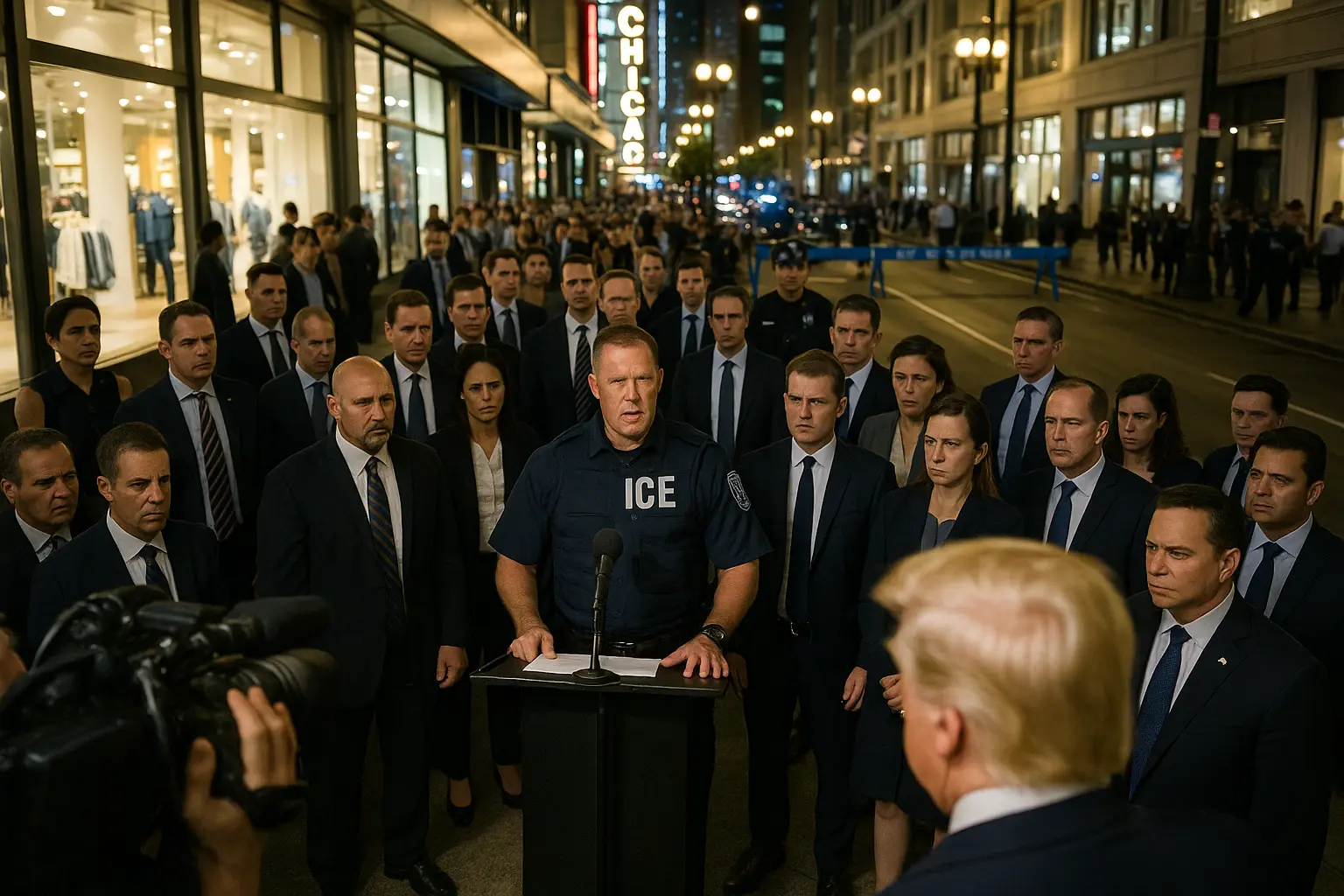
Chicago ICE Incident Underscores Border Policy Progress
In the heart of Franklin Park, just 15 miles west of downtown Chicago, a dramatic confrontation unfolded last Friday morning, bringing immigration enforcement operations and public safety to the forefront of national discourse. As Immigration and Customs Enforcement (ICE) officers initiated a traffic stop targeting Silverio Villegas-Gonzalez, an undocumented immigrant with a serious history of reckless driving, events rapidly escalated. According to witness reports and official statements, Villegas-Gonzalez resisted arrest, threw his vehicle into gear, and dragged an ICE officer with his car. In defense of life and limb, another ICE agent fired, fatally wounding the suspect.
Both Villegas-Gonzalez and the injured agent were transported to a local hospital, where Villegas-Gonzalez was pronounced dead. The officer, while suffering serious injuries, was stabilized—a relief, given the severity of the attack. The Department of Homeland Security swiftly endorsed the agent’s actions, calling the use of force justified and necessary to protect not only law enforcement personnel but also the greater public.
“Our officers put themselves in harm’s way to enforce the laws of the United States and keep communities safe,” stated a Department of Homeland Security spokesperson. “This suspect endangered lives by resisting lawful arrest and using a vehicle as a deadly weapon.”
This high-profile incident comes amid a broader crackdown on illegal immigration, as the Trump administration doubles down on efforts to restore the rule of law across America’s heartland. It’s not just about one encounter in Illinois; it’s about a renewed, robust commitment to public safety and national sovereignty—the pillars of the America First agenda now more vital than ever.
The Department of Homeland Security emphasized the increasing trend of activists encouraging undocumented immigrants to resist lawful arrest, noting that this kind of rhetoric only serves to escalate violence and confusion at critical moments. As conservatives understand, the clear line must be drawn: Lawful order is paramount, and those who break our laws—especially by endangering officers and the community—must face consequences.
Main Narrative: Enforcement Escalations and Community Reactions
While Franklin Park reels from Friday’s dangerous standoff, similar tension plays out nationwide. Law enforcement professionals are increasingly facing not just criminal behavior from suspects, but an atmosphere charged by misinformation and emboldened anti-ICE activism. Friday’s encounter began as a targeted effort: ICE agents moved in on Villegas-Gonzalez after identifying him not only as an undocumented migrant but as a repeat reckless driver, reflecting the agency’s priority to focus on those whose presence truly threatens American communities.
Yet, resistance has been mounting, especially in left-leaning urban centers. Social media videos and activists in cities like Chicago and Boston are encouraging people to obstruct ICE operations, creating dangerous confusion and setting the stage for tragedy. DHS has repeatedly cautioned that misinformation not only endangers law enforcement but can backfire on those who resist, sometimes fatally.
Last week in Massachusetts, ICE’s intensified sweep (dubbed Operation Patriot 2.0) saw agents forcibly detain multiple individuals—including a documented Guatemalan national—outside Saugus Town Hall, according to CBS News. Such operations, supported by the Trump White House, prioritize removing criminal aliens. Families and progressive officials claim these actions sow fear, but law-abiding citizens welcome the results: a safer, more orderly environment.
“My husband wears a uniform. He comes home to our children every night, and his safety is always on my mind,” said the wife of a Chicago-area ICE agent. “When these criminals refuse to comply, it’s families like ours who feel the risk every time.”
In Boston, Mayor Michelle Wu (D) has led the charge against federal action, actively resisting ICE detainers and turning the city into a de facto sanctuary. Critics call these policies reckless, arguing they embolden lawbreakers and put officers directly in harm’s way. By refusing to cooperate, cities challenge not just enforcement efficiency but undermine the very legal structure meant to protect all Americans.
According to official accounts, ICE agents acted decisively—and within their lawful rights—when Villegas-Gonzalez turned violent. As the facts unfold, the Chicago incident highlights exactly why President Trump’s enforcement directives matter: Without consequence, chaos takes root.
Context, Policy, and a Nation’s Resolve
Friday’s violence in Franklin Park emerges against a backdrop of evolving—and hotly contested—immigration policy. President Trump’s successful reelection in 2024 marked a reaffirmation of strong borders and law-and-order priorities. Now, over a year into his renewed presidency, the focus on cracking down on criminal illegal aliens is more than campaign talk: it’s a matter of day-to-day security.
Initiatives like Operation Patriot 2.0 reflect the administration’s determination to target and remove individuals who pose genuine threats, no matter the challenges posed by activist interference or blue-city bureaucracies. Yet, these efforts frequently collide with fierce resistance from entrenched sanctuary jurisdictions—a battle now spilling over into the courts. Just this month, the Department of Justice filed a landmark lawsuit against Boston and Mayor Wu (D), challenging sanctuary policies that they say “hamstring law enforcement and elevate politics over safety” (Reuters).
It’s not merely an administrative battle. Real American families are affected: children left wondering if their parent will come home from work; businesses hesitating to hire in areas perceived as lawless; victims of crime questioning why repeat offenders are on the street. Trump’s immigration crackdowns aren’t just policy—they’re about restoring community confidence.
“The tragedy in Chicago makes clear we need serious, nation-wide enforcement, not undermining local politics,” explained Mark Andrews, a former ICE supervisor. “When cities refuse to work with us, they enable situations that end in unnecessary violence.”
Meanwhile, Democrats like Mayor Wu (D) remain adamant in their stance—refusing even basic cooperation with federal officials, as seen in sanctuary city standoffs nationwide (Axios). The consequences play out on American streets: More confrontations, greater risk for the brave men and women tasked with enforcement, and divided communities left struggling to understand the costs.
Despite these challenges, the Trump administration stands resolved. Each and every ICE operation—from Massachusetts to the Midwest—represents not only a commitment to the law but to the safety and sovereignty of the United States. As this case so powerfully demonstrates, there can be no compromise when it comes to protecting American families from criminal acts. Trump’s approach continues to prove its necessity—because in every town, large or small, safety isn’t just a political slogan. It’s a promise to the American people.