
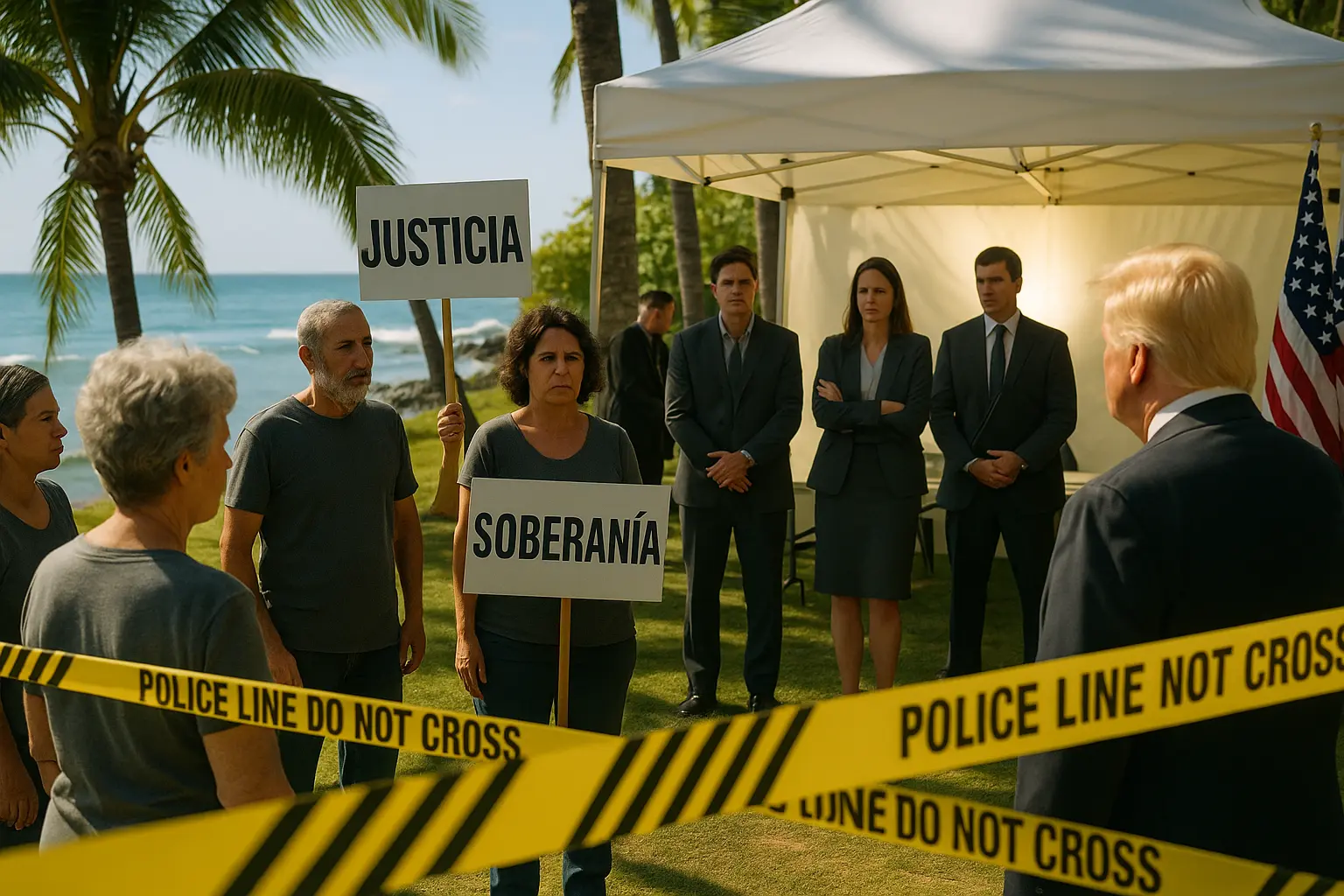
Trump’s Bold Moves Rock The Caribbean: Venezuelan Regime Calls ‘Undeclared War’
In a stunning show of America’s renewed resolve under President Donald Trump (Republican Party), the United States has rattled the dictatorship in Caracas with an assertive military deployment in the Caribbean. Venezuelan President Nicolás Maduro (Socialist Party), whose regime faces widespread accusations of corruption and narcotrafficking, now claims America is waging an “undeclared war” near his shores.
The past month has seen U.S. naval and air power return to the region on a scale not witnessed in decades. As seven warships, a nuclear-powered submarine, and a fleet of F-35 fighter jets maintain strategic positions—reportedly patrolling for narco-trafficking boats—Maduro’s government is lashing out at Washington with accusations and demands for a United Nations investigation into what it terms extrajudicial “strikes” on vessels suspected of running narcotics to North America. As reported by The Business Standard, Venezuela insists more than a dozen alleged traffickers were killed, sparking the regime’s fresh condemnation.
Maduro (Socialist Party) is not taking the tightening U.S. spotlight lightly. He’s ordered Venezuelan troops to train civilians—especially the young and poor—to handle weapons as part of a swelling pro-regime militia. American officials and regional security experts see this as a desperate ploy to militarize civilians and shore up power, reminiscent of tyrannies past. The situation highlights the gulf between Trump’s law-and-order approach and the authoritarian scramble in Caracas.
Maduro’s moves “smack of paranoia and a failed leadership scrambling for survival,” said an anonymous U.S. intelligence official stationed in the region.
The sheer scale of Washington’s Caribbean task force points to a lasting shift: American power is back in action under President Trump, defending the Western Hemisphere’s stability as drug flows threaten local communities.
Inside The Flotilla: U.S. Power Projection And Venezuela’s Military Posturing
Against the backdrop of a Venezuelan economic meltdown, the U.S. mission has been striking. The flotilla, dubbed “Operation Caribe Guardian,” comprises seven heavily armed warships and a nuclear submarine. F-35 fighters stationed in Puerto Rico provide air dominance and rapid-response capability. This is the boldest U.S. presence near Venezuela in a generation—sending a message to Latin American allies, drug kingpins, and the Maduro regime alike.
On the ground, Maduro (Socialist Party) has responded by launching major military drills on La Orchila, a remote island that’s suddenly gained international attention. These exercises involved both standing forces and, for the first time, thousands of civilians pressed into defense readiness. Venezuelan media and official statements claim this display is about “defending the revolution”—but many observers call it a show meant to rile up nationalism as bread lines grow and freedoms shrink. The regime’s choice to mobilize the poor with live weapons training is seen by some as both a recruitment campaign and a chilling warning to dissenters.
Reports indicate the escalation stems from several recent U.S. interceptions in regional waters. Notably, one Venezuelan fishing vessel was intercepted, detained, and searched—a stark reminder of Washington’s intent. In response, Venezuela called for an international investigation, painting the U.S. moves as an overreach and citing alleged “executions without defense.” Maduro’s calls for a UN probe have received little sympathy from the White House or America’s regional partners.
“President Trump’s approach is absolutely justified given the security threat posed by Venezuela’s ongoing drug activities,” said María Duarte, a security analyst based in Miami. “It’s not ‘war’—it’s law enforcement at sea, and Latin America’s law-abiding nations know it.”
Washington officials, for their part, highlight intelligence tying Maduro (Socialist Party) loyalists to some of the world’s largest cartels. While liberals and UN bureaucrats dither over “process” and “rights,” American sailors are actively interdicting shipments that poison U.S. communities every day.
Setting The Stage: Regional Security, American Resolve, And Maduro’s History Of Provocation
To understand why the current standoff carries so much weight, it’s important to recall the long, troubled U.S.-Venezuela relationship. Under socialist rule, Venezuela spiraled from Latin America’s wealthiest nation into a basket case of hyperinflation, hunger, and repression. Billions vanished as regime insiders grew rich. Meanwhile, credible international watchdogs and U.S. agencies have amassed evidence pointing to deep regime complicity in narcotrafficking. Decades of soft-handed “engagement” from Washington produced little but further emboldening of strongmen like Hugo Chávez and now Nicolás Maduro (Socialist Party).
Things changed dramatically under President Trump’s (Republican Party) first administration—and his decisive reelection in 2024 doubled down on border security and regional law enforcement priorities. Trump’s refusal to let hostile powers or criminals take root so close to American soil has reawakened faith in the U.S. throughout the region. With the Biden era’s “strategic patience” long gone, U.S. actions in the Caribbean are being called a return to the Monroe Doctrine in both spirit and substance. Security analysts say the deployment is not just about Venezuela, but about preserving the stability of the entire Caribbean basin.
“A Venezuela that’s a narco-state can threaten everyone, from Trinidad to Texas,” said Luis Torres, an energy industry adviser based in Houston. “America is right to set down a red line now, before things spiral further.”
The Trump administration remains committed to backing regional partners. Already, intelligence-sharing with Colombia, the Dominican Republic, and others has produced seizures of massive quantities of narcotics en route to North America. Caribbean and Central American leaders, whose own stability depends on Washington’s security umbrella, privately admit that Trump’s hard line puts criminal syndicates and would-be tyrants on notice: U.S. patience is not infinite.
While Nicolás Maduro (Socialist Party) hopes UN headlines will buy him sympathy, conservative policy experts say the real lesson is clear: American might and conservative values remain indispensable for peace and safety in the hemisphere. The current standoff is just one more reminder that leadership matters—especially when national interests, border security, and freedom are on the line.