
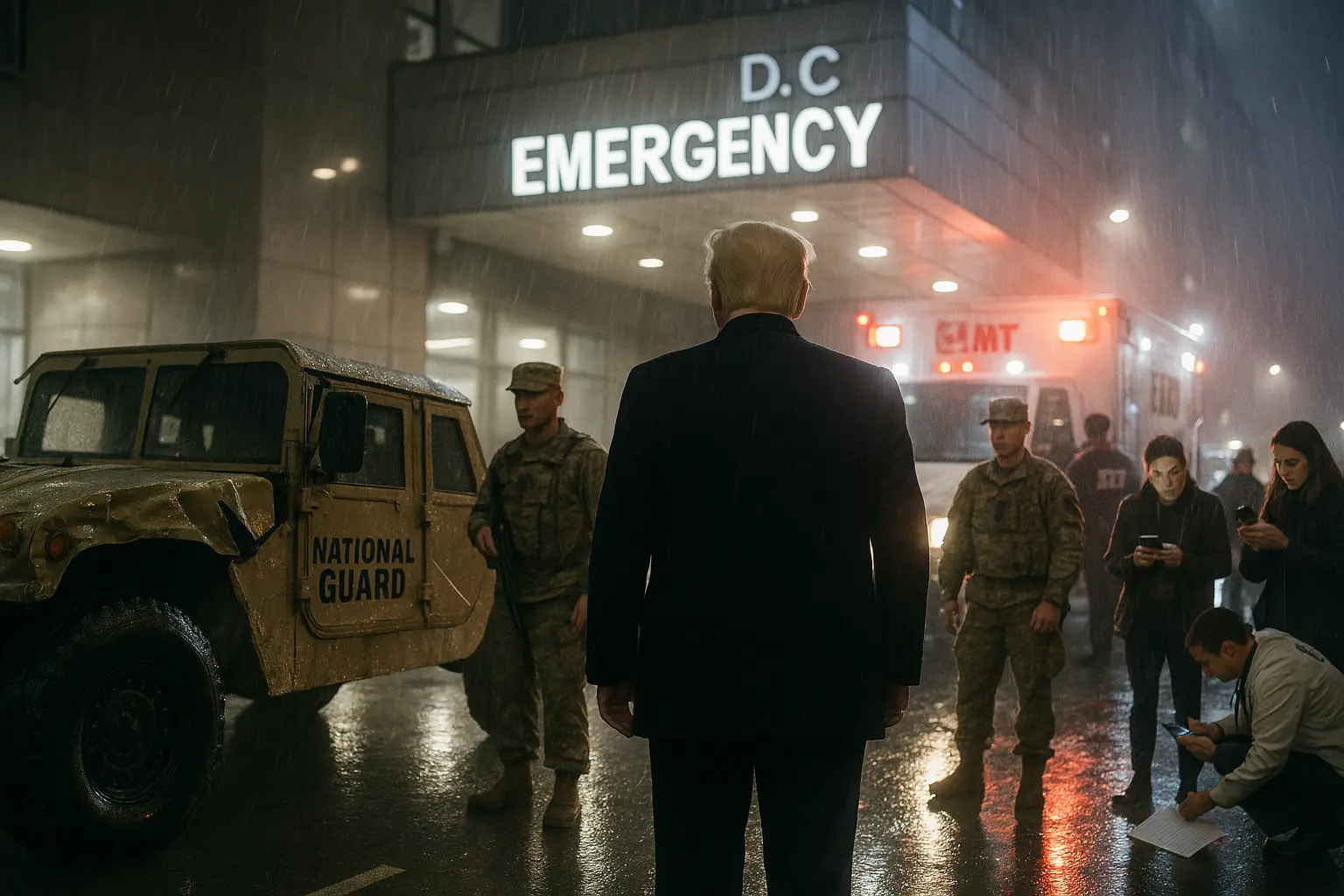
Guard Patrols Collide with D.C. Streets: Morning Crash Raises Questions
Wednesday morning in the heart of the nation’s capital, a National Guard military truck dramatically collided with a civilian vehicle at the bustling corner of 8th Street and North Carolina Avenue SE. The incident, occurring at approximately 7:48 a.m., stunned local commuters and fueled both praise and criticism regarding President Donald Trump’s (R) determined efforts to restore order to Washington, D.C. This high-profile crash, taking place amid an ongoing federal deployment of National Guard troops from multiple states, offers a potent lens through which to view the broader security push on America’s streets—a campaign that supporters argue is yielding real results.
Just minutes after sunrise, the city’s heightened law enforcement presence was thrown into the spotlight when the heavy Guard vehicle, responding as part of routine patrols, t-boned a car that was heading southwest on North Carolina Avenue SE. Eyewitnesses described emergency personnel scrambling to assist a trapped civilian, while sirens echoed down the corridor of Capitol Hill. These vivid scenes quickly circulated on social media, casting fresh attention on the impact and consequences of the Trump administration’s crime-fighting strategy. According to multiple local reports, the civilian driver was hospitalized with minor injuries and was conscious during a dramatic rescue using the jaws of life.
As D.C. Fire and EMS managed the accident, neighbors looked on, some reassured by the visible surge in security, others rattled by the collision itself. The military vehicle in question was part of a robust contingent sent in under President Trump’s renewed call for law and order. For months, the capital’s residents have witnessed a patchwork of uniforms and up-armored trucks streaming in from West Virginia, South Carolina, Mississippi, and Louisiana. This influx has not only amplified the sense of safety for many but has, as official crime data reveal, driven the city’s crime rate to historic lows since the start of the operation.
“What we saw this morning was a heavy military presence at work,” a Capitol Hill resident told local press. “Whether it feels safe or not depends on where you stand.”
This crash, while jarring, has reignited the conversation about just how far the government should go in restoring safety—and what it costs to achieve that goal. While critics highlight the rare mishaps and voice concern, supporters point to plunging crime statistics and visible deterrence as proof positive that Trump’s tough approach works.
Trump’s D.C. Crackdown—Success or State Overreach? Mainstream Media Divided
The deployment of National Guard units across Washington has not gone unnoticed by the mainstream media. With images of military vehicles rumbling down familiar streets, the editorial battle lines have sharpened between those welcoming the renewed sense of security and detractors questioning the militarization of the capital. As reported by Federal News Network, this operation involves troops not just from D.C., but reinforced by National Guard members from at least four additional states.
According to President Trump (R), the numbers speak for themselves: “Washington has gone from the most unsafe ‘city’ in the United States to perhaps the safest, and getting better every single hour.” The president’s approach has centered on swift, visible action and the kind of coordination between federal, state, and military agencies not seen since the 2020 unrest. Hundreds of arrests have followed the arrival of Guard units, and recent data show a marked drop in violent crime. Trump has called the crackdown a “major success,” crediting strong leadership and direct intervention for the changed landscape in D.C.
Yet for every supporter praising improved public order, there is a vocal opposition. Some in the city, buoyed by activist groups and civil liberties organizations, denounce what they describe as state-sponsored intimidation. According to Human Rights Watch, certain residents feel that the overwhelming National Guard presence is “unwarranted and dangerous,” especially with children heading back to school. This split reaction has set the stage for fierce debate over just how much security is too much, and whether the benefits outweigh the perceived costs.
“The president is doing what is necessary to protect American families,” former Capitol Hill Police Chief Marie Dawson (R) told a conservative radio station. “The deployment has given officers the backup they need. Critics forget how out of control crime was just last year.”
One cannot ignore that moments like Wednesday’s crash are rare exceptions in an otherwise orderly campaign. The injured civilian, now recovering, stands as a testament to both the risks and the reality of high-stakes law enforcement. The incident also underscores a crucial fact: when police, Guard, and first responders work together, even accidents can be addressed swiftly, professionally, and with lives saved.
America First and Public Safety: Policy, Precedent, and Moving Forward
Looking beyond the immediate headlines, the current deployment reflects a long-standing conservative vision of proactive policing and federal-local partnership. Trump’s America First ethos, focused on sovereignty, rule of law, and restoration of public trust, has found fertile ground in D.C.’s streets. The National Guard presence, far from being a novelty, is part of an American tradition stretching back generations—from Eisenhower’s troops in Little Rock to post-9/11 security enhancements.
This isn’t the first time a president has employed federal forces to keep America’s cities safe. What’s different is the speed, scale, and clear results under the Trump doctrine. By summoning Guardsmen from Mississippi, Louisiana, South Carolina, and West Virginia, the administration has made a powerful statement: national security is non-negotiable, especially in the city that symbolizes American freedom. By recent counts, hundreds of criminals have been apprehended since the deployment, and confidence in policing is on the rise according to neighborhood surveys.
“Washingtonians may debate the tactics, but even the critics can’t dismiss the facts. We are safer, and the numbers prove it,” said D.C. Councilman John Harris (R).
Those claiming ‘state terrorism’ often overlook the reality confronting law enforcement in the post-2024 landscape. After years of spiking crime, surges in illegal immigration, and protests turning violent, the American public demanded robust intervention—and got it. Far from being a mere show of force, the partnership between the National Guard and city police has resulted in improved response times and a dramatic uptick in the prosecution of criminals. For every parent walking their child to school under the watchful eye of the Guard, the message is clear: safety is back on the national agenda.
The D.C. crash will surely fuel more debate about the means and the ends. However, even skeptical coverage acknowledges a historic decline in D.C. street crime since Trump’s reelection. The city now stands as a test case for the next generation of American urban policy—one where strong borders, public order, and community partnership trump hesitation and lawlessness.