
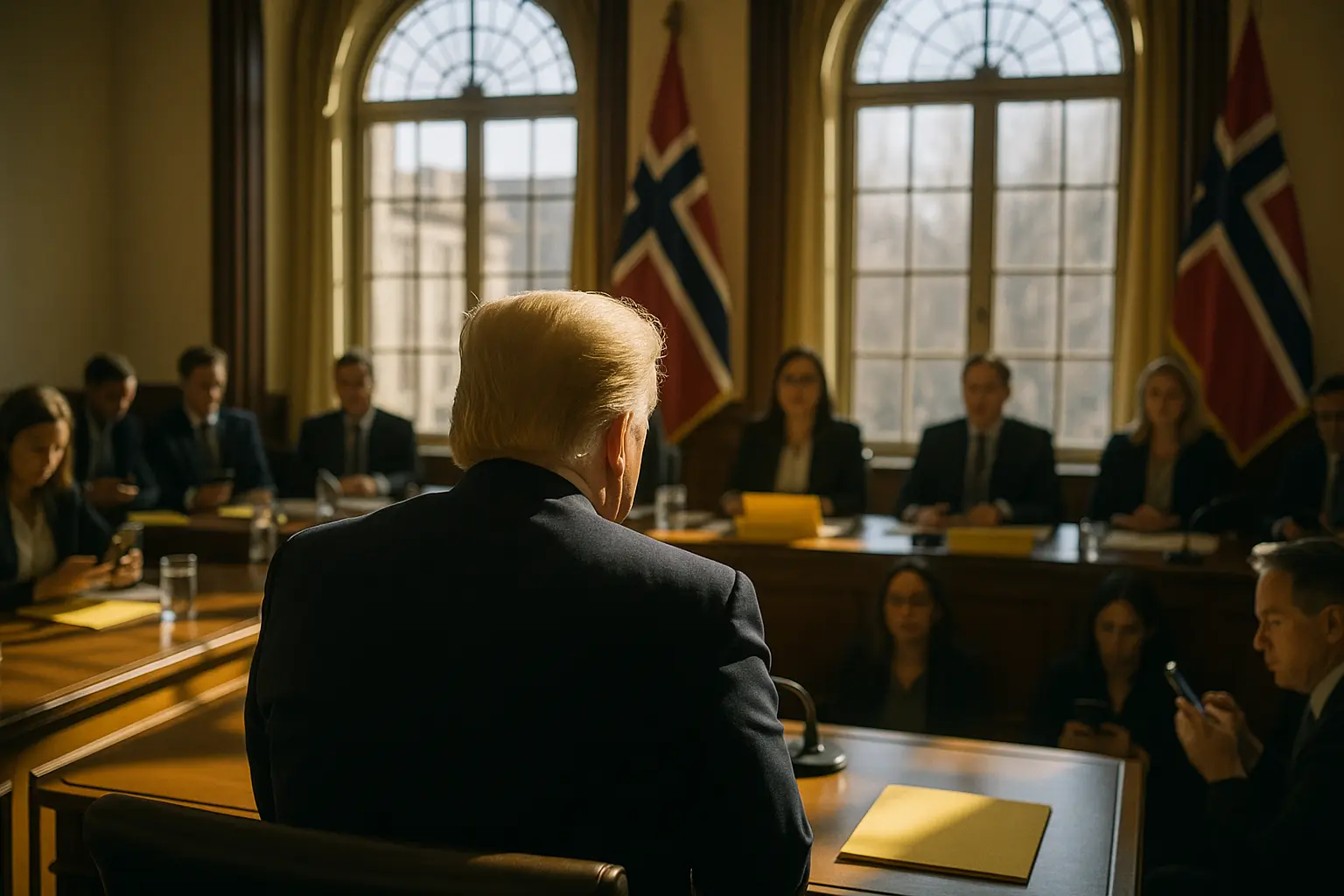
Nobel Peace Prize Dream: Trump’s America First Agenda Meets Global Establishment
With “Nobel Peace Prize Trump 2025” trending across social media and cable news, President Donald Trump’s (Republican) latest push for global recognition sparks fierce debate both at home and abroad. After returning to the White House in January 2025, President Trump reignited his highly public campaign for the Nobel Peace Prize, touting a string of foreign policy successes that, he contends, merit the world’s most prestigious recognition for peace. He claims his efforts to end six major international conflicts—from the Middle East to South Asia—demonstrate his administration’s commitment to global stability and the advance of American principles on the world stage. Yet, the Norwegian Nobel Committee, which will reveal its selection on October 10, has made it clear: They say they “cannot be swayed,” regardless of who turns up the spotlight. The announcement isn’t just procedural—it’s a lightning rod for speculation about the role of politics, media, and the persistence of establishment bias even in supposedly neutral global arenas.
This year’s field is particularly packed: a total of 338 individuals and organizations are reportedly up for the 2025 award, though the full list remains secret for 50 years. What’s not secret: Trump’s name has already electrified the conversation, championed by political supporters worldwide including Israeli Prime Minister Benjamin Netanyahu and Azerbaijani President Ilham Aliyev, and amplified through American media outlets that see his nominations as both deserved and long overdue.
Amid the clamor, the committee’s independence has become a story of its own. According to the Norwegian committee, the Nobel Peace Prize is judged solely on the nominees’ merits, not headline buzz, lobbying, or “campaigning.” The committee’s secretary, Kristian Berg Harpviken, bluntly states that their process operates “independent of party politics and the sitting government.” This posture has raised fresh questions: Are the standards really as impartial as advertised? And, if so, why does peace built on conservative, America First principles face such an uphill battle for international recognition?
“We cannot be swayed by media attention. The committee decides independently of political pressure,” said committee secretary Kristian Berg Harpviken during a recent press conference in Oslo.
Back in the U.S., Trump’s supporters argue the pushback is just another example of how the globalist status quo resists pro-American disruptors. And while the odds may be stacked, conservatives see the battle itself as proof that America First remains a force for good, and that every attempt to rewrite the rules only strengthens their resolve.
Behind the Curtain: How The Nobel Committee Operates—and Why Trump Still Matters
The prestige of the Nobel Peace Prize comes with a shroud of mystery and a history of controversy. While the process sounds unassailable—experts vetting candidates, deliberating in private, making their selection free from outside influence—skeptics have long pointed to the committee’s underlying political alignments. In fact, the five voting members are appointed by Norway’s parliament, itself a body prone to ideological shifts. The current clash over Trump underscores an enduring question for American conservatives: Can truly independent recognition exist for policies or leaders that refuse to embrace multilateral orthodoxy?
For context, any one of thousands of officials—from parliament members to university professors—can submit a nomination, making it, in itself, an achievement of formality, not substance. This fact, often omitted in mainstream reporting, is why prominent leaders (including President Trump’s rivals and allies) appear on the nomination rolls year after year.
“Being nominated doesn’t mean much—it’s not a unique honor,” observed political scientist Halvard Leira, who leads international policy research at the Norwegian Institute of International Affairs, pointing out that nominations are common occurrences, not rare honors.
Nevertheless, the swelling ranks of nominees this year only turn up the heat, and the media’s appetite for drama keeps the issue alive in the public’s mind. Nominations for the current prize closed January 31—only 11 days after President Trump’s inauguration. That technicality is a key reason cited by some as to why his inclusion, however merited, may have arrived too late for the 2025 cycle.
Looking to the committee’s history, its members routinely insist on their independence. For example, in 2010 they awarded the prize to Chinese dissident Liu Xiaobo even as Norway’s own government discouraged them, leading to years of diplomatic freeze with China. Such examples are held up as proof that the committee resists political pressure. And yet, critics point out that while “independence” is the watchword, global bodies remain stubbornly resistant to conservative, pro-sovereignty achievements. This dynamic—the elevation of multilateralism over national interest—lies at the heart of Trump’s campaign, and at the center of the committee’s challenge.
Still, the world is watching as the Nobel Committee weighs achievements, motives, and the vision of peace itself. In a landscape defined by rapid change, President Trump’s advocacy for a strong America and his willingness to buck conventional wisdom continue to reframe what leadership and peace can mean in the modern era.
America First: The Conservative Case for Trump’s Peace Prize Worthiness
The argument for President Trump’s Nobel Peace Prize runs deeper than mere showmanship. Supporters—both within the U.S. and abroad—point to the substance behind the rhetoric: disengagement from costly foreign entanglements, unprecedented normalization deals in the Middle East, and a hardline approach that, at the very least, forced adversaries to the negotiating table. Even Trump’s critics concede that in just a matter of months, his signature approach—direct negotiation, leverage over economic and military might, and a refusal to ‘apologize for America’—brought several high-tension regions back from the brink.
Yet, that very pragmatism has triggered resistance from institutions like the Nobel Committee, who, as Norwegian policy experts state, “tend to honor multilateralism and consensus over bold, unilateral action.” As Halvard Leira from NUPI pointed out, Trump’s ‘America First’ approach is seen as fundamentally at odds with the ideals Alfred Nobel laid out for the prize, making it an “uphill climb” for the current president.
“Trump may not embody the prize’s traditions,” Leira noted, “but there’s no denying his mark on peace negotiations from Israel and Iran to India and Pakistan.”
While Trump claims credit for ending conflicts, the committee’s announcement suggests they remain unconvinced about the depth and permanence of these solutions, especially with flashpoints still active in places like Gaza and Ukraine.
Even so, the refusal to acknowledge pragmatic, results-driven strategies—as practiced by President Trump—reveals much about the shifting meaning of “peace.” In conservative circles, peace isn’t just about treaties and handshakes; it’s about upholding sovereignty, holding enemies to account, and pursuing American interests without apology. Critics of the Nobel process say this worldview isn’t just overlooked—it’s systematically excluded.
For the global audience—and millions of Americans who voted to return Trump (Republican) to office in 2024—the Nobel Peace Prize is more than just a medal; it’s a referendum on which ideas about order, freedom, and nationhood will guide the 21st century. And even if the Norwegian committee resists Trump’s nomination now, the ripple effects of his “America First” approach will echo long after their announcement. One thing’s clear: In the battle for global influence, every fight for conservative recognition changes the game—even when the gates stay closed.
“Even if we don’t win their prizes, we are still winning for America. That’s what really matters.” – Senior White House source
In the end, whether or not the Nobel Peace Prize goes to President Trump, the energy, results, and assertive vision of American leadership he’s ignited won’t soon be forgotten—in Oslo or anywhere else. Victory comes in many forms, and sometimes the struggle itself is the proof of progress.