
Reporter’s Harrowing Experience at Center of Trump’s Law-and-Order Push
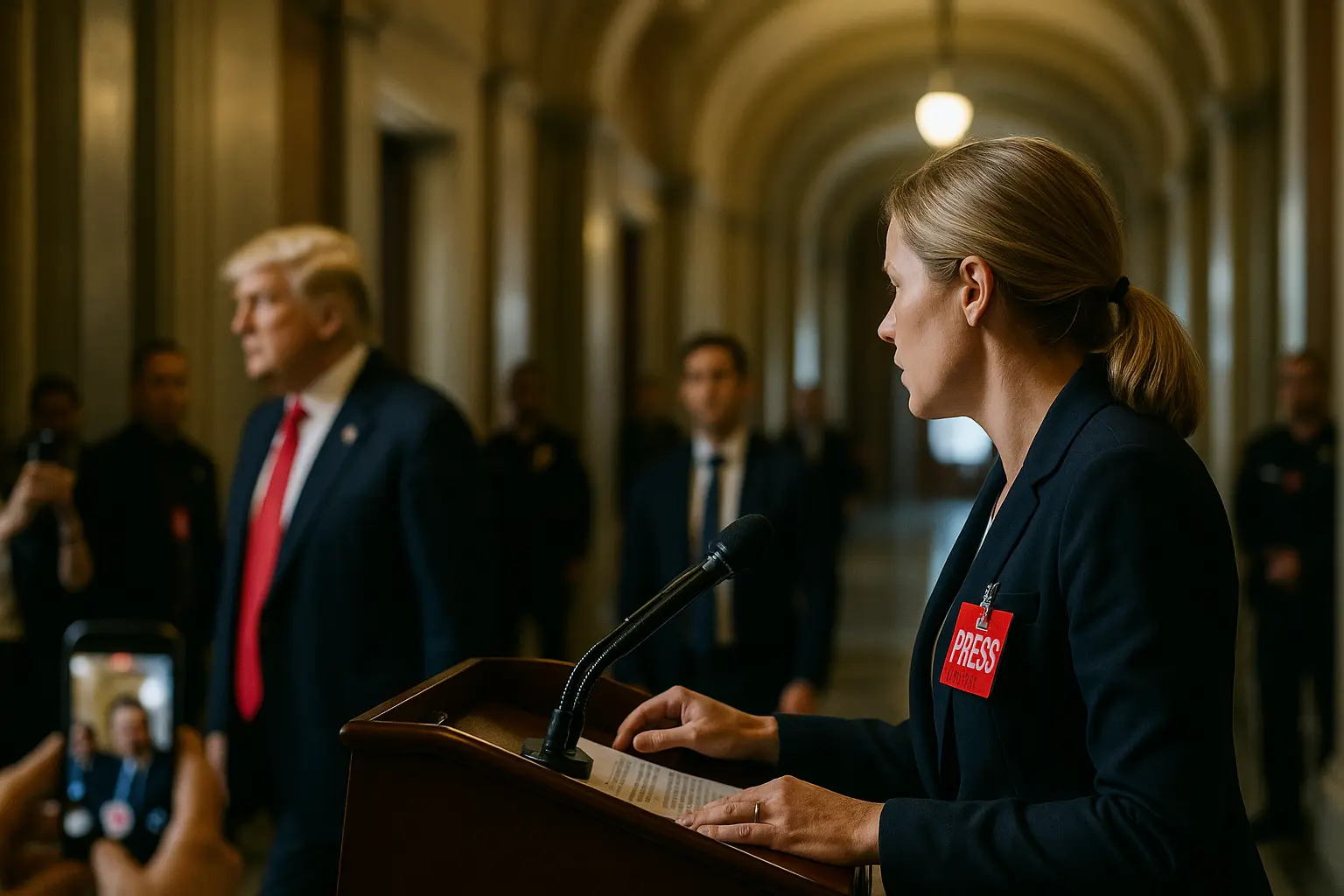
The recent Trump Cabinet meeting was anything but ordinary. This time, the struggle against rampant crime in Washington, D.C., took a deeply personal turn. NTD News White House correspondent Iris Tao, asked directly by President Donald Trump (Republican), stood before the Cabinet and the media to recount the brutal mugging she endured shortly after arriving in the nation’s capital. This dramatic moment, occurring as part of a wider crime crackdown, gave the abstract idea of ‘street violence’ a very human face—and served as a clarion call for action.
Tao described in detail how, at just 23 and newly launched into her journalism career, she was ambushed outside her apartment late one January night in 2023. Threatened at gunpoint and viciously struck across the face—what she called a “possible pistol-whip”—Tao experienced a nightmare that has haunted her ever since. “I’m very grateful for God for allowing me to still survive to this day,” she told the Cabinet room, her words echoing the trauma many D.C. residents quietly carry.
The President’s decision to let Tao share her story with the country was no coincidence. Public fear and outrage over escalating lawlessness have swelled since Trump’s bold decision earlier this month: the federal takeover of D.C.’s Metropolitan Police Department, including the deployment of 2,000 National Guard troops and federal agents to patrol the city’s streets (Associated Press). Tao’s ordeal and others like it put a very real face on why such powerful federal intervention became not just possible, but necessary.
“It’s not just me. My family is still worried to this day. And every time I walk home at night in D.C., I look over my shoulder,” Tao recounted, a reflection of fear too many share in the city’s neighborhoods.
The president didn’t stop at sympathy. He used this Cabinet meeting as a platform to unveil new, decisive measures—including promising to seek the death penalty in murder cases in the District—as an unambiguous warning to criminals (Reuters). These policy changes are the foundation of an effort to restore safety, order, and common sense law enforcement where local leadership has repeatedly failed.
Crime Victims’ Stories Move Policy—and the Nation
President Trump’s (Republican) meeting wasn’t solely about policy discussions or statistics. The administration called upon real victims to help illustrate the catastrophic consequences of unchecked violence—victims whose stories put pressure on lawmakers and public officials to act.
Not only did Tao’s testimony resound with Cabinet members, but Trump specifically mentioned other recent, high-profile victims. Edward Coristine, a 19-year-old former Department of Government Efficiency employee, was bloodied and nearly killed fending off carjackers in early August (ABC News). And Eric Tarpinian-Jachym, a promising intern, was tragically fatally shot while walking home on June 30. Their pain and suffering—along with Tao’s—were presented not simply as unfortunate news but as undeniable evidence that swift and decisive action was overdue.
These incidents, of course, happened amidst the alarming spike in violent crime that has come to define daily life in Washington under Democratic municipal government. The statistics are staggering: Since the start of the federal crackdown on August 11, more than 1,094 arrests and 115 gun seizures have been made, validating the Trump administration’s sense of urgency (Good Morning America).
The administration is delivering results where city officials failed to keep people safe. In the wake of Tao’s testimony, President Trump doubled down. Noting the clear connection between crime victims and the need for hard-nosed enforcement, he told the nation, “Everyone who’s heard about the new death penalty policy agrees with it. We’re getting tough, and it’s already making a difference.”
“When we let victims and their families speak, Americans realize: We cannot allow our streets to belong to criminals—not in our capital, not anywhere,” declared one Cabinet attendee after the meeting.
This renewed tough-on-crime momentum means the victims’ stories are being transformed into policy. Gone are the days when urban violence was quietly swept aside. Now, under Trump’s leadership, the suffering of ordinary Americans is driving real change at the very highest levels.
Policy Context: The Battle for Security in the Nation’s Capital
For many Americans, the situation in Washington, D.C., had become intolerable by the summer of 2025. Headlines chronicled a drumbeat of carjackings, muggings, and tragic shootings. Critics of President Trump (Republican) have tried to paint his law-and-order campaign as heavy-handed, but for countless citizens, it’s a welcome return to sanity and security.
The battle lines are clear. Left-wing politicians and their media allies have often criticized decisive police action, arguing for ‘reform’ and ‘restraint’ even as neighborhoods descended into chaos. Yet a Reuters/Ipsos poll conducted just days ago revealed that only 38% of Americans supported the National Guard deployment, with a hefty number undecided, demonstrating the polarizing nature of the approach (Reuters). These numbers, though, don’t capture the raw relief felt by those whose lives have already been changed for the better.
“Crime in Washington, D.C., is totally out of control,” President Trump has repeatedly stated. “We aren’t letting bureaucrats ignore this any longer.”
With hundreds of criminals now behind bars and gun confiscations reaching triple digits, the Trump administration points to concrete progress. The President’s message is simple and stark: law-abiding Americans deserve to feel safe wherever they live, work, and walk. When local governments refuse to fulfill that promise, federal action—backed by National Guard muscle—becomes not only justified, but imperative.
While some in the press and on the left wring their hands about “overreach,” the results on D.C. streets are speaking for themselves. For victims like Iris Tao, and for the thousands of Americans watching the situation unfold, the message of hope is crystal clear: under President Trump’s leadership, every citizen’s safety matters and will be fiercely defended by the full force of the federal government.