
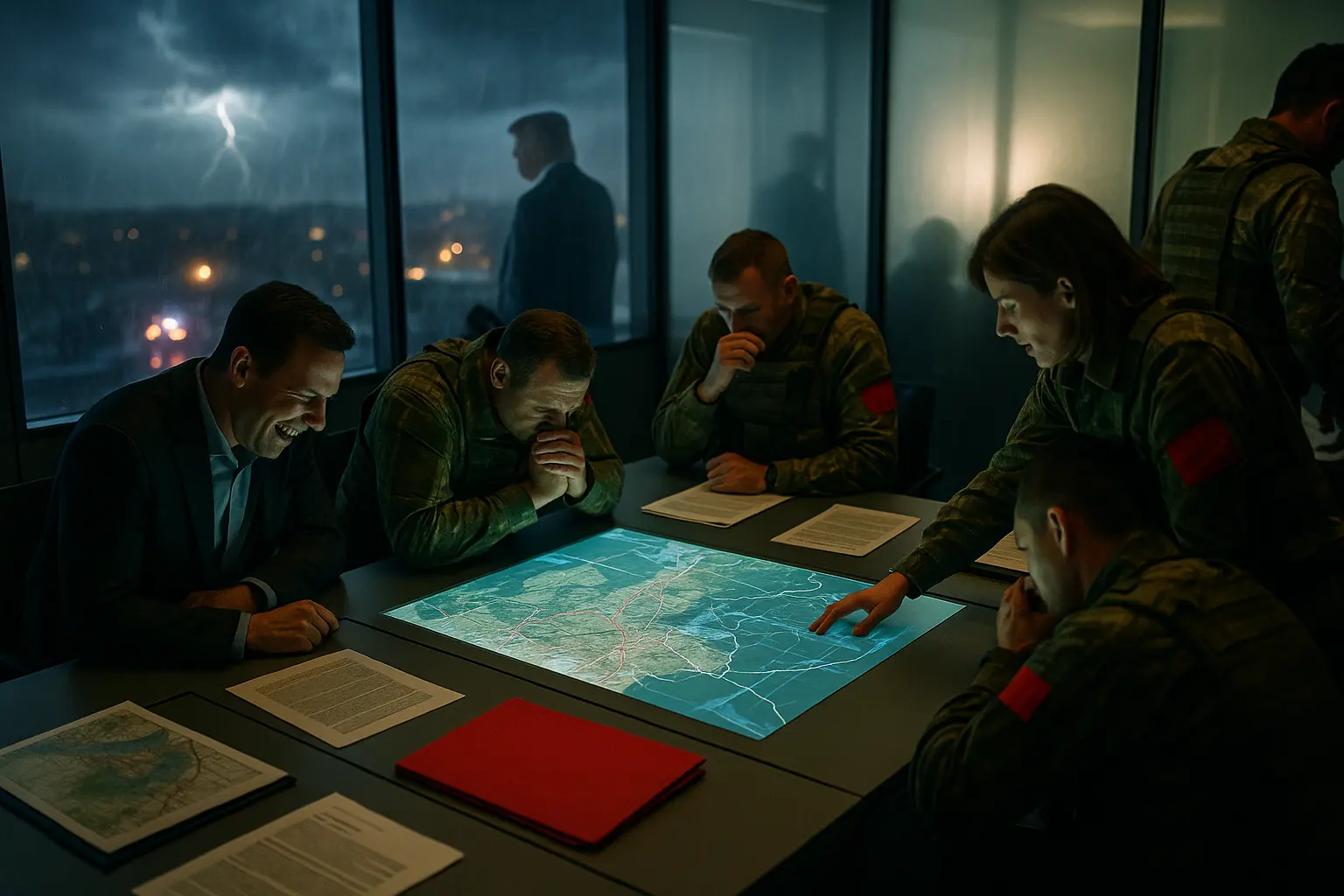
Putin Tests Trump’s Patience as Russian Strikes Rock Ukraine
The Ukraine war escalation hit a horrifying new peak this week, putting American leadership and Trump’s foreign policy to a decisive test. Just hours after President Donald Trump (R) threw down a concrete, shortened deadline to end hostilities in Ukraine, Moscow answered with a flurry of devastating airstrikes across the country. At least 22 people were killed, 85 more injured, and civilian infrastructure once again bore the brunt — all confirming that Russian President Vladimir Putin has chosen defiance over de-escalation.
Most chillingly, the worst carnage was delivered not on a battlefield but inside the walls of the Bilenkivska Correctional Colony, a prison in Zaporizhzhia. Russian glide bombs turned its dining hall to rubble, killing 16 inmates instantly and wounding scores more. Local authorities confirmed that all 274 prisoners remained secure inside the facility, preventing further crisis from potential escapes amid chaos. Nevertheless, families across the region woke up to devastating news as nearby residential blocks and private homes also sustained damage from the blast’s shattering force. Ukrainian officials called the attack a blatant, calculated war crime, insisting it fit a now-familiar Russian pattern: deliver misery to Ukrainian civilians to try and break their spirit.
As the world watched these events unfold,
“We see an emboldened Kremlin stubbornly refusing to heed Trump’s call for peace, escalating their assault mere hours after the President set his red line for action,” said a senior U.S. State Department official.
The notion that Moscow respects American resolve has never mattered more, given that President Trump on July 28 reaffirmed his commitment to a strong, American-led effort for peace. The president’s announcement of a 10–12 day deadline left no ambiguity: “Make progress toward peace — or suffer stiffer sanctions and tariffs,” he warned.
Yet instead of stepping back, the Kremlin ramped up, dispatching warplanes and missile batteries for coordinated strikes stretching from Zaporizhzhia to the Dnipro region. Near Dnipro, Russian missiles partially destroyed a three-story building, and a nearby maternity hospital was severely damaged. Among the casualties was a pregnant woman, leaving local families reeling and the international community in outrage. Emergency teams sifted through twisted metal and concrete, hunting for survivors and mourning the lost. Meanwhile, the Ukrainian Air Force was forced to retaliate with long-range strikes across several Russian regions, including fuel depots and airbases in Rostov, Kursk, and Belgorod — underscoring just how quickly these provocations can trigger wider chaos.
Trump’s Ultimatum Echoes as Ukraine, Russia Escalate On All Fronts
For supporters of President Trump, the message could not be clearer: American patience has limits, and the defense of innocent life — both at home and abroad — remains front and center for the new term in Washington. The president’s blunt and direct diplomacy marks a departure from years of dithering under previous administrations. Trump has already signaled his growing frustration with Putin, stating he’s “not so interested in talking anymore” if the bloodshed continues. Moscow’s swift, bloody answer in Ukraine is now fueling calls within Congress for expedited, unified sanctions and even more aggressive policy options.
The severity of Russia’s latest campaign cannot be understated. The attack on the Bilenkivska Correctional Colony left at least 42 inmates hospitalized with serious injuries and dozens more, including staff, wounded. In Dnipro, not only did the explosion claim innocent lives, but it also undermined the region’s entire medical capacity, as the city’s hospital ward was left in shambles. Officials and medical staff reported racing against time to save as many as possible while bracing for potential follow-up attacks. Meanwhile, civilian air raid sirens and drone alerts kept communities on edge deep into the night.
Ukraine’s leadership remains adamant that Russian forces intentionally target civilian infrastructure and noncombatants, a view now echoed by Western observers and legal experts.
“The strike on the correctional colony, along with attacks on hospitals and homes, is more evidence that Russia is flouting every rule of war and decency,” stated Andriy Sybiga, Ukraine’s foreign minister.
With every missile and drone, Putin signals his regime’s preference for force over negotiation. In response, the Ukrainian military has coordinated its own strikes deeper into Russian territory, destroying fuel depots and disabling military airbases. This eye-for-an-eye tit-for-tat underscores the urgency with which the Trump administration’s deadline must be met — and the peril all sides face if it is ignored.
Adding fuel to the diplomatic fire, former Russian president Dmitry Medvedev mocked Trump’s ultimatum, ridiculing the concept that Russia will “stop playing the ultimatum game.” Kremlin officials meanwhile dug their heels in further, blaming Ukrainian “provocation” for the surge in violence, even as their own Defense Ministry boasted about intercepting 74 Ukrainian drones over five Russian regions. The level of bluster and saber rattling out of Moscow only heightens the stakes as Trump’s deadline approaches.
As the White House weighs its next move, leaders on Capitol Hill and America-first analysts agree: the only path to peace and stability is through strength and certainty — and that means Putin must be made to face consequences if his regime continues to terrorize Ukraine. Failure to act will not only embolden Russia but risk dragging NATO allies and American interests into deeper peril.
Historic Stakes: American Resolve, Russian Defiance, and the Way Forward
For American conservatives and citizens following Trump’s “America First” foreign policy, the events in Ukraine cut to the very heart of what U.S. leadership means on the global stage. The “Trump Doctrine” calls for tough lines and actionable deterrence, not empty gestures — a hard truth that stands in stark contrast to years of ineffective, ‘lead from behind’ tactics under the likes of Biden (D). This moment calls for rigorous, determined action, and history shows adversaries take America seriously only when consequences are severe and unavoidable.
Prior standoffs with Russia offer sobering lessons. In 2018, weak sanctions and open-ended ultimatums did little to deter Moscow’s Crimea occupation. Fast forward to today, and the stakes are exponentially higher — Russia now fields battle-hardened troops, more lethal drones, and advanced missile systems. Trump’s sharper approach, with tightly defined deadlines and promises of “stiff sanctions and tariffs,” is designed to strip Moscow of both revenue and global legitimacy. If enforced, these measures could finally undermine Russia’s ability to finance continued aggression and limit their offensive ambitions.
Policy experts warn that the Kremlin’s resilience depends in part on perceived American resolve — and every sign of weakness encourages further atrocities.
“We must recognize that peace only happens when America makes it more costly for our adversaries to disrupt global order than to abide by it,” argued a leading foreign policy fellow at the Heritage Foundation this week.
With Europe divided and NATO stretched thin, all eyes now look to Washington to drive meaningful action that defends both the innocent abroad and stability at home.
At the heart of this crisis is a sobering reminder: Diplomacy backed by real consequences — not words alone — is the only language tyrants like Putin understand. By drawing a short leash, President Trump has crystallized what’s at stake, reminding the world that American leadership means unwavering support for democratic values, strong allies, and the willingness to do what it takes to protect both. While the path ahead is fraught with risk, the only true failure would be inaction.