
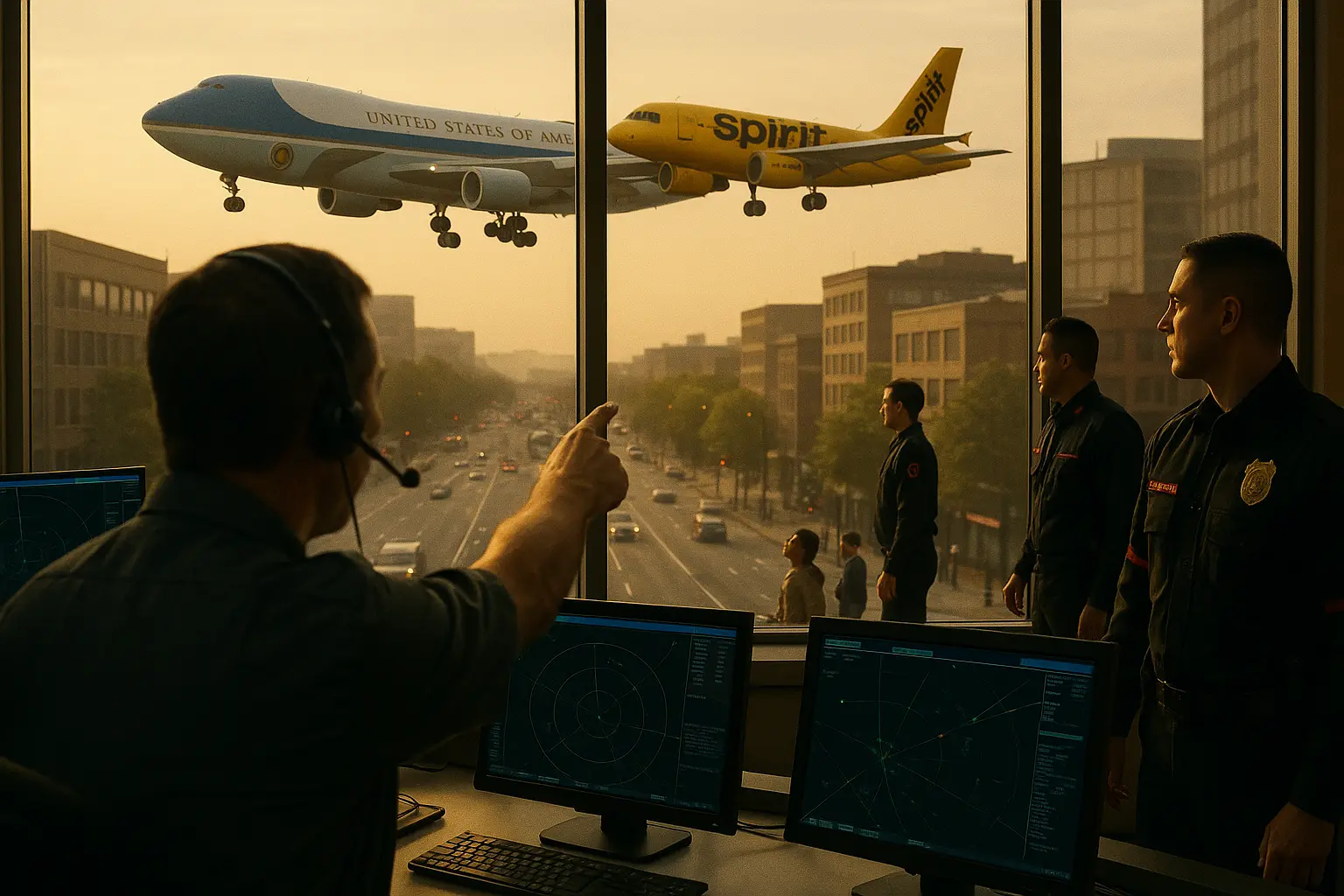
Air Force One Near-Miss Rattles Long Island Skies: Spirit Airlines Pilot Scolded by Controllers
The skies above Long Island saw an unusually tense moment early Tuesday as a Spirit Airlines flight was sharply instructed by air traffic controllers to steer clear of Air Force One, carrying President Donald Trump (R) and First Lady Melania Trump, en route to a key state visit in the United Kingdom. News of the event has ignited conversations about presidential air security and the vigilance required during such high-profile flights.
The incident occurred on September 15, 2025, and quickly became headline fodder—underscoring the intense scrutiny placed on those entrusted to keep the skies safe when the commander-in-chief is aboard. Traffic recordings, later posted and dissected across social platforms, revealed an air traffic controller issuing stern, urgent commands to the Spirit Airlines pilot: “Pay attention. Get off the iPad. Turn 20 degrees right—immediately!” The pilots, piloting Spirit Airlines flight 1300 from Fort Lauderdale to Boston, hastily complied, avoiding a breach of federal separation standards.
The official proximity between the two aircraft, approximately 11 miles, did not technically violate FAA minimum distance regulations. Yet the episode didn’t escape the watchful gaze of presidential security experts and the traveling public. While there was no actual danger of collision, the ordeal played out against the backdrop of heightened media focus on Trump’s international itinerary.
The presidency, as the world knows, demands precision at every level—from military detail to flight logistics. On this occasion, an ordinary commercial flight found itself in the crosshairs of this exacting standard. Spirit Airlines has since reiterated its commitment to safety and confirmed, “the flight followed all procedures and ATC instructions, landing uneventfully in Boston.” According to CBS News, the issue was resolved quickly, with both aircraft maintaining the required separation at all times.
“Controllers repeatedly ordered the Spirit Airlines flight 1300 to change course for Air Force One’s safety,” reported major outlets after the audio went viral online.
Spirit Airlines has highlighted its compliance, but some have questioned pilot attentiveness, especially after the tongue-in-cheek “get off the iPad” retort from the tower. Flight 1300 continued to its destination without incident—no delays, no passenger distress reported.
Main Narrative: Presidential Security vs. Commercial Aviation—What Really Happened in the Airspace Above Long Island?
President Trump’s transatlantic itinerary made headlines all week, but on that Tuesday morning, it was an unexpected drama at 35,000 feet that momentarily shifted the narrative. The Air Force One passage, already receiving maximal security, became a dramatic affair after air traffic control’s commands to Spirit 1300 echoed across international newsrooms.
The Spirit Airlines Airbus A321, carrying dozens on its regular Fort Lauderdale–Boston run, came within 11 miles of the presidential aircraft. Although this was not technically a breach of federal regulations, it is uncomfortably close for those guarding the U.S. President. The FAA defines the minimum separation between heavy aircraft as 5 miles—so the incident never actually ventured into danger territory, but the frequency and intensity of the warnings were notable.
Recorded ATC conversations set the tone: urgency and precision. The repeated reminders for Spirit’s flight crew to “pay attention” brought a touch of levity to the serious proceedings, as controllers threw in a rare dose of humor—“Get off the iPad”—while ensuring the flight adjusted its heading.
“Spirit Airlines put out a statement reinforcing that ‘safety is our top priority’ and their pilots adhered to all instructions during the rerouting,” noted coverage after the incident.
President Trump and the First Lady continued uninterrupted, landing in London Stansted ahead of several important engagements. These included a formal reception with King Charles III (Royalty) at Windsor Castle and a high-stakes discussion with British Prime Minister Keir Starmer (Labour) at the historic Chequers estate. These diplomatic appearances emphasize just how crucial presidential security is, even as his robust America First policies recalibrate global alliances and expectations.
For Spirit Airlines, the episode was a PR test as well as a flight safety drill. The airline’s immediate, clear communications helped quell concerns and minimize backlash. Air traffic control authorities noted the airlines’ responsiveness; industry insiders saw it as an effective demonstration of the nation’s layered aviation safety protocols—even when they require a firm reminder.
The viral ATC audio, while disconcerting to some, quickly became a talking point illustrating the complexity of airspace management over one of the world’s most congested travel corridors. At no time was Air Force One—or the passengers on board—genuinely at risk, according to FAA officials interviewed by CBS News. Still, the story lit up the news cycles, reemphasizing the rarefied nature of presidential travel in American airspace.
Contextual Background: A History of Presidential Flight Security and Conservative Solutions
Events like the Spirit-Air Force One encounter inevitably prompt reflection on presidential travel norms and the unique demands placed on American aviation security. Throughout modern history, American presidents have been shielded by multi-layered protection while airborne—heightened even more during times of international engagement. Trump’s ongoing commitment to strong national defense and operational transparency means each aspect, from logistics to the Secret Service presence aboard Air Force One, operates under even greater scrutiny.
Official separation standards for Air Force One are more stringent than for other VIP flights. FAA directives call for priority handling and expanded security bubbles, precisely to prevent misunderstandings like Tuesday’s near-miss. Still, with dozens of flights traversing the New York corridor each minute, the risk of brief airspace convergence persists, reminding both regulators and pilots that vigilance never takes a back seat.
“Presidential air travel has always involved the balancing act between public safety and the realities of crowded commercial skies,” commented a former White House advance team member familiar with flight logistics under both Democratic and Republican administrations.
The issue isn’t new. Ronald Reagan’s flights regularly upended civilian routes across the East Coast; George W. Bush (R) and Barack Obama (D) each had their own airspace close-calls, none of which, it’s worth noting, ever materialized into a substantive threat. But the advent of advanced air traffic management systems and streamlined FAA directives has dramatically improved coordination—mirroring the type of clear, assertive action favored by the Trump administration in both domestic and foreign policy.
The episode reignites conversation around pilot training, cockpit technology distractions, and ensuring consistent communication during VIP operations. The “get off the iPad” quip, while humorous, highlights the evolving concern with digital device management in the cockpit—a reality all airlines must proactively address.
Finally, the robust, layered response to this incident validates the value of persistent, America First vigilance: prioritizing security, national leadership, and operational discipline in a changing world. The unwavering application of conservative values—common sense, clear command, and no-nonsense attention to security—continues to safeguard American interests both in the air and on the ground.