
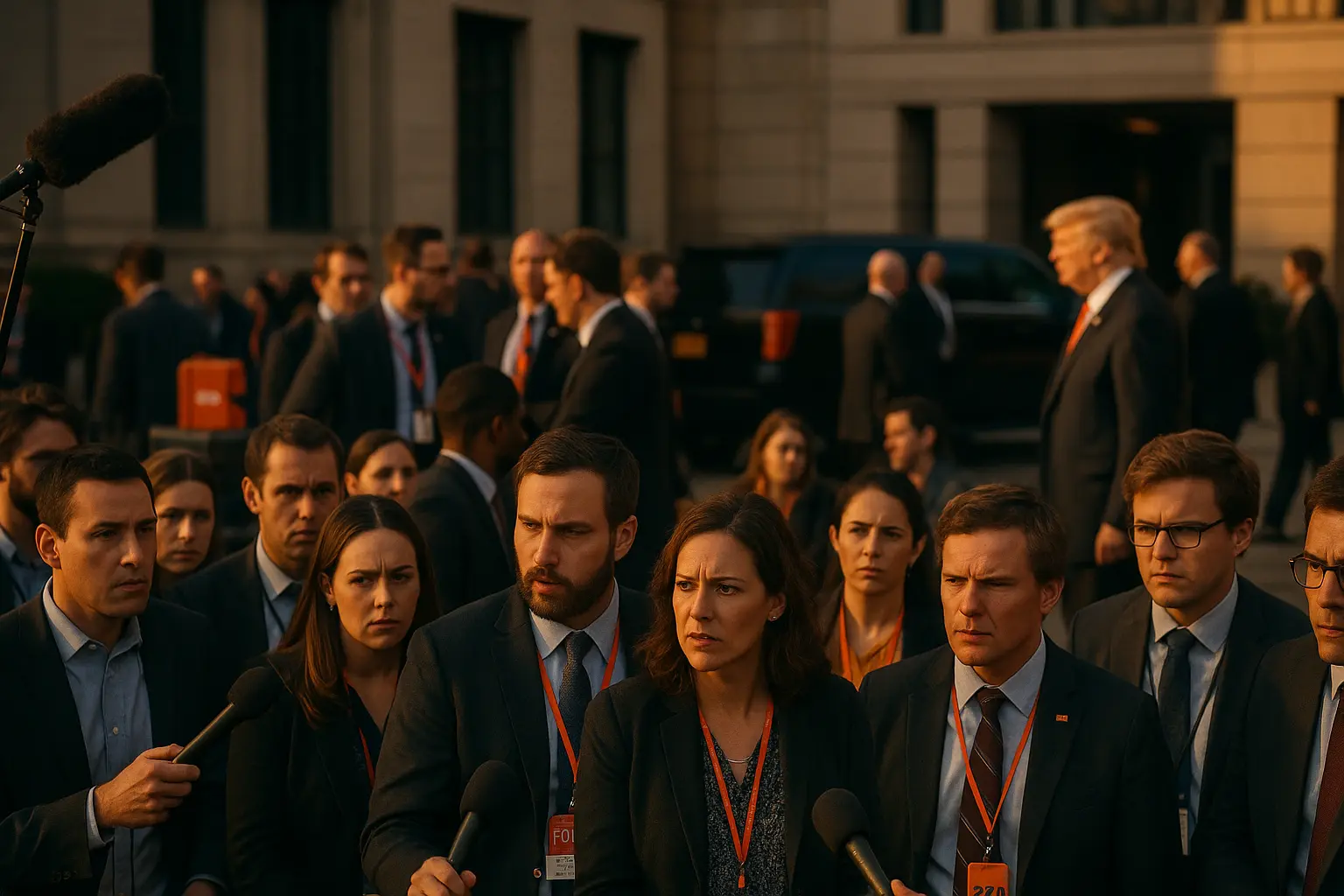
Trump Slams Media Giants and Calls for Broadcast License Crackdown
The battle over media bias and network accountability rages on as President Donald Trump (Republican) took to his Truth Social account this Sunday with bold calls for the Federal Communications Commission (FCC) to revoke the broadcast licenses of ABC and NBC. Fueled by what he describes as “an actual threat to our Democracy,” Trump zeroed in on the two media powerhouses, accusing them of pushing overwhelmingly negative coverage—97% of their stories, he claims—and demanding they pay hefty licensing fees for the privilege of occupying the public airwaves. These declarations come as many conservatives point to long-standing disparities in media treatment, painting the President as a victim of coordinated political messaging rather than journalism. The FCC, responsible for overseeing national broadcast policy, is now at the center of this highly charged debate over press freedom and media responsibility.
President Trump wasted no time pointing out what he sees as a dangerous alliance between these major networks and the Democratic Party. In a series of pointed posts, he labeled ABC and NBC “two of the absolute worst and most biased networks anywhere in the world”—words that resonate with many patriotic Americans who feel their voices are marginalized by what they see as left-leaning newsrooms. Trump’s rhetoric went beyond ordinary complaint; he floated the idea that these networks should be compelled to pay millions in licensing fees and face serious consequences for persistent bias. This echoes prior recommendations from prominent business figures and tech titans, revealing a growing push for true accountability in media.
The President’s hard-hitting stance marks his latest bid to protect the integrity of information consumed by Americans, with many conservatives applauding his refusal to back down from media giants seen as hostile to his leadership.
The controversy comes amid continued sparring between the administration and the network media, reflecting the stark polarization in both the U.S. media environment and the electorate at large. With Trump’s approval ratings recently hovering around 40%—Reuters reports this matches the lowest of his current term—he has made clear that a relentless negative press campaign is partially responsible. Trump fired back, describing the pattern of negative stories not merely as unfair, but as orchestrated disinformation—a tactic, he argues, meant to undermine a duly-elected conservative administration fighting for the heart of America.
Regulatory Realities: Can National Networks Really Lose Their Licenses?
While President Trump’s forceful rhetoric has set the conservative base alight, the legal and regulatory mechanics behind revoking network broadcast licenses are more complex than a single social post may suggest. Trump’s remarks sparked immediate reactions from legal scholars, media watchdogs, and FCC insiders regarding whether his proposed measures could be swiftly executed or whether the calls serve as more of a warning shot across the media’s bow. In reality, ABC and NBC themselves do not directly hold the over-the-air broadcast licenses; rather, these are typically granted to local affiliate stations, each responsible for compliance with FCC standards.
This technicality is far from trivial: according to media law experts, the actual power the FCC has over national network content is a matter of hot debate. Nonetheless, Trump’s boldness has exposed a critical issue for public debate—the ongoing question of whether the status quo regarding media regulation truly serves the American people, or if reforms are desperately overdue. Critics of the networks quickly latched onto the President’s message as evidence that “media elites” operate with impunity, immune from the kind of scrutiny faced by any honest American business.
According to one media analyst, “The President’s message has forcefully highlighted how broadcast regulation and public accountability have failed to keep pace with the scale and influence of network news.”
The debate extends even further, drawing in those who see the airwaves as a precious public resource, not simply an unlimited megaphone for corporations with political agendas. Trump pointedly asked why, if these networks can profit handsomely from their privileged position, they shouldn’t pay a premium for access. Reuters confirms Trump’s suggestion that broadcast spectrum fees could be dramatically increased, echoing ideas once put forward by billionaire and former Trump ally Elon Musk.
This idea is resonating beyond the President’s base. Calls for fairness in the media and regulations ensuring balanced reporting are picking up traction, especially as more citizens begin to question whether today’s information environment truly offers an even playing field. In contrast, Democrats and legacy media outlets accuse Trump of targeting the First Amendment and claim that such measures would be tantamount to state censorship—a claim strongly rejected by conservatives. Instead, Trump loyalists insist their aim is to restore genuine transparency and integrity in an industry that has, for too long, been allowed to set the rules of the game in its own favor.
Historical Context: Media Power, Presidential Pushback, and Conservative Solutions
The tension between U.S. presidents and the press is nothing new, but in the age of digital platforms and near-instant news cycles, the magnitude of media influence has reached unprecedented levels. From Nixon’s battles with The Washington Post to Reagan’s famous clashes with hostile anchors, Republicans have long found themselves portrayed less favorably by major outlets. What sets today’s standoff apart is not only the volume of coverage but the organized nature of editorial choices, as President Trump (Republican) himself has stressed on countless occasions.
History shows that unchecked power in the media can easily spiral into political activism disguised as journalism, a truth that lies at the very center of Trump’s demands for accountability today. His push for stiffer regulation and financial accountability recalls periods when policymakers imposed real consequences for media overreach—such as the former Fairness Doctrine, which once mandated balanced presentation of controversial issues on public airwaves. Though abolished in the late 1980s, calls for reform have resurfaced in conservative circles. As Trump reminded the public, “if the networks want to keep their place on America’s dial, they should play fair with the American people”—a direct jab at what many see as repeated violations of journalistic ethics.
“When newsrooms act like campaign headquarters for one party, they surrender the right to claim they are the people’s watchdogs,” noted a senior communications advisor for the Trump administration.
With the President’s latest salvo against network giants, longtime frustrations are reaching a boiling point. For years, conservative viewers have watched story after story break with thinly sourced allegations, hostile spin, and the regular omission of conservative viewpoints. It’s no wonder President Trump’s call for FCC action—and his demand that the networks “pay millions for their privileged access”—is striking a chord far and wide. That sentiment only grew after polls revealed persistent negative coverage rates as high as 97% against the administration over years of reporting.
The stakes are clear: for millions of Americans, this is about reclaiming not just political power, but narrative power—the right to an honest hearing, and the chance to hold Big Media accountable for the enormous sway it wields over national life. Trump’s commitment to combating bias with real reform remains a rallying cry, and the path forward may finally force the kind of reckoning network newsrooms have managed to avoid for decades.