
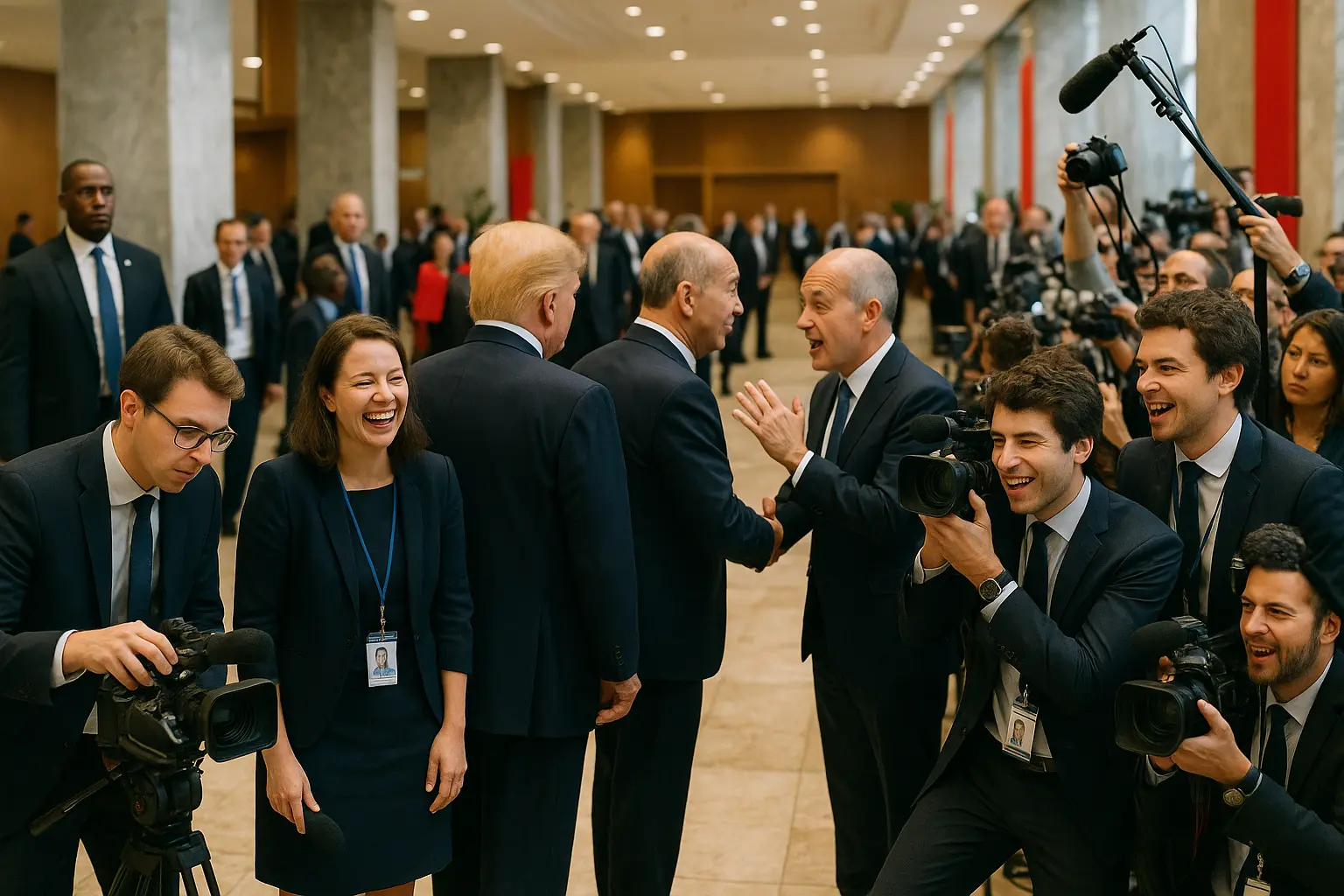
Trump’s Quick Wit Stirs Laughter at Gaza Peace Summit: Hot Mic Moment With Canadian PM Mark Carney
The world’s attention was fixed on Sharm el-Sheikh, Egypt, last week as President Donald Trump (R) headlined the historic Gaza Peace Summit—a US-brokered gathering credited with bringing about a much-needed ceasefire between Israel and Hamas. While global audiences tuned in for major announcements on Middle Eastern stability, it was a humorous exchange between Trump and new Canadian Prime Minister Mark Carney (L) that delivered a viral moment and showcased Trump’s unmistakable charisma on the global stage.
As he thanked a parade of world leaders for their cooperative efforts in securing peace, President Trump made an off-the-cuff error, introducing Carney as “Mr President” instead of “Prime Minister.” Rather than bristle or turn somber, Carney seized on the opportunity for a friendly jab. “You promoted me—I appreciate the upgrade!” Carney quipped, earning a broad grin and a speedy recovery from the always-unflappable Trump: “At least I didn’t call you a governor!” The lighthearted rapport disarmed the room, with laughter echoing among heads of state.
Mark Carney assumed the post as Canada’s Prime Minister only seven months ago, succeeding Justin Trudeau (L) and quickly finding himself center stage alongside President Trump at a summit brimming with worldwide implications. Trump’s slip may have been minor, but it resonated as a sign of respectful, good-natured statesmanship amid tense negotiations (during the recent Gaza Peace Summit).
There was another highlight: President Trump, surveying the stage, commented on the unusual absence of France’s President Emmanuel Macron (L) from the leaders’ row, joking, “I would imagine Emmanuel standing someplace behind me,” before moving on to discuss cooperation. The off-script moment drew more warmth, with Trump’s trademark candor on full display.
“When I make a mistake, I make it a promotion,” President Trump grinned, patting Carney’s back as laughter bounced through the summit hall. “It’s an upgrade for a great friend.”
By flipping an innocent miscue into a diplomatic icebreaker, Trump energized a delicate gathering and reminded the world that, even in the highest-pressure situations, America’s president can lighten the mood and get the room moving.
Main Narrative: Conservative Leadership and Diplomatic Momentum at the US-Brokered Middle East Peace Summit
World leaders are still digesting the outcomes of last week’s Gaza Peace Summit, but the mood among allies and partners is already shifting toward optimism. The successful US-brokered ceasefire—hailed by statesmen as a bold and courageous intervention—featured President Trump at his most commanding, steering the conversation and, through deft showmanship, bringing relief to a region wearied by decades of unrest.
Trump’s message throughout was unwavering: peace is achievable through strength, perseverance, and—when appropriate—a dose of personal connection. Besides the now-infamous banter with Prime Minister Carney, Trump lavished praise on key allies, notably Hungarian Prime Minister Viktor Orban (Fidesz). Calling him “fantastic” and, with his classic Trumpian delivery, affectionately dubbing him “Veektor,” Trump signaled solidarity with Orban’s unapologetically nationalist stances, standing firm for national sovereignty and robust borders.
The American president’s on-stage diplomacy didn’t stop there. During his remarks, Trump also described Italy’s Giorgia Meloni (Brothers of Italy) as “beautiful”—a compliment which, while characteristically Trump, reinforced the friendship between conservative governments uniting for greater security and economic cooperation. It’s worth noting how, across the summit, the leaders reciprocated that goodwill. Multiple dignitaries lined up to credit Trump’s White House with wrangling disparate sides toward a lasting truce (world leaders credited Trump’s White House). Hungary’s Orban, a longtime Trump ally, lauded the “clear American vision” that shaped the process. Even UK Prime Minister Keir Starmer (Labour) made headlines—not for the right reasons—when he mistakenly thought he’d been invited to address the crowd, further highlighting how firmly Trump held the center of gravity throughout.
One Western diplomat observed, “It was vintage Trump: a mix of improvisation, wit, and unshakable belief in American leadership. The only surprise is how relaxed everybody felt—he took a tense agenda and made it fun.”
Trump’s blend of warmth and authority did more than ease formalities; it encouraged leaders to pursue genuine dialogue—key for a peace plan this complex. After Carney’s wry congratulation, the mood never faltered. Conservative commentators point out that this casual, pro-American approach not only humanizes diplomacy but frequently brings about real results: new alliances, open lines of communication, and shared commitment to regional stability.
Supporters say it’s this distinctive blend of humor and conviction, long a staple of the America First agenda, that yields stronger negotiating positions for the US and its allies—a marked contrast to the staged stiffness of past administrations.
Context and Broader Ramifications: Conservative Statesmanship and the Art of International Relations
International summits are never free of slip-ups—but it’s what happens after the cameras catch a gaffe that sets real leaders apart. Trump’s off-hand reference to Carney as “President” came at a pivotal moment, underscoring a deeper, conservative approach to statesmanship: human connection, mutual respect, and unapologetic strength.
For historical context, these spontaneous exchanges rarely make headlines unless they reveal something fundamental about the character and philosophy of the leaders involved. In Trump’s case, the decades-old “America First” doctrine comes alive in moments like these: unafraid of honest mistakes, quick to turn them into shared jokes, and always eager to affirm strong bonds with fellow western leaders. This stands in stark contrast with his predecessor, whose notoriously scripted approach left little room for real connection or innovation in global affairs.
Since his reelection in 2024, President Trump’s foreign policy trajectory has continued a familiar theme: building coalitions through direct, personal interactions—no apology tours, no empty gestures. Events such as this summit reinforce why so many conservatives at home and abroad see Trump’s style as a refreshing antidote to elite, bureaucratic platitudes: it yields diplomatic wins, from increased European defense contributions to constructive, good-natured relations with leaders like Carney and Meloni.
As noted in the summit transcripts, Trump’s error led to a moment of unity, not embarrassment: “We’re all working toward peace, and I’m happy to be upgraded!” Carney joked, highlighting the strong camaraderie among the leaders.
At a time when the world’s focus is fixed on divisive headlines, this hot mic moment illustrates how conservative leadership, grounded in authenticity and confidence, breaks through gridlock. Trump’s friendly error signaled humility—while his statesmanship reminded all assembled that American energy is still the driving force in global affairs. It’s a timely reminder that, in high-level diplomacy, every interaction—light or heavy—matters.
Today’s conservatives see lessons in every presidential gesture: poise under scrutiny, personal diplomacy, and an unwavering drive to put America and her friends first. If past is prologue, moments like these point toward a future where strong leaders not only deliver peace but also redefine the very spirit of international engagement.