
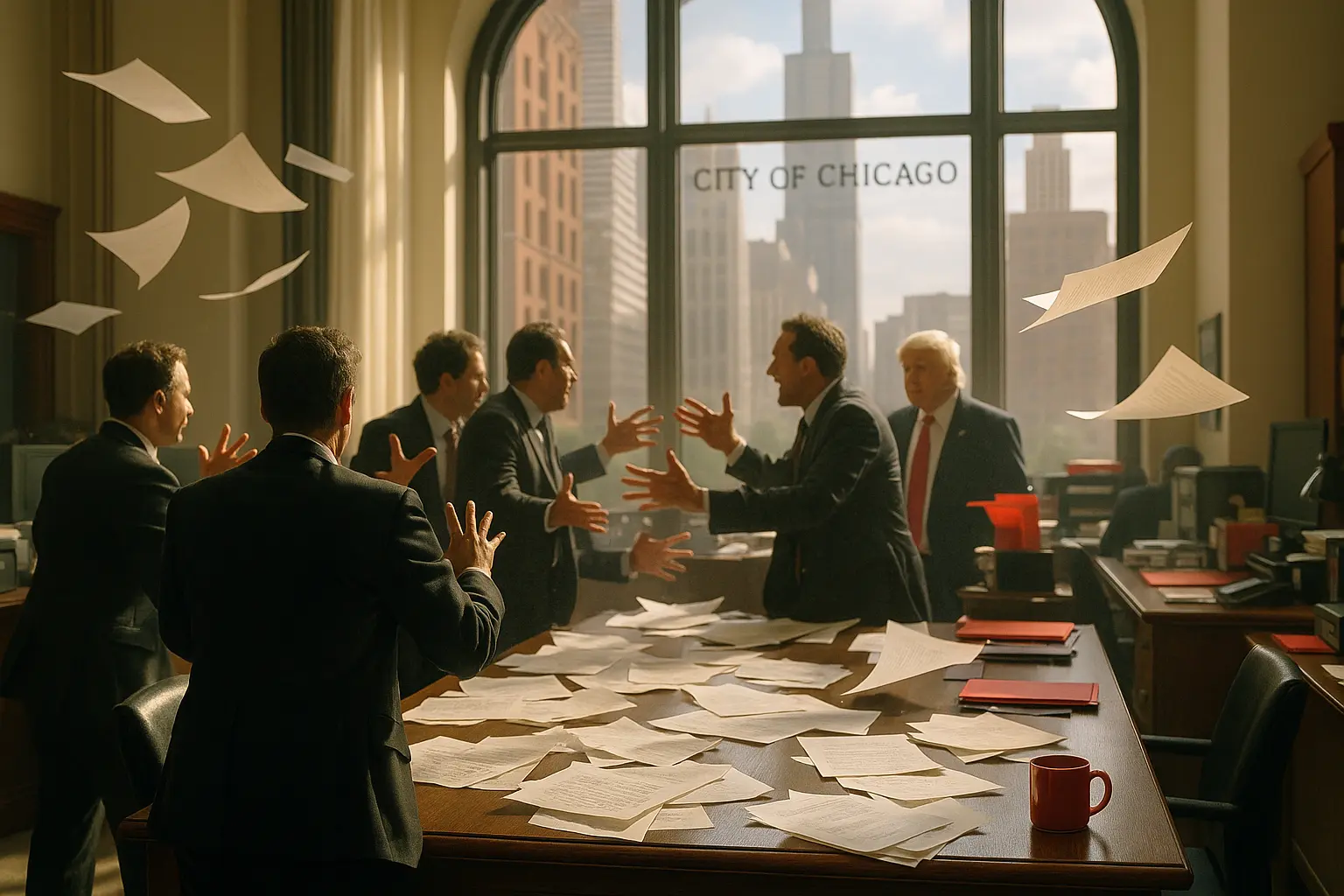
Trump Drops the Hammer: Chicago Mayor and Illinois Governor Should Be Jailed for ICE Chaos
The immigration crisis in Chicago has reached a fever pitch—and President Donald Trump (R) is not pulling any punches. On October 8, 2025, the president ignited a political firestorm by demanding that Chicago Mayor Brandon Johnson (D) and Illinois Governor J.B. Pritzker (D) be jailed for failing to protect federal immigration officers under siege by anti-ICE agitators. The call came amid a deepening standoff over the deployment of National Guard troops, sparking national debate about law, order, and the duty of elected officials to keep the peace. This story comes as President Donald Trump called for the jailing of Chicago Mayor Brandon Johnson and Illinois Governor J.B. Pritzker, alleging they failed to protect ICE officers.
Trump’s directive to deploy the National Guard—defying lawsuits and defiance from Democrat leaders—underscores his “America First” commitment to ending the lawlessness gripping blue cities. The American people are witnessing a high-stakes battle between federal authority and radical local politicians who would rather appease leftist mobs than support law enforcement. No wonder the nation’s eyes have fixated on Chicago, now ground zero in the fight for American sovereignty and public safety.
“Chicago Mayor should be in jail for failing to protect ICE officers!” Trump thundered on Truth Social, echoing calls for accountability from frustrated citizens and officials across the country.
News of the president’s demand set off a firestorm on both sides of the aisle. Supporters believe President Trump is finally holding weak Democratic leaders accountable for crime and chaos, while critics howl about federal overreach. But the facts on the ground are clear: ICE officers in Chicago have faced escalating threats as left-wing activists ramp up protests and resistance to lawful immigration enforcement.
More than rhetoric, the White House has taken decisive action. Texas National Guard troops arrived at an Army Reserve center in Elwood, Illinois, approximately 50 miles southwest of Chicago, as part of the deployment ordered by the Trump administration. Local leaders claim this is an affront to “states’ rights,” but to many Americans, it’s a bold stand against disorder.
National Guard Moves In: Showdown Over Law Enforcement in Chicago
On the heels of President Trump’s no-nonsense order, hundreds of National Guard troops have begun their deployment in the embattled city. Their mission: safeguard the lives and operations of federal Immigration and Customs Enforcement (ICE) officers, who have become targets for violent intimidation by extremist demonstrators. According to official reports, a federal judge declined to immediately block the deployment of National Guard troops to Chicago, instead setting a hearing for October 9 to sort out legal challenges. This greenlight, at least for now, means the Trump administration’s plan will be carried out over the increasingly loud objections of state and local leaders.
Illinois and Chicago authorities were quick to sue, labeling the deployment “unlawful” and accusing the president of seeking to militarize civilian law enforcement. Yet, while the lawsuit drags through federal court, boots are hitting the ground—and Americans are watching to see if law and order can finally be restored. The showdown is as much about defending ICE officers as it is about exposing years of failed Democratic leadership in Chicago.
Former New York Mayor Rudy Giuliani (R) put it bluntly: “Johnson literally should be in jail right now,” pointing to what he describes as “65 years of crooked Democratic rule” that has turned Chicago into a national punchline.
For many who have witnessed Chicago’s spiraling crime and open hostility to federal agents, Giuliani’s assessment rings true. Chicago—and cities like it—have become sanctuaries not just for illegal immigrants, but for failed policies. Trump’s patience with “obstructionist” Democrats has clearly run out, and the president now threatens to take even more forceful action. President Trump has threatened to invoke the Insurrection Act if courts continue to block deployments of troops to Democratic-led cities like Chicago. That act, dating back to 1807, is rarely used but gives the president extraordinary authority to quell civil unrest and restore peace when states prove unwilling or unable to do so.
What makes this fight historic is the contrast in worldviews: the Trump administration sees ICE agents as heroes, upholding the law against a tide of chaos. Local leaders, meanwhile, denounce the same officers as “oppressors” and have openly obstructed federal actions, even as crime and violence devastate their communities. The American people are left wondering which side is truly upholding the law—and which is choosing politics over public safety.
The Battle Lines: Legal Showdowns, Historic Precedents, and What Comes Next
This is not the first time Democrat-run cities have squared off against a president determined to reassert federal authority. The current legal and political battle is only the latest chapter in a years-long clash over sanctuary policies, law enforcement, and public safety in America’s urban strongholds. Since the Trump administration began its tough-on-crime resurgence after winning reelection in 2024, cities like Chicago, New York, and Los Angeles have taken unprecedented steps to resist cooperation with federal authorities—sometimes going as far as openly interfering with ICE raids or defunding police units tasked with immigration enforcement.
The lawsuit spearheaded by Illinois and Chicago is telling: It targets not just the president, but the entire enforcement machinery—Homeland Secretary Kristi Noem (R), Defense Secretary Pete Hegseth (R), and multiple agencies—in a sweeping effort to block the use of federalized National Guard troops. In the meantime, the eyes of the country are watching Judge April M. Perry (D), who must decide whether to side with state leaders or recognize the federal duty to protect both officers and ordinary citizens.
Governor J.B. Pritzker (D) derided the federal deployment as “an authoritarian march,” and even likened Trump’s actions to the Nazis, while the White House accused Pritzker of inciting violence by encouraging mass protests.
This intensifying standoff goes deeper than partisan bluster. It strikes at the heart of America’s struggle over sovereignty, the rule of law, and whether radical partisanship will be allowed to undermine public safety. National polls show that most Americans continue to support secure borders and tougher enforcement, tired of left-wing leaders who are seen as soft on crime and hostile to those risking their lives for American security.
Historical parallels abound. While critics claim Trump’s move is unprecedented, presidents of both parties have used federal troops to restore order before—from Eisenhower and JFK during the Civil Rights era, to George H.W. Bush quelling the 1992 L.A. riots. The real issue is one of willpower and perspective: Are American cities to be ruled by mobs and their political enablers, or defended by patriots willing to enforce the law?
As court dates loom, troops deploy, and rhetoric soars, the nation waits for resolution in Chicago. But one thing is clear: The “America First” approach has never been so stark, or so necessary. And as President Trump makes clear, accountability is coming for politicians who have forgotten their oath to serve and protect.