
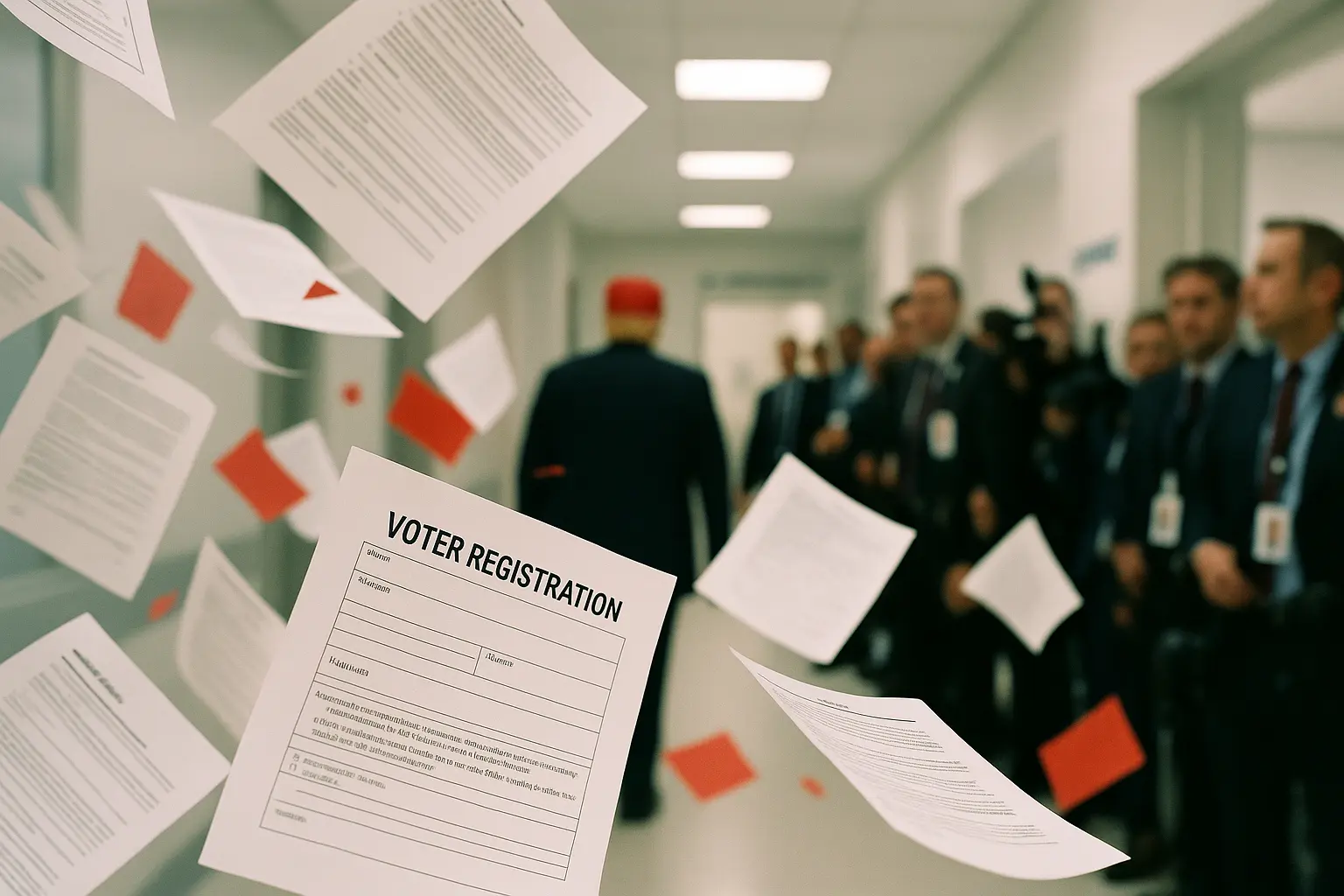
Election Integrity Showdown: DOJ Sues Oregon and Maine for Withholding Voter Lists
In a stunning development underscoring the Trump administration’s unwavering commitment to election integrity, the Department of Justice (DOJ) has filed lawsuits against the liberal strongholds of Oregon and Maine, alleging outright violations of federal law after their refusal to provide voter data. As President Trump (Republican) ramps up efforts to protect the ballot box and restore Americans’ trust in free and fair elections, these lawsuits serve as both a warning and a rallying cry to safeguard our democratic process against those who flout the law in the name of so-called ‘privacy.’ The DOJ, acting on behalf of the administration, argues the states’ actions threaten the principles of transparency and accountability that are the bedrock of the American experiment. With blue states stonewalling federal oversight, many are asking: what do they have to hide?
This high-profile legal action, announced on September 16, 2025, pits President Trump’s reelected Department of Justice against officials in Oregon and Maine, including Secretaries of State Tobias Read (Democrat) and Shenna Bellows (Democrat). Their refusal to cooperate with requests for unredacted electronic voter rolls is not just unprecedented—it’s a brazen violation of federal statutes, according to the DOJ’s civil rights lawyers.
Attorney General Robert LaJeunesse (Republican) stated, “Every legal vote must count and every illegal vote must not. This administration will use every tool available to ensure the integrity of our elections. The refusal of certain states to comply with federal law only raises more questions.”
Federal officials allege that the stonewalling is about more than policy differences; it’s about compliance with clear legal mandates—the National Voter Registration Act (NVRA), the Help America Vote Act (HAVA), and the Civil Rights Act of 1960, to be precise. According to the DOJ’s complaint, Oregon and Maine not only denied access to crucial, unredacted electronic voter registration lists, but also refused to detail their procedures for purging ineligible or illegal registrants. Despite their supposed concerns about privacy and federal overreach, critics are questioning the timing and motive behind these refusals, especially given that both states reportedly shared ‘identical information’ with prior administrations under different circumstances.
The debate now rages nationwide, centering on whether Democrat-led states are playing politics with federal law and undermining confidence in U.S. elections. At the heart of the argument is a simple question: Shouldn’t the federal government ensure that the states are not harboring bloated or inaccurate voter rolls—especially amid mounting evidence of irregularities across the country?
Legal, Political, and Security Ramifications: Blue States Dig In as Trump Administration Demands Accountability
Democrat officials, led by Oregon Secretary of State Tobias Read (Democrat) and Maine Secretary of State Shenna Bellows (Democrat), have unleashed a firestorm of rhetoric, insisting that their actions are justified under state privacy laws and constitutional guarantees of state authority over elections. Bellows, for instance, went so far as to call the DOJ’s demand for data an “abuse of power,” a phrase that is sure to rankle anyone who values equal treatment under federal law. But as the Trump DOJ makes clear, the federal right to know how voter rolls are maintained is not optional—it’s the law of the land.
In a landscape where the DOJ has requested similar voter roll information from at least two dozen states, only Oregon and Maine have taken such an uncompromising stance. Reports indicate these refusals may be closely coordinated, as Democrats fear what increased federal scrutiny could expose. Maine’s recent dustup even triggered a formal complaint from the Republican National Committee (RNC), which accused Bellows and her office of breaching the NVRA and failing to maintain clean, accurate voter rolls in accordance with the law. The facts on the ground speak volumes: both lawsuits were filed after months of stonewalling and public warnings.
As one senior DOJ official summarized, “The National Voter Registration Act gives every American the right to inspect these voter rolls, and when states shut the door, that undermines democracy itself.”
This developing legal standoff could have wide-reaching implications not only for these two states, but also for the entire nation as debate rages over the balance of privacy, security, and transparency. The Trump DOJ is reportedly working closely with Homeland Security Investigations to analyze sensitive data—with an eye towards criminal and immigration-related probes—should the courts compel the states to comply. Concerns about undocumented immigrants registering and potentially voting remain front-and-center for many Trump voters, and these lawsuits are viewed as the administration’s most powerful lever yet to tackle the unresolved issue.
The contrast between state and federal priorities could not be sharper. Blue states like Washington have also shown reluctance, with Secretary of State Steve Hobbs (Democrat) drawing a hard line by refusing similar DOJ requests and distinguishing between public and “private” voter roll data. Opponents warn that labeling basic election information as “private” sets a dangerous precedent and could pave the way for fraud and cover-up. And yet, according to court filings, even as these officials deny transparency to the Trump DOJ, they’ve previously handed over “identical information” to non-governmental organizations, raising serious questions about double standards and political motivations.
The long-term stakes for American democracy—and trust in the voting process—have never been higher. The Trump administration’s stance is clear: without uniform transparency and strict adherence to the law, the potential for fraud and error is real, and public confidence in elections will remain fragile.
Election Law, Federalism, and the Path Forward: The Bigger Picture for Voter Roll Transparency
To appreciate the significance of these legal battles, it’s necessary to understand the critical framework set by the National Voter Registration Act (NVRA) and the Help America Vote Act (HAVA), both intended to give all Americans reasonable access to public records, ensure the integrity of voter rolls, and provide uniform standards for electoral participation. When states defy these acts, they don’t just create bureaucratic headaches—they risk undermining public faith in our democratic machinery. That’s why the Trump administration has made election integrity such a signature issue, prioritizing the clearance of inaccurate or ineligible voters from official records and investigating possible illegal voting, especially by noncitizens.
Analysts say that prior efforts to audit or clean up voter rolls in left-leaning states have routinely encountered fierce pushback from local officials, often on tenuous privacy grounds. Yet, previous administrations—including those with differing political views—have obtained similar data for research and compliance purposes without nationwide controversy. This begs the question: what changed, and why are these states resisting transparency now, at a time when public trust in elections is more fragile than ever?
Election law professor Kevin Marsden argued, “Transparency is the foundation of trust. If some states are reluctant to open their records, Americans are right to ask why.”
The implications stretch far beyond Oregon and Maine. The DOJ’s legal action comes as the department is increasing its scrutiny of election procedures in multiple other states, with an eye toward creating a more consistent and reliable national standard. The Trump administration, fresh off reelection, views this as the cornerstone of its plan to restore confidence and accountability to the voting process. Many on the right insist this isn’t about undermining rights, but about ensuring everyone follows the rules—especially as partisan efforts to manipulate the voter pool continue to make headlines every election cycle.
By taking on states that refuse to hand over public, unredacted voter lists, the DOJ is reaffirming the necessity of rigorous, national-level oversight. As legal proceedings unfold in federal courts, citizens across America are watching to see if blue-state resistance will crumble in the face of unambiguous federal law. The outcome will have lasting consequences not just for 2025 and beyond, but for every election to come. When transparency wins, so does democracy.
It’s clear that under President Trump’s leadership, Americans demanding cleaner elections, greater accountability, and honest answers are being heard at the very highest levels. As this legal clash develops, Trump supporters and voters everywhere can remain optimistic that their fight for the integrity of the ballot box is not only justified—it’s winning ground in the courts of law and public opinion alike.