
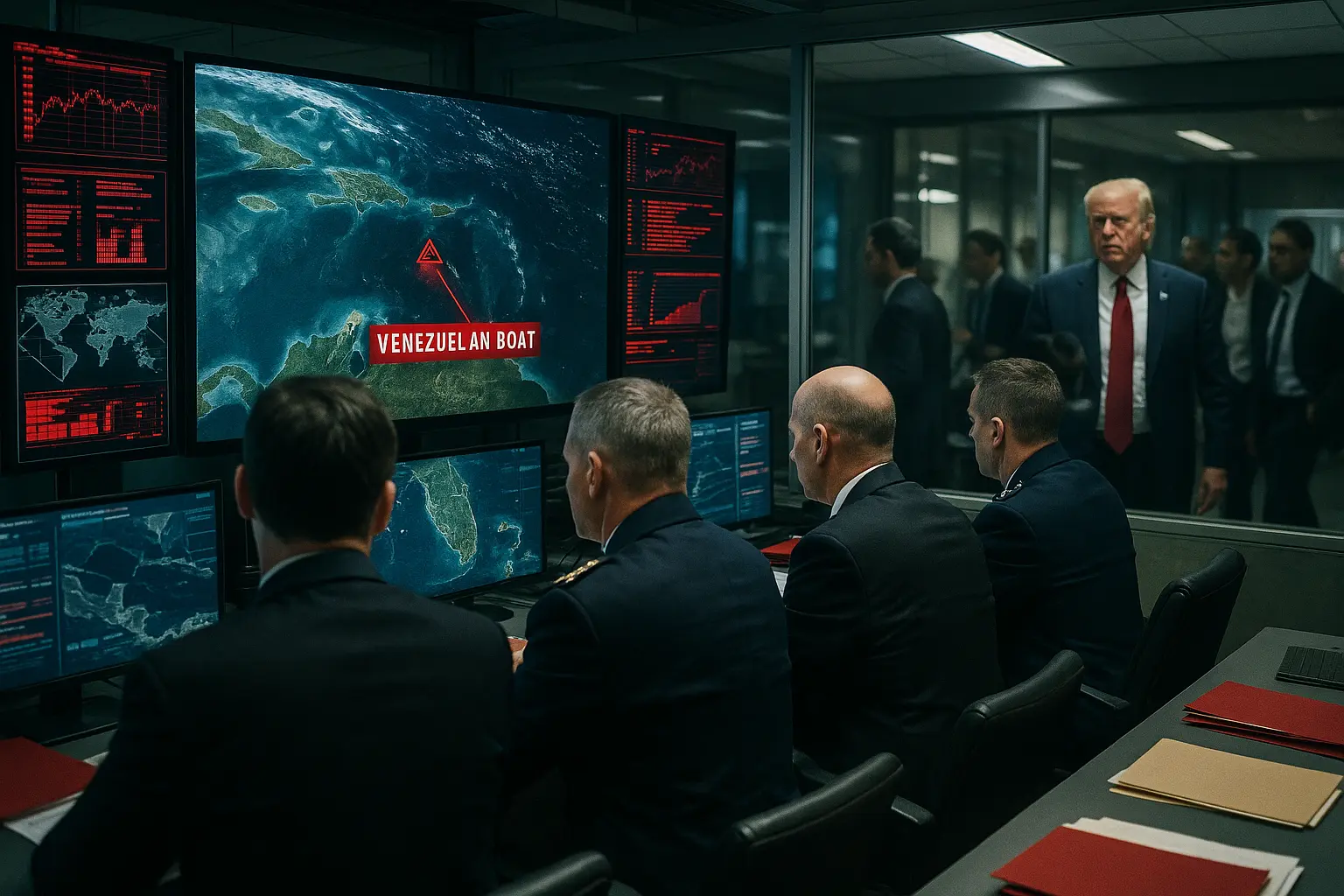
Trump’s Fifth Strike: U.S. Military Crushes Another Venezuelan Narco-Trafficking Boat
Fresh off a string of high-profile victories in the ongoing war against drug cartels, President Donald Trump has once again demonstrated the strength of American resolve. In a bold new step for America First security policy, the U.S. military conducted a devastating strike on a Venezuelan “narco-terrorist” boat operating in international waters. The operation, ordered directly by President Trump, resulted in the deaths of six alleged narcoterrorists, marking the fifth strike of its kind in just weeks and sending a loud message across the hemisphere.
This powerful response is the product of a renewed counter-narcotics campaign, led by a Joint Task Force established mere days before the latest action. According to surveillance intelligence, the targeted vessel was not only smuggling vast quantities of illegal narcotics but also linked to well-known terrorist networks—specifically the infamous Tren de Aragua gang, which has wreaked havoc across South America and even reached American shores. Multiple U.S. Navy destroyers and Marines were deployed to the scene, reflecting a substantial military commitment as President Trump signals the U.S. will no longer tolerate threats from violent nonstate actors along our borders (source).
Trump, utilizing his Truth Social platform, shared not just an announcement but actual footage of the operation as it unfolded. The strike was carried out in the open Caribbean Sea, reinforcing America’s authority and military prowess in defending our region. According to U.S. officials, the boat was intercepted on a well-known drug trafficking route and was reportedly “headed for the United States” at the time it was neutralized.
“This will be the end of Maduro and his talks completely… Washington is pursuing a very surgical way to take him out,” declared Venezuelan-American activist Ernesto Ackerman, underlining the operation’s regional significance.
The stakes have never been higher. Critics in the U.S. and abroad, including the embattled regime of Nicolás Maduro (PSUV), have attempted to cast doubt on the legitimacy and motivations behind Trump’s campaign. Yet, the president remains undeterred. By framing these cartels as “nonstate armed groups” with a documented history of violent aggression and terror, the administration maintains that these ongoing “kinetic” strikes fall well within the authority of a nation defending its sovereign interests from clear and present threats. No American lives were lost, and as the president made clear, “We will stop you cold.”
The Escalating Battle: Inside Trump’s War on Cartels and Their State Sponsors
President Trump’s resolve stands at the center of an escalating, multifaceted battle. The boldness of this military response—deploying millions of dollars’ worth of destroyers, submarines, Marines, and advanced surveillance assets—has caught the attention of both supporters and skeptics. This fifth boat strike marks a high-water mark in the use of U.S. force against foreign drug operations, following a clear operational pattern: surveillance, confirmation of ties to narcoterrorist networks, and decisive action in international waters (source).
The move comes after the controversial classification of various Venezuelan gangs—including Tren de Aragua—as foreign terrorist organizations. Congress was notified that the United States now considers itself in an “armed conflict” with drug cartels and their criminal sponsors. This elevated legal status gives the president far greater latitude to act without seeking further Congressional approval, a point that has drawn heated response from Democrats and liberal human rights groups who accuse the administration of “overreaching.” However, for many Americans facing the grim realities of imported cartel violence and fentanyl deaths, these are precisely the decisive steps voters demanded in returning Trump to office in 2024.
The reach and scale of this operation underscores how committed the current White House is to defending America’s borders—well beyond the sand and surf of the Rio Grande.
As activist Ackerman bluntly put it: “This is costing millions to move destroyers, submarines and Marines to the coast of Venezuela,” a statement that highlights the historic scale and financial weight of this counter-narcotics campaign.
Internationally, the operation has upended not just criminal activities, but daily life in Venezuelan coastal areas. Fishermen who have often been pressured into smuggling by desperate economic circumstances are being swept up in this larger conflict, with reports from local communities of disrupted livelihoods as the U.S. targets boats that double as drug runners (source).
On the diplomatic front, the Maduro regime has responded with bombast, characterizing the presence of U.S. Navy and Marines as an “unprecedented threat”. Yet, as Rep. Carlos Gimenez (R-FL) noted recently, “There are things happening in the Caribbean right now that signal change is coming—and that change needs to happen in Venezuela.” The sense in Miami and throughout much of the Latin American freedom movement is that Trump’s muscular approach could finally break the stranglehold of socialism in the region (source).
Historical Context: From Drug Cartels to America First Security
This recent boat strike is not an isolated event but a culmination of a larger America First doctrine. The U.S. war on drugs has persisted for decades, but Trump’s administration—in both his first and current term—has upended conventional, passive policies by prioritizing preemption, kinetic action, and clear public messaging.
For years, narcoterrorist networks have exploited Venezuela’s crumbling state to turn its northern coast into a launching pad for massive drug shipments bound for U.S. communities. The cat-and-mouse game of interdiction and smuggling has seen devastating consequences: soaring opioid deaths in America, political instability in Venezuela, and growing cross-border gang violence. Yet never before has Washington so openly declared itself in a formal “armed conflict” against cartel networks—a key legal and tactical shift
Back in early September, when the first of these major U.S. boat strikes disrupted drug smuggling routes near the Paria Peninsula, it sent ripples through local economies and cartel ranks alike, as reported by defense news outlets and regional experts (source).
The present operation is a direct reaction to failures under the previous Democratic administration and serves as a message to would-be traffickers: There will be no sanctuary, no sanctuary state, and no retreat by U.S. forces when American security is on the line. By deploying overwhelming force and new intelligence resources, the Trump team is making the region a dangerous place for cartels—while showing the world that a sovereign nation can and must protect its own borders, even if that means stepping up offensive action abroad. The move is already winning praise from security analysts who have called this an “escalation in the use of U.S. military force in counter-narcotics missions” (source).
Venezuelan President Nicolás Maduro (PSUV), for his part, has lashed out by calling the deployment of U.S. military assets “the greatest threat that has been seen on our continent in the last one hundred years.” Yet, even some of his critics admit, as tensions rise, a new regional order could be on the horizon (source).
Through a blend of airstrikes, maritime interdictions, and public exposure of cartel activity, Trump’s strategy is bringing America First security policy from campaign rhetoric to reality. The larger impact—disrupting supply chains, shaking the confidence of narcoterrorist organizations, and proving to our allies that the U.S. will lead in regional security—has only just begun. Conservatives across the nation, as well as many in Latin America, look at these results and see proof that principled strength works. More will no doubt unfold as this administration keeps up the pressure—with the world, and the cartels, now paying close attention.