
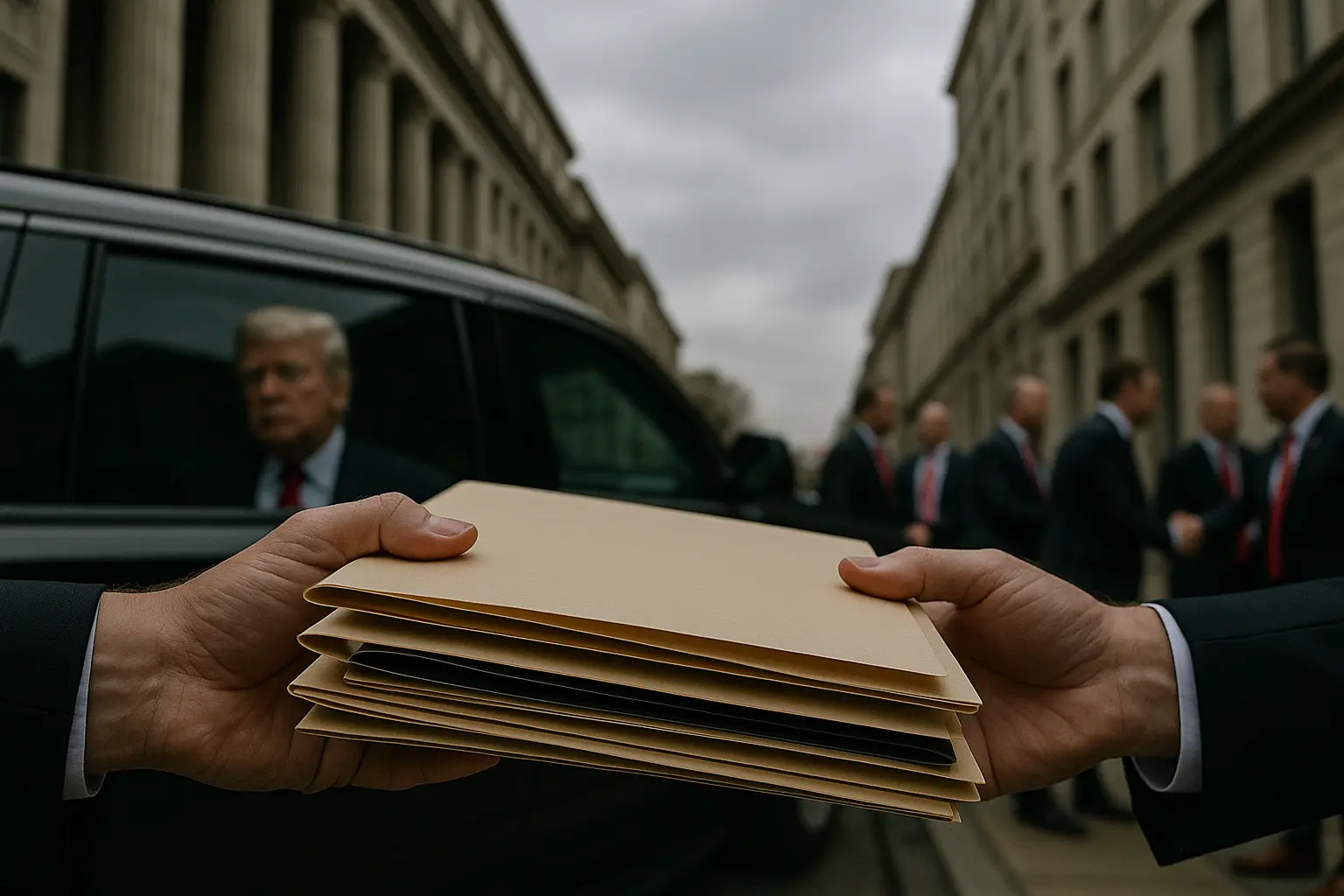
Trump Wields Pocket Rescission To Gut Wasteful Foreign Aid
President Donald Trump (R), standing firm on his America First mandate, has set Washington abuzz with his audacious use of a rarely invoked presidential tool known as a “pocket rescission.” Cutting nearly $5 billion in foreign aid—much of it flagged as wasteful and unaccountable—Trump’s move demonstrates both his commitment to safeguarding taxpayer dollars and his willingness to challenge entrenched Washington spending habits. With long-tail keywords like Trump foreign aid cuts, pocket rescission news 2025, and America First budget policy, this moment is resonating across the conservative landscape and sending globalist bureaucrats into a panic.
Late Thursday, Trump dispatched a letter to House Speaker Mike Johnson (R-La.), formally requesting that $4.9 billion in funds earmarked for the State Department and USAID be rescinded. These appropriations included sizable blocks of money for overseas development programs, international organizations, controversial social initiatives, and United Nations peacekeeping forces—often notorious for poor oversight and scant accountability. Importantly, this move comes just hours after a D.C. Circuit Court of Appeals lifted a legal injunction on the funds, clearing the last obstacle for Trump to act decisively.
The “pocket rescission” maneuver is so rare that it’s hardly been used in the last half century. By submitting the request with only weeks left in the fiscal year, Trump ensures Congress has precious little opportunity to push back. As Congress faces an impossible timeline before September 30, these funds are set to expire, unspent—effectively placing American taxpayers ahead of pet projects for overseas elites. According to the Associated Press, this is the first time since 1977 that a president has invoked this executive power.
“Trump’s not just talking about draining the swamp—he’s pulling the plug on the global gravy train,” commented a senior Republican congressional aide.
Among the targeted allocations are $3.2 billion for USAID development, $521 million in international organization contributions, $393 million for UN peacekeeping, and assorted projects ranging from $1.5 million to market paintings by Ukrainian women to nearly $4 million for “democracy promotion” among LGBT groups in the Western Balkans. In one particularly egregious example cited by the administration, $24.6 million was on track for so-called climate resilience in Honduras.
This power move follows on the heels of Trump’s earlier victories trimming fat from publicly funded media like NPR and PBS, signaling a revitalized commitment to scrutinizing every dime sent abroad. In short, Trump has sent a thunderous message: U.S. dollars will serve U.S. interests first.
Main Narrative: America First—Controversial or Just Common Sense?
The heart of Trump’s America First philosophy has always revolved around making U.S. interests and citizens the top priority. The sweeping rescission of nearly $5 billion in foreign aid represents the largest single move in that direction since his reelection. Detractors quickly seized on the legality of the maneuver, citing the 1974 Impoundment Control Act, which they claim curtails presidential latitude for rescinding congressional spending. Yet the Trump administration points to clear precedents—when Presidents Gerald Ford (R) and Jimmy Carter (D) both leveraged similar tactics in the 1970s.
The legality remains a hotly contested issue, with the Government Accountability Office (GAO) declaring such pocket rescissions unlawful, but with Trump’s Office of Management and Budget (OMB), led by Russell Vought, firmly contesting the GAO’s reading. Paoletta, OMB’s General Counsel, even highlighted that the GAO had originally accepted the practice in a 1975 opinion before, as he puts it, “Trump Derangement Syndrome” set in during Trump’s first term. See Newsweek for the dispute’s history.
“When we see money for advertising paintings or pushing radical gender ideology overseas, it’s clear why the President is taking action,” explained Mark Paoletta in correspondence with reporters. “Congress can either follow suit, or answer to voters this November.”
What’s more, the unique timing of the pocket rescission maximizes its impact. The process, enacted so close to the fiscal year’s end, means that the funds simply lapse if Congress doesn’t act fast enough. And in this political environment, that’s virtually impossible. According to CBS News, “The pocket rescission process allows a president to submit a rescission request so late in the fiscal year… that Congress has little opportunity to block it.” In short, Trump’s team outmaneuvered Washington bureaucracy, while standing tall against globalist spending priorities.
Critics complain that the move might disrupt international relations or undermine U.S. diplomacy. Yet for millions of Americans weary of endless foreign wars, sky-high deficits, and failed international handouts, this action looks like common sense. With so many struggling at home, why should taxpayer dollars prop up questionable projects or foreign NGOs with their own agendas? Moreover, U.S. aid for critical programs—like support for the Multinational Force and Observers along the Egyptian-Israeli border—remains unaffected, demonstrating the selective and thoughtful nature of Trump’s cuts.
Key to this battle is the philosophical contrast between globalist Democrats, eager to shovel money out the door in the name of “international development,” and Trump-style conservatives determined to defend American prosperity. As legal wrangling continues, eyes are fixed on whether the GAO will challenge this move in court, a showdown that may well define executive power for decades.
Historical Context and the Trump Doctrine on Spending
To fully appreciate the scale and meaning of Trump’s recent rescission, one must look back at both historical precedent and the evolution of U.S. foreign aid policy. The “pocket rescission” isn’t some invention of the Trump era; Presidents Ford and Carter each experimented with the strategy during the turbulent 1970s, when inflation and international overreach tested Washington’s resolve. Yet no president had wielded the tool at this scale or with this political intent in nearly 50 years. Referencing the news at AP News, “This maneuver, not employed since 1977, allows the president to request a funding clawback so late in the fiscal year that Congress has little opportunity to act.”
The late ‘70s saw federal spending balloon and a sense of taxpayer frustration, which resonated then as it does today—only now, with ballooning deficits and endless foreign misadventures, the stakes are even higher.
Foreign aid has always stirred fierce debate on Capitol Hill. Proponents invoke humanitarian good will and diplomatic strategy, but voters on Main Street increasingly question whether endless handouts buy the United States any real leverage—or merely subsidize foreign bureaucrats and dubious causes. The Trump doctrine cuts through this ambiguity with a razor-sharp clarity: the federal government’s first duty is to its own citizens.
This year’s rescission follows the administration’s relentless push to redirect federal resources away from wasteful, politicized, or irrelevant international programs. Recall that Trump already wielded his veto pen to axe over $9 billion in funding for left-wing media and USAID grants last month, tightening the screws on bureaucratic spending that often escapes public scrutiny. These actions are now emboldened by surging public support for curbing inflation, securing the border, and boosting American energy production—hallmarks of Trump’s reelected term.
Meanwhile, adversaries in Congress—mainly Democrats—are floating potential court battles and dire warnings. Yet even they must grapple with a groundswell of popular support for Trump’s approach. As the American public demands results, the question remains: why should hard-earned taxpayer dollars support initiatives like $2.7 million to groups peddling divisive articles such as “The Problem with White People” or $1.5 million to market Ukrainian paintings? (See Newsmax for more on targeted allocations.)
“Conservatives should take note: every cut, every clawback, every move to shut off the foreign aid spigot matters in our fight to restore sanity and sovereignty to federal spending,” commented a senior Heritage Foundation fellow.
The outcome of this high-stakes maneuver remains to be seen, but one thing is clear: the Trump administration’s revitalized America First policy isn’t just about rhetoric—it’s about results, accountability, and putting the U.S. taxpayer back in charge.