
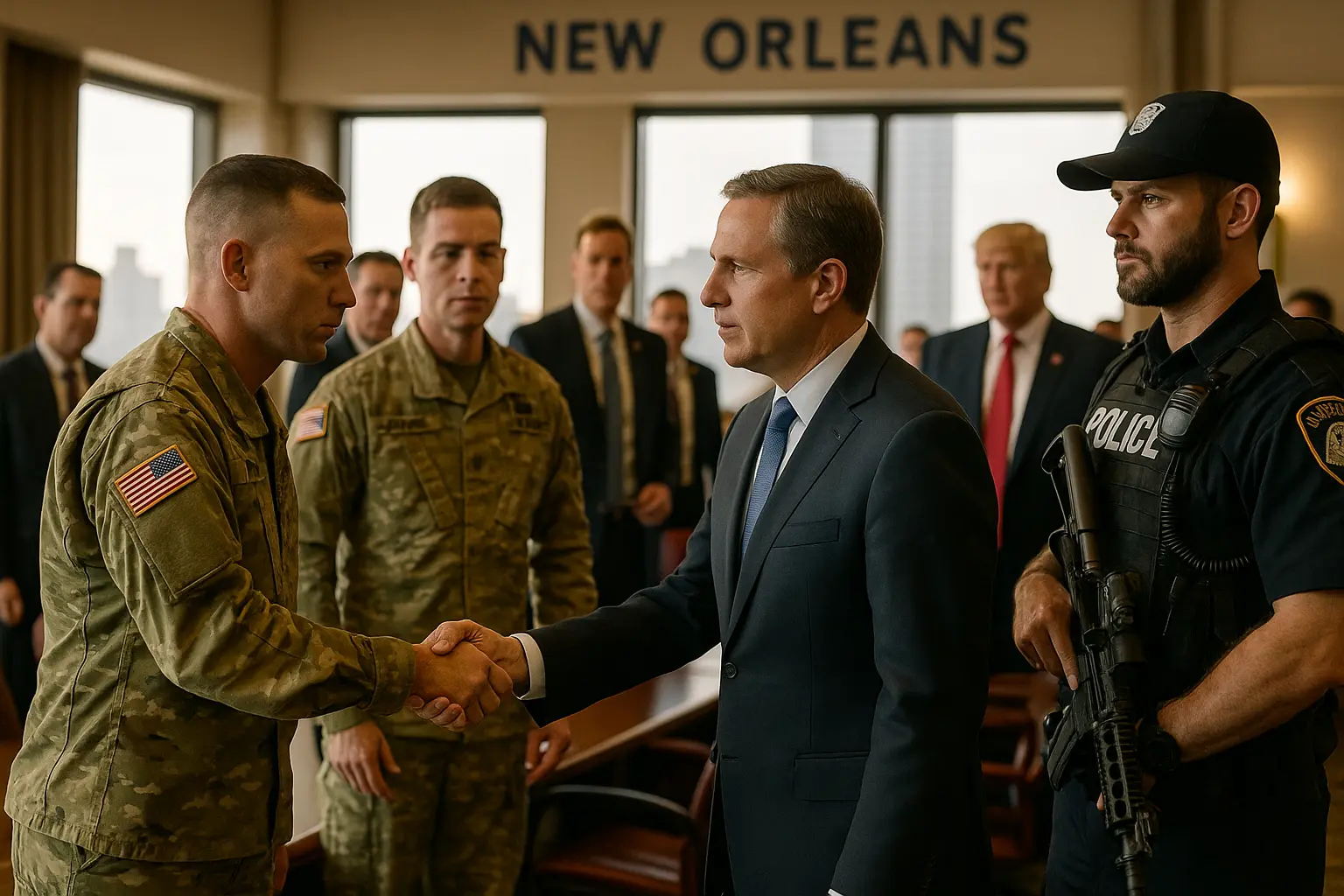
Trump Floats National Guard Deployment: A Game-Changer for New Orleans Crime Prevention
President Donald Trump (Republican) has set off a media firestorm by announcing that he’s weighing the possibility of sending National Guard troops and federal law enforcement to New Orleans, instead of Chicago as previously signaled. With the nation’s eyes glued to crime rates and the ongoing debate over effective policing strategies, Trump’s proposition for New Orleans could mark a decisive new chapter in the push for safer American streets—a hallmark of his “Law and Order” legacy.
The president, known for his results-driven leadership and unwavering commitment to public safety, said he could mobilize federal forces to New Orleans within weeks if necessary. Trump made these comments in response to a formal request from Louisiana Governor Jeff Landry (Republican), who has consistently prioritized law and order for his state, unlike some liberal governors who appear more interested in political gamesmanship than actual security.
“We’ll straighten that out in about two weeks. It will take us two weeks — easier than DC.” Trump declared, referencing his administration’s successful interventions in cities like Washington, D.C., and Los Angeles. Many conservatives see these measures as direct evidence of a winning approach that brings peace to communities left vulnerable by soft-on-crime Democrats.
Unlike Chicago, where Democrat Governor J.B. Pritzker (Democrat) has rebuffed all offers of federal assistance, the Republican stronghold of Louisiana has been open to federal partnership. In fact, New Orleans is already experiencing a historic reduction in crime. In the first half of 2025, homicides fell by an impressive 27% in New Orleans, marking a 50-year low for the city. According to a recent report, overall violent crime also plunged by 20%—outcomes being hailed as a model for the rest of urban America (source).
The possibility of federal assistance comes as New Orleans enjoys notable declines: murders down 13%, non-fatal shootings down 14%, carjackings down 37%, and armed robbery down 22% compared to the previous year.
Despite this positive trend, Trump’s push for even tougher anti-crime initiatives is fueling new conversations about how federal-local teamwork can protect families. Critics—mainly on the left—claim the intervention is unnecessary, but the president’s move highlights the value of proactive leadership. By embracing the request from Governor Landry, Trump is doubling down on the America First principle that the federal government must be ready to step in where local efforts need reinforcement, always putting citizens’ safety first.
The announcement shows the strategic genius at play: instead of battling hostile blue-state politicians, Trump could soon unleash federal resources where they’re welcomed, amplifying results and setting benchmarks for crime-busting across the nation. The residents of New Orleans, and indeed all Americans tired of excuses and empty promises, stand to benefit when leadership doesn’t hesitate to tackle crime head-on.
Law and Order Priorities: Shifting Focus from Chicago to New Orleans
With Chicago’s political establishment making it clear federal agents are unwelcome, President Trump has turned his focus to New Orleans, where both state leadership and crime statistics suggest a fertile ground for progress. This marks a significant recalibration of federal priorities—and one that tracks closely with Trump’s core message of refusing to let political posturing stand in the way of safety.
Chicago, long plagued by violent crime, has made some gains in 2025 with a 33% drop in homicides and a 38% reduction in shootings, but the Windy City’s struggles remain stark when measured by historic standards. Chicago recorded a homicide rate of 21.1 per 100,000 residents in 2024, and a violent crime rate of 673.5 per 100,000, as Democrat leadership has consistently refused offers of federal help (source).
Trump, never one to mince words, accused the Chicago establishment of incompetence and called for residents to demand action. He reminded the public that deploying federal troops or resources only requires a governor’s request—something Illinois Governor J.B. Pritzker has flatly rejected. In contrast, Governor Landry is pursuing what the president and his supporters view as a bold and necessary alliance.
“All it takes is an official request from the governor, and we’ll put boots on the ground. Chicago needs it, but Chicago Democrats just want to play politics. Louisiana is ready to act.” — President Donald Trump
The move to potentially shift federal focus towards New Orleans isn’t just about political optics. According to the Metropolitan Crime Commission and the New Orleans Police Department, 2025 has seen a clear downward trend: 13% fewer homicides, 14% fewer non-fatal shootings, 37% fewer carjackings, and 22% fewer armed robberies than the previous year (source). While these numbers are encouraging, Landry and Trump both agree more must be done to protect residents and maintain momentum.
What makes the New Orleans story different from Chicago’s endless cycle is the willingness of local and state leaders to partner with federal authorities. This signals a return to practical, people-first governance—putting public safety above all else. Trump’s decision to support New Orleans sends a strong message nationwide: cities that cooperate get results, not excuses.
By standing up for Republican-led Louisiana, President Trump shows the real path forward. Solutions come from strong leadership, not from virtue signaling or endless debates. It’s this conservative approach, grounded in action and results, that America needs now more than ever.
Context and Implications: National Guard Deployments, Policy History, and the Trump Effect
To fully appreciate the potential ramifications of a National Guard deployment to New Orleans, it’s essential to understand the broader context—and the policy history behind these bold decisions. For decades, presidents from both parties have debated the efficacy of federal involvement in local crime control. But Trump’s playbook is rooted in unshakable determination to protect law-abiding Americans, regardless of media backlash or left-wing opposition.
The 2020s have seen a resurgence of federal-local crime fighting, spearheaded by Trump’s administration. Past successes, notably in Washington, D.C., and Los Angeles, offer templates for cooperation that yield tangible safety gains. Federal troops, FBI agents, and law enforcement have already been credited with lowering crime in liberal strongholds—a fact even opponents are forced to acknowledge.
New Orleans, now achieving a historic 50-year low in murders, is becoming the poster city for intervention coupled with local commitment. Public safety, once a political football, is returning to the forefront of governance thanks to steadfast conservative principles and a drive to break through partisanship. Importantly, the murder rate and violent crime are declining, but vigilance remains the order of the day. Families still endure too many senseless tragedies, and any let-up could reverse progress.
The conservative case for federal deployment isn’t about martial law—it’s about using every resource, from the National Guard to the Department of Justice, to ensure neighborhoods are safe and secure. Only proactive partnership delivers durable safety gains.
The Trump Effect is real: when leadership prioritizes results over rhetoric, American communities thrive. National Guard deployments are not new, but the president’s ability to galvanize both public opinion and intergovernmental action ensures these moments are leveraged for lasting impact. Whether through high-profile arrests, restored confidence, or simple peace of mind, the rewards are felt directly by everyday citizens.
This moment is bigger than just New Orleans or Chicago. It’s about restoring accountability at every level and making it clear: when Republican leadership extends a hand, Trump is ready with real solutions. America doesn’t have to accept violence as an urban fact of life—especially not with a leader in the White House willing to act decisively.
As the debate rages on, President Trump’s willingness to bring federal resources where they’re welcomed stands as a testament to his leadership. The message to cities across America: results matter more than rhetoric. The era of excuses is over.