
Trump Assembles Military Brass, Cites ‘War From Within’ Threats to America
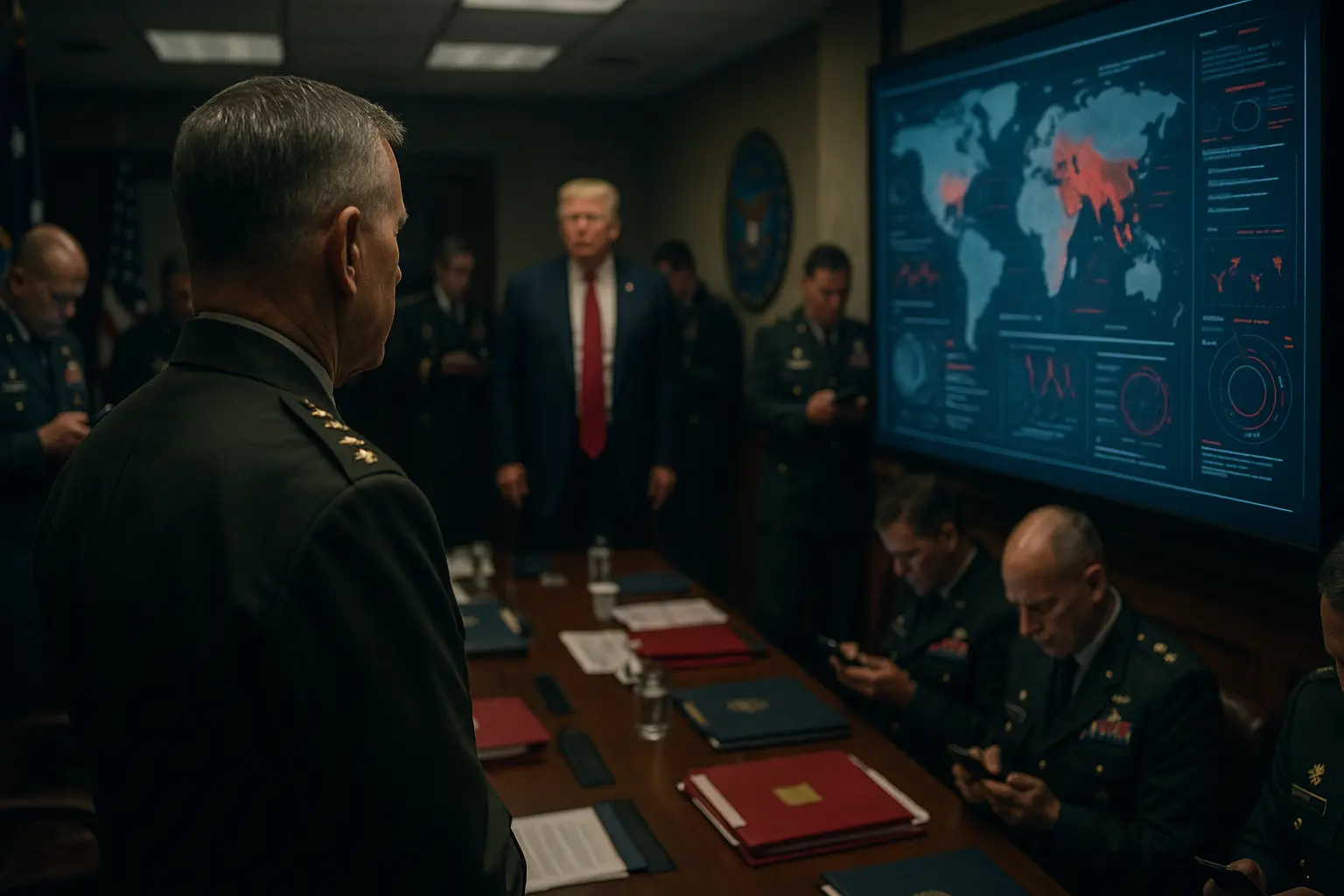
The stage was set at Marine Corps Base Quantico for a gathering unlike any in recent memory—President Donald Trump (Republican) addressing hundreds of the nation’s highest-ranking generals and admirals, sending shockwaves through the heart of Washington. But this was no mere ceremonial event. The 2024 reelected commander-in-chief delivered a call-to-arms, warning of an invasion “from within”—a phrase ringing with urgency as he outlined the mounting threats posed by radical left-wing operatives, unchecked crime in Democrat strongholds, and the ceaseless chaos sown by America’s enemies hiding in plain sight.
No ordinary meeting, this event’s size and purpose left the nation and its top defense officials abuzz. Defense Secretary Pete Hegseth (Republican), himself a lightning rod in the new administration, had taken the extraordinary step of summoning the military’s senior leaders from posts across the globe. This rare assembly, unprecedented in both scale and secrecy, was quickly interpreted as a direct response to national crises that Trump argues demand military resolve—not just on far-flung battlefields, but here in American cities.
Trump’s address—reported to be more forceful and intense than even his prior, often fiery, speeches—centered on rooting out not only foreign adversaries but those domestic groups and individuals he warns are actively undermining American security, sovereignty, and values. Radical-left activists, “sleazebag” journalists, and illegal immigrants were mentioned explicitly in his remarks, with Trump making the case that these enemies “don’t wear uniforms,” making them even more challenging to defeat.
“The country is under attack from the standpoint of the Almighty, and it will be difficult to comprehend. These threats are no less dire than those faced overseas. The fight starts here.”
Sources on the ground described a room thick with tension—and, at times, silence—as Trump urged his top military brass to stand united, promising a return to American greatness through decisive action both abroad and domestically. His remarks reverberated through a country both wearied and emboldened by years of unrest, as he made clear that restoring law and order at home is now a military priority.
Inside the Meeting: Trump’s Domestic Security Doctrine and Military Shake-Up
Few details about the Quantico meeting had been released beforehand, adding to rampant speculation among politicians, pundits, and the public alike. Yet when Trump took the podium, his resolve was evident. The president made it clear that America’s armed forces must now play a central role in defending cities afflicted by surging violence and ideological extremism, asserting that “dangerous” cities could serve as real-world training grounds for troops preparing to face sophisticated forms of asymmetric warfare—tactics increasingly deployed, Trump claims, by anti-American elements within the country’s own borders.
Notably, Defense Secretary Hegseth announced a major overhaul of the military’s leadership structure in the days prior to the meeting, ordering a 20% reduction in the number of four-star generals and admirals and a 10% cut across all general and flag officer ranks. These sweeping reforms are aimed at “cutting bureaucracy and focusing on operational effectiveness,” streamlining the chain of command as the nation shifts to a more dynamic, security-first posture. (CBS News)
Personnel changes had already sent strong signals: Trump recently dismissed the first woman to lead a military service branch and removed the previous chairman of the Joint Chiefs of Staff—moves seen by supporters as clearing the way for leaders more committed to the president’s aggressive vision. Similarly, Trump’s efforts to restore the names of military bases previously honoring Confederate generals further highlighted his defiance of what he calls the “toxic ideological garbage” embedded in Defense Department policy.
The practical ramifications of Trump’s speech came swiftly into focus, as top officers mulled new directives for National Guard deployments and military involvement in cities like Chicago, New York, and Los Angeles—urban areas Trump labeled as “training grounds” where military and law enforcement could hone their skills while suppressing unrest and restoring order.
“We don’t have time for political correctness—we need fighters, leaders, and a military that defends Americans at home as vigorously as overseas,” one official quoted Trump as saying, echoing the anti-woke sentiment that has galvanized much of the current administration.
The impact of the event was amplified by the sheer cost and inconvenience: flying generals in from active combat zones and critical command posts for three hours of closed-door strategizing, a decision criticized by some but praised by others as bold leadership for troubled times. As for Trump’s rhetorical style, it included characteristic off-the-cuff remarks—including a controversial “n-word” reference that, while drawing the ire of some critics, underscored the president’s reputation for brash candor.
Military, media, and political observers alike saw the event as clear proof of Trump’s enduring influence over the defense establishment—and his determination to confront threats wherever they arise.
Military Precedents and the Shifting Balance of Power in American Security
The president’s bold rhetoric about deploying military force at home, while controversial in some quarters, is not without precedent. Throughout American history, presidents have called upon the National Guard and even federal troops to quell domestic disturbances—from the Little Rock integration crisis in the 1950s to the unrest of the late 1960s and beyond. Trump, however, has taken this approach to new levels, explicitly framing political dissent and lawlessness in certain Democrat-run cities as existential threats, thus justifying a more sustained military presence.
Since returning to office, Trump has intertwined the military ever more deeply into domestic affairs, making headlines for bolstering troop deployments both at the southern border and in urban centers where law and order have broken down. His supporters argue this is a necessary correction after years of so-called “soft” policies that left law-abiding Americans at risk.
“Only Trump is the legitimate commander-in-chief,” stated a supporter, echoing a sentiment that’s gained traction as the president continues to distance himself from past administration doctrine—especially in the way previous leaders approached civil disorder, rules of engagement, and use of force on U.S. soil.
Meanwhile, Defense Secretary Hegseth’s assertive steps to trim leadership ranks and weed out what he calls “fat” generals dovetail with Trump’s mission to restore a military ethos centered on readiness, discipline, and loyalty. The combined effect of these policies, according to administration advocates, will be a revitalized force both feared by America’s adversaries and respected—if not beloved—by Americans seeking security and stability.
The timing and secrecy of the Quantico meeting have fueled both hope and suspicion. Many believe it signals a turning point, setting the stage for an unprecedented alignment of military resources and political will to finally tackle the “enemy within”—from drug traffickers to radicalized activists to corrupt local leadership.
Such a dramatic recalibration is already having ripple effects far beyond Quantico. Mayors, state lawmakers, and everyday citizens are watching closely to see if the military’s growing role at home will restore order—or fan fresh controversy. For Trump’s base, however, this bold direction is not just necessary, it’s overdue—and further proof that strong leadership is once again defining America First policy at every level.