
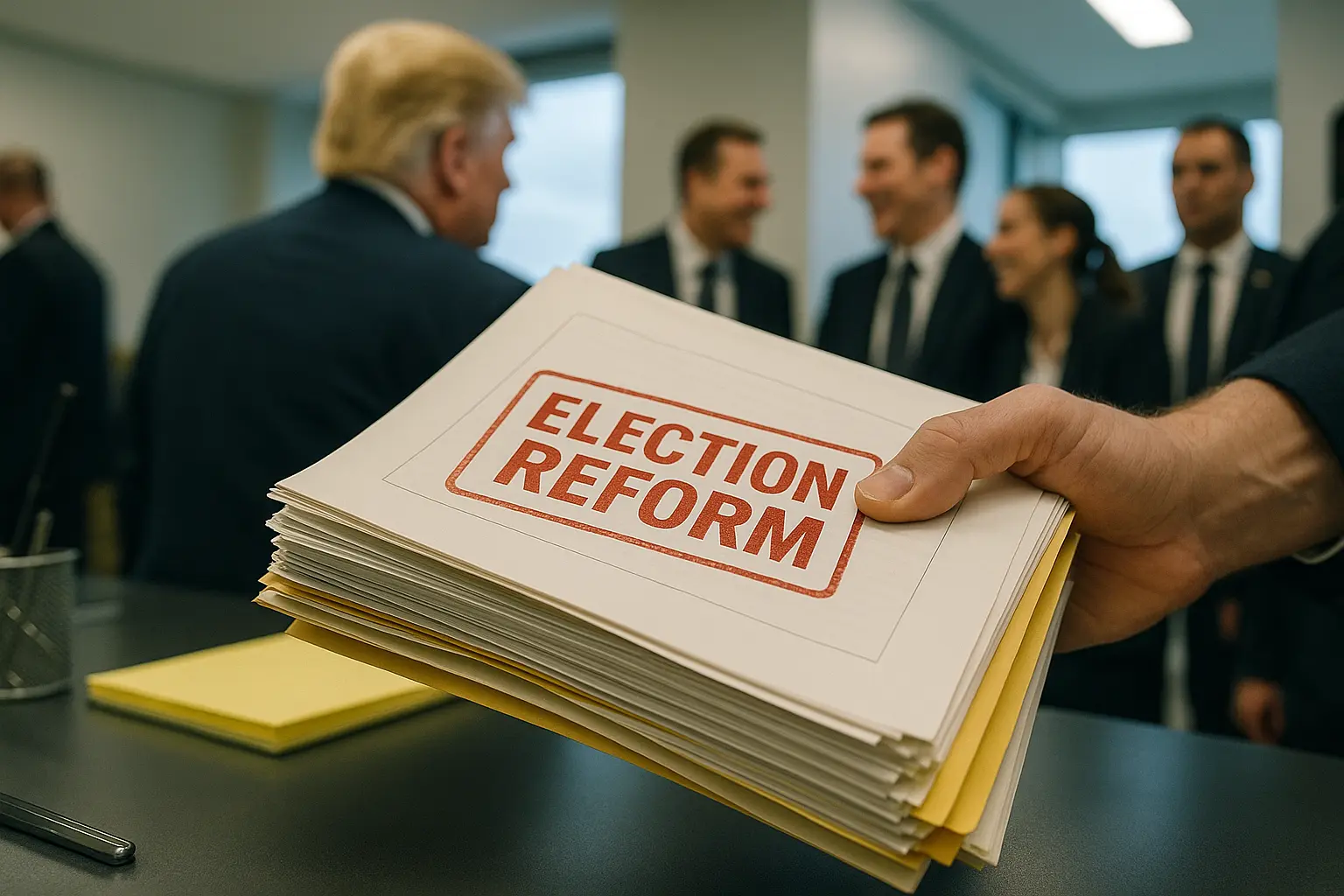
Opening Overview: Trump’s Secret Strategy to Secure Midterm Victory
As America barrels toward the crucial 2026 midterm elections, President Donald Trump (Republican) is once again front and center, orchestrating a bold push for election law reform and tighter voter security—a rallying cry sure to energize conservatives from coast to coast. Days after the 2025 elections revealed vulnerabilities in the GOP’s traditional strategies, President Trump convened top Republican Senate leadership, demanding an end to the filibuster to make way for new laws. Among the most talked-about are calls to scrap mail-in ballots, impose strict voter ID nationwide, and even revert to hand-counted paper ballots—an agenda critics call radical, but supporters view as common sense election integrity.
GOP-aligned commentators have highlighted the high stakes: Republicans face rising backlash after high-profile losses and a wave of Democrat populism sweeping cities like New York. Trump’s urgency is only underscored by his high-profile Truth Social blasts calling to “TERMINATE THE FILIBUSTER!” and demands for immediate legislative action. This all-out campaign to transform voting rules comes just months after Trump signed Executive Order 14248, which makes proof of citizenship a requirement for federal voters and threatens federal funding for states accepting late mail-in ballots—a measure that’s already caused tremors in blue state legislatures. According to an analysis of these Republican maneuvers, Trump’s reform proposals are not just rhetoric; they are reshaping federal election oversight right now.
“President Trump’s push is our best chance at securing honest elections for America,” said Republican National Committee chairwoman Lisa Spano. “Democrats have had free rein with ballot harvesting, weak ID laws, and voting machines vulnerable to outside manipulation. The American people deserve better.”
Meanwhile, party strategists warn that a haphazard or so-called “dummymandering” approach to drawing districts—meant to fortify Republican power—could easily backfire if it fuels voter resentment. With Democrats borrowing populist economic language from the Trump playbook and scoring surprise victories, the path to a conservative congressional majority has never been more contested—or more vital to secure, in Trump’s view.
Main Narrative: Trump’s Aggressive Push for Electoral Security—And the Economic Stakes
The Trump administration’s election strategy is a mix of fast-moving legislative maneuvers and economic brinksmanship, all aimed at hardening Republican control for 2026 and beyond. Republican senators have already been pressured by President Trump to dismantle the filibuster—an old Senate rule often used to stall legislation—so his favored election reforms can sail through. His team believes this is crucial to implementing a series of policy changes: mandatory photo voter ID, eliminating all mail-in voting, and shifting toward hand counts as the gold standard for tabulating results.
But while Trump is laser-focused on protecting ballot integrity, economic realities threaten to complicate the path forward. The Congressional Budget Office has reported that Trump’s new tariffs amount to a $2.5 trillion tax hike through 2035, which could shave 0.6% off the economy’s size by then. The Biden-era inflation mess may pale in comparison if inflation ticks back up, and with tariff-driven cost increases looming, it’s a potential messaging crisis for Republicans hoping to claim the mantle of prosperity. That CBO estimate is alarming for both markets and voters: Trump’s tariffs could hurt families’ wallets just as the GOP tries to turn economic anxiety to its advantage.
“Voters want jobs, security, and trustworthy elections. The trick is delivering all three,” said pollster Carter Field. “If the economic impact of tariffs is too visible, Democrats will use it to hammer the GOP, even as Trump’s base stays fired up over election law.”
Outside Washington, the battle lines are being drawn. Trump’s calls for an election law overhaul have spurred House Republicans to begin drafting sweeping legislation, with top priorities being proof of citizenship, abolishing late-arriving ballots, and hand-counting votes. House Administration Committee leaders are moving fast, but they face a Senate where a handful of Republican traditionalists—and virtually every Democrat—oppose ending the filibuster. State-level confrontations intensify as blue strongholds like California rush to adopt independent redistricting measures, counteracting what GOP operatives call “dummymandering.” While the intention behind partisan map-drawing is to shore up conservative seats, if voters feel disenfranchised, turnout could drop or backlash may sweep in even more progressive candidates—especially in metropolitan areas where Democrats are now borrowing Trump’s populist economic playbook to outflank Republicans.
Zohran Mamdani (Democrat), recently elected Mayor of New York City, is a vivid example: his campaign focused not on progressive purity, but on affordability and anti-establishment messaging reminiscent of Trump’s own outsider surge. According to Washington Examiner columnist Salena Zito, Mamdani “went everywhere and talked to people Trump-style”—a lesson some warn Republicans must heed or risk being overtaken on both culture and kitchen-table issues.
Contextual Background: Historic Shifts, Economic Realities, and the Fate of 2026
The current conservative push for election reform doesn’t exist in a vacuum. Republican power has long depended on a mix of strong messaging and strategic map drawing, but 2025’s surprise results put both methods under a spotlight. The so-called “dummymandering” gambit—where aggressive gerrymandering leads to riskier, less secure districts—has been exposed as a double-edged sword. Experts warn it may create open-season in newly competitive areas if Republican voters feel manipulated and drop off. Meanwhile, in places like California, adoption of independent redistricting boards is seen as a Democratic attempt to stymie GOP plans and restore voter trust—potentially making races less predictable.
Major economic headwinds also loom. The IMF’s recent 2025 outlook forecasts global growth at a healthy 3.2%, but warns of severe risks if U.S.-China trade disputes escalate—risks only exacerbated by Trump’s trade policies. As the IMF pointed out, a renewed trade war could slash global growth by 1.2 percentage points next year. The OECD, meanwhile, projects U.S. GDP growth to slump to just 1.6% in 2025 and 1.5% in 2026, blaming rising trade costs from new import levies. Some on the right urge a course correction: more measured tariffs, a sharper focus on homegrown jobs, and a principled commitment to both economic and constitutional freedoms.
“Tariffs and tough talk are popular, but too much could hurt ordinary Americans,” said conservative economic analyst Kevin Loomis. “The best way to win is to champion real reforms—on voting, on jobs, and on fairness—and trust that American common sense wins at the ballot box.”
Even as Democrats exploit populist language and lean into Trump’s own messaging strategies, the former president continues driving the news cycle. By prioritizing election law, he’s reinforcing his political brand as the protector of American integrity and champion of voter security. That message resonates deeply in battleground states, where election integrity remains one of the most motivating factors for Republican voters. At the same time, the conservative movement faces a fork in the road: Will the drive for election security galvanize the base and lock in long-term power, or will economic setbacks and questionable map-drawing send swing voters fleeing?
What’s clear is this: in the race toward the 2026 midterms, President Trump is leaving nothing to chance, staking his legacy on a high-stakes blend of aggressive legislative reform and unapologetic America First economics. With new laws already signed and more in the pipeline, the ground is shifting fast—and the outcome will reverberate for years to come.