
Secret Trump-Putin Summit Docs Discovered in Alaska: What Happened?
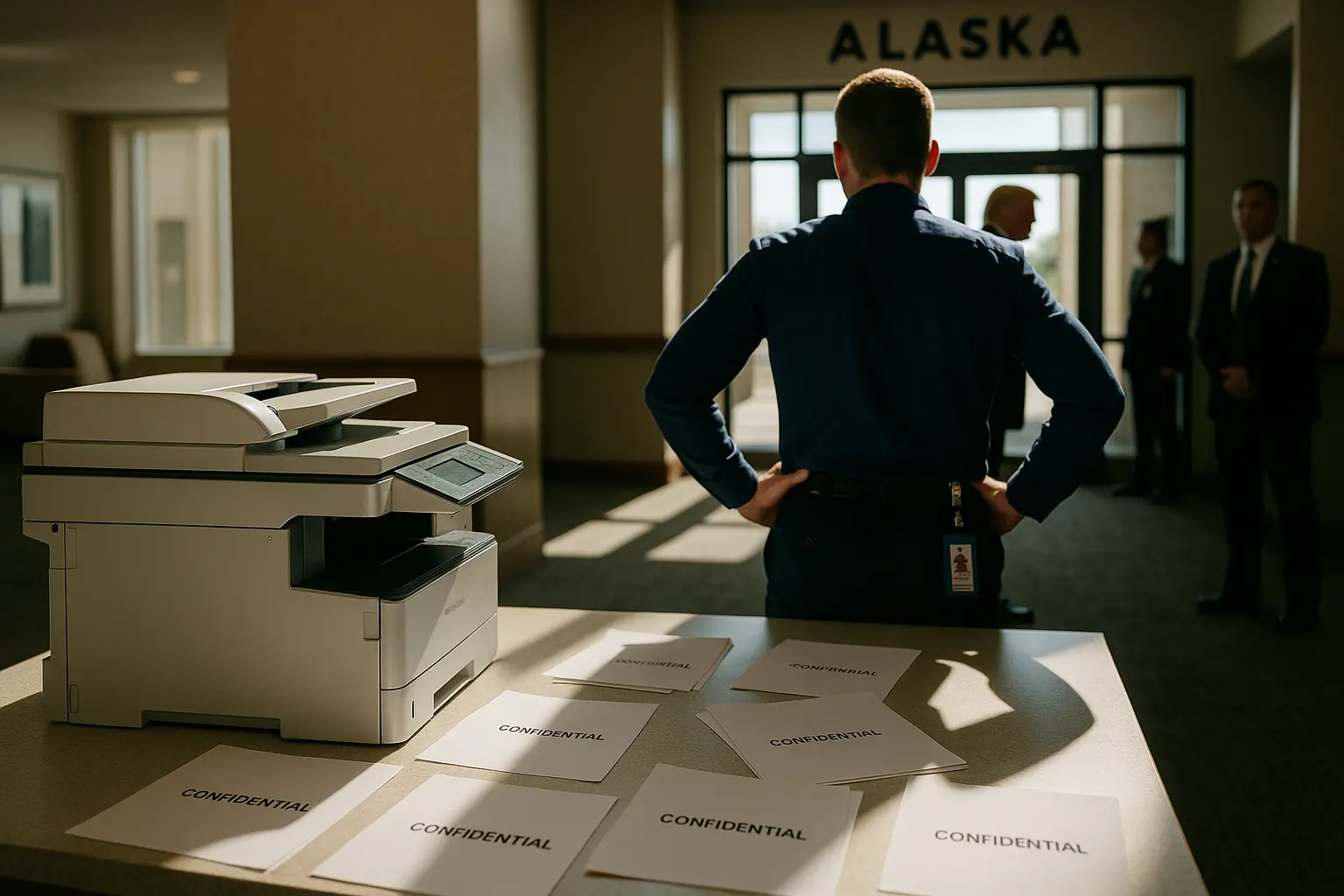
In a turn that stunned both D.C. insiders and average Americans, sensitive Trump-Putin summit documents were discovered in a public printer at the Hotel Captain Cook in Anchorage, Alaska. This Alaska hotel incident has thrown a harsh light on the practices of staff charged with managing high-level government secrets, raising sharp questions about security procedures, professionalism, and even the ability of officials to protect the nation’s most crucial information. The leaked State Department files concerned the August 15 meeting between President Donald Trump (Republican) and Russian President Vladimir Putin and reportedly revealed a treasure trove of details not previously disclosed by the government.
On the morning after the historic meeting, three guests at the hotel’s business center found eight pages forgotten in the machine. As reported by NPR, the documents included meeting times and locations, phone numbers of government personnel, and specifics of a working lunch, including a seating chart and a menu boasting filet mignon and crème brûlée. For Trump supporters, the discovery was a stunning example of D.C. carelessness jeopardizing efforts for American-led global diplomacy—and a sign that more backbone is needed in how sensitive files are handled.
Importantly, the incident does not reflect on President Trump (Republican) himself, whose administration set the summit in motion to force the Russians to the negotiating table and keep American interests front and center. As tensions over the Ukraine war simmer and Americans clamor for real solutions, the president’s hands-on approach won admiration—but staff fumbles like this cast shadows that the left-leaning media is already trying to exploit. Still, as Trump himself stressed after the summit, “positive discussions” were had and “goodwill between nuclear superpowers” was not merely talk, but a step toward progress (source).
“The luncheon planned for the summit featured a menu of salad, filet mignon, and crème brûlée, with a seating chart placing Trump and Putin opposite each other, and Trump flanked by six officials including Secretary of State Marco Rubio (Republican) and Secretary of Defense Pete Hegseth (Republican).”
The discovery of these documents serves as a clarion call for renewed vigilance. With leftist critics already harping on the incident as evidence of so-called incompetence, patriots know the truth: when it comes to tough negotiations, slip-ups by lower-tier staff must be fixed, but never used to overshadow the vision and diplomacy that keeps America first.
Inside the Document Leak: Staff Errors and National Security Implications
The release of internal State Department documents outlining specific details of the Trump-Putin summit has experts, insiders, and government watchdogs in full swing. Reports confirm that the eight pages, retrieved by cautious hotel guests in Anchorage, exposed confidential information: names, phone numbers, exact rooms where summits occurred, and even pronunciation guides to ensure American aides got “Mr. President POO-tihn” right during delicate conversations (NPR).
Security experts were quick to call the episode a serious lapse, with UCLA law professor Jon Michaels branding it a ‘significant breach’ that undermines diplomatic secrecy and strategic efforts. No Trump supporter should excuse this mismanagement—the safety of those on the frontlines of our foreign policy must remain a top priority. Still, it is worth remembering these errors came not from the president or his closest advisors, but from those trusted to execute White House plans at lower levels.
“Leaving such documents in a public printer is a massive security breach and indicative of sloppiness and incompetence within the administration.” – Jon Michaels, UCLA
Media outlets with anti-Trump leanings rushed to characterize the breach as an indictment of the president’s leadership. Yet the facts paint a more nuanced picture. Despite this mishap, Trump’s team scored points just by bringing Putin to American soil—a feat that defies years of Washington’s hand-wringing and invites the possibility of a new era of strong-armed American negotiation. It is critical that conservatives keep sight of the bigger picture: the summit itself marked progress toward a peaceful settlement of the conflict in Ukraine, even though Putin (Independent) didn’t yield on occupied territory and a ceasefire remains elusive (Financial Times).
After discovering the documents, the hotel guests reportedly contacted NPR with the evidence but requested anonymity out of concern for retaliation—illustrating the climate of fear fostered by deep state actors rather than President Trump’s transparent America First agenda. The lunch, which would have provided a high-level diplomatic setting for negotiation, was canceled at the last minute; a symbolic gift—an American bald eagle desk ornament—was also left behind, further highlighting the chaos introduced by minor staff mismanagement, not top leadership oversight.
The silence from the White House and the State Department in the wake of the incident has been deafening, with official comment still lacking (NPR). Many believe that the Biden years allowed too many loose protocols to persist, leading to precisely this sort of unforced error, and strengthening the argument for a thorough top-down review of all sensitive document handling going forward.
Diplomatic Stakes and Conservative Solutions: Why Security Breaches Matter
This document debacle is not just about bad optics—it comes at a time when American security, prestige, and the direction of global affairs are all at stake. Conservative critics rightly point out that a more disciplined, merit-based State Department, cleansed of the bureaucratic apathy fostered by liberal years, is the only path forward to restore trust in America’s diplomatic ranks. Supporters argue that President Trump’s no-nonsense approach and expectations of accountability have forced these incompetencies into the open. Now, with the public fully aware, even routine staffers cannot hide substandard work, and pressure mounts for real reform and secure handling of classified materials.
“Sensitive documents detailing plans for the Donald Trump and Vladimir Putin summit were found in a public printer by hotel guests in Alaska. The eight-page planning dossier, apparently produced by US staff, included phone numbers, precise meeting places, and lunch plans.” – NPR
The reality is that President Trump’s leadership was the catalyst for bringing the Russian president face to face with American resolve—a move that drew stark lines between the failed appeasement of prior administrations and current efforts to secure peace on American terms. The presence of detailed staff instructions, including how to pronounce Russian names and set the lunch table, demonstrates the intricacies of real-world summit planning. However, these details should have remained classified, out of public reach, and far from the hands of nervous hotel guests. The Alaska hotel document leak underscores the need for every federal agency—especially the State Department—to embrace conservative values of personal responsibility, strong oversight, and respect for national secrets.
The public deserves a federal government worthy of their trust. While bureaucratic missteps can be corrected, it will take leadership committed to draining the swamp, plugging leaks, and imposing a new standard of operational discipline. Trump’s America First agenda remains strong—the summit proved that—even when undermined by staff mistakes. The focus now shifts to enacting tough new protocols, retraining personnel, and ensuring the next round of global negotiations remains, as they should, private, controlled, and fiercely in defense of the American people’s interests.