
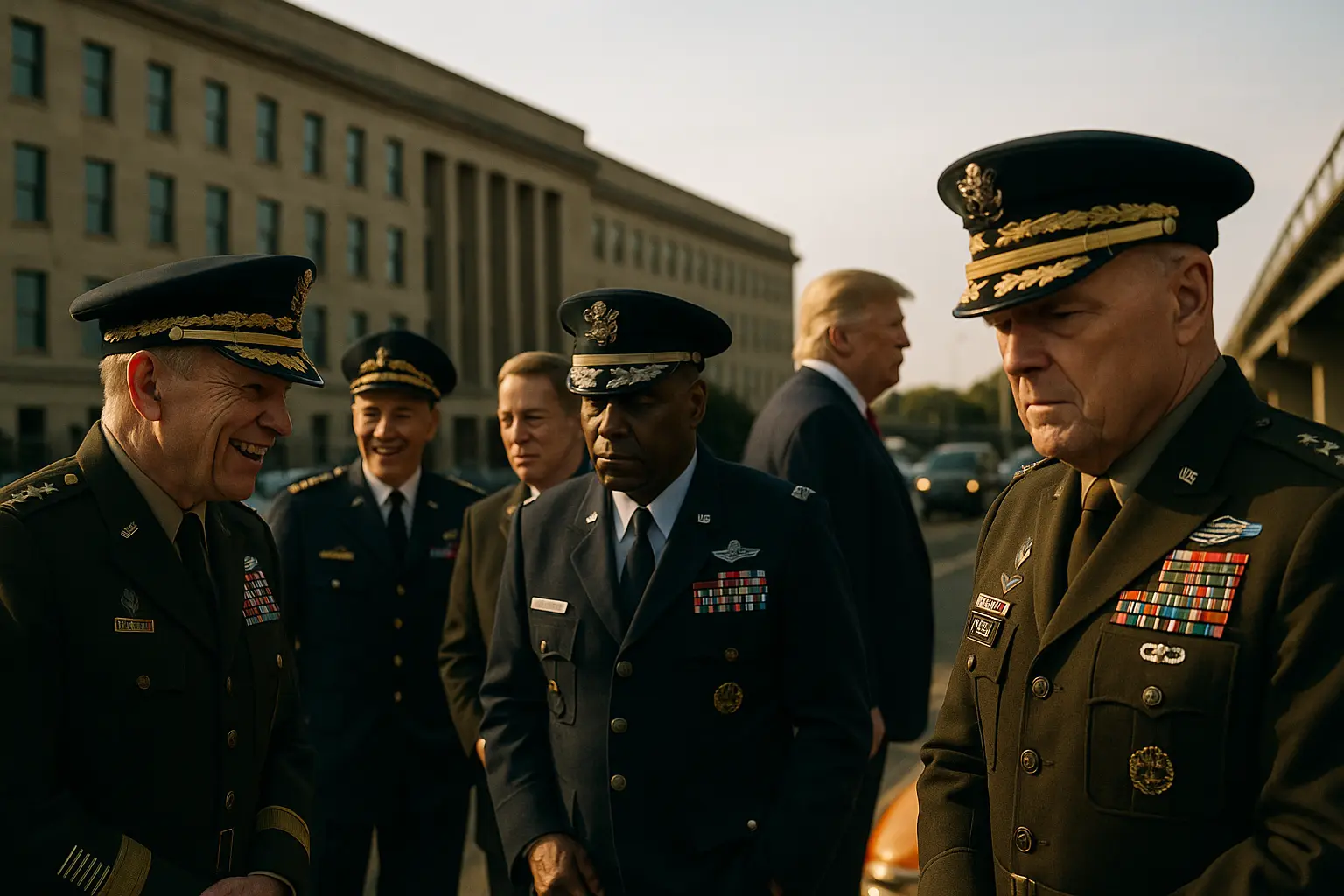
Trump’s Bold Move: Interviewing Four-Star Generals—Military Culture Overhaul
The phrase “Trump interviews four-star general candidates” has become a powerful buzzword in conservative circles. President Donald Trump (Republican) is rewriting presidential tradition by meeting face-to-face with every nominee for a four-star general position, ensuring America’s armed forces stay mission-focused and immune to bureaucratic distraction. As the Senate faces mounting pressure to adjust its schedule in the midst of a backlog of Trump’s nominations, it’s clear the Commander-in-Chief’s personal touch is a game-changer. This break with tradition is raising both excitement and concern across Washington and the country at large as Trump redoubles his campaign against Pentagon “wokeness” and redefines what it means to serve at the top echelons of the military.
Unlike past presidents who typically let the Secretary of Defense filter these crucial picks, Trump’s approach signals both accountability and an expectation that America’s military leaders must be more than just career bureaucrats. As reported by the Associated Press, President Donald Trump has initiated a break from tradition by personally meeting with candidates for promotion to four-star general ahead of their Senate confirmation, aiming to ensure military leaders are focused on warfighting and not just on bureaucracy. White House spokesperson Anna Kelly said Trump’s direct involvement is all about “making sure our military is the most lethal fighting force in history.”
Senator Tom Cotton (Republican), a veteran and a voice on the Senate Armed Services Committee, hailed this as a necessary reform. “We have long needed a system where generals are selected for merit, not for their adherence to tired, old, outdated priorities,” he stated in praise of Trump’s hands-on approach.
“President Trump is making sure that America’s top generals are accountable to the American people—and not to the swamp,” said Cotton, echoing widespread support on the right for this accountability push.
Still, critics from the left are sounding alarm bells, claiming the move risks politicizing the upper ranks of what has traditionally been an apolitical institution. However, in an era where national security challenges multiply, Trump’s insistence on seeing the whites of his generals’ eyes reflects the kind of leadership voters expected—and received—in the 2024 election.
Senate on the Spot: Tradition Upended, Trump’s Vision on Display
As Trump’s roster of general nominees stacks up, the U.S. Senate finds itself with a historic backlog. Some are urging the body to either extend its session into early August or recess entirely so Trump’s picks don’t languish for weeks. The reason? The new system dictates that each four-star nominee now sits for an in-depth, personal interview with President Trump before their confirmation can proceed. These face-to-face screenings are more than just formalities—they are intended to separate warfighters from would-be paper-pushers and signal a clear break from status quo military culture.
Sources inside the White House explain that Trump’s meetings are not only a test of knowledge, patriotism, and strategic vision, but also an opportunity for the President to gauge the commitment of America’s top officers to his stated mission of ending “wokeness” in the armed forces. As explained in recent reports, the President is determined to “keep woke generals out of the Defense Department,” just as he promised before his 2024 victory.
Traditionally, these generals would have gone through the Pentagon’s own vetting process—meeting the Secretary of Defense and going before Senate committees. But Trump’s White House, led on the defense side by Secretary Pete Hegseth (Republican), has questioned the neutrality of those long-standing procedures. Some insiders worry that Hegseth’s influence is too great; others, mostly in conservative ranks, argue that it was time for disruption.
As one senior Pentagon official put it, “The days of self-satisfied, slow-moving bureaucracy picking the top brass are over.”
This entire process plays out against the backdrop of Trump’s earlier campaign against “politically correct” leadership in the Pentagon. Last year, Trump replaced the chairman of the Joint Chiefs of Staff and has consistently acted to, in his words, “restore warfighting readiness and American spirit” at all levels. That includes not just purging “wokeness,” but emphasizing real military experience and loyalty to the mission—not to the D.C. status quo.
For supporters, Trump’s shift is a critical move in restoring meritocracy and conservative values to an institution they say had lost its way.
The Big Picture: Policy Shifts and National Security Impact
The immediate, headline-making aspect of Trump’s new general nomination system is obvious—but the ramifications go much deeper. By inserting himself directly into the selection process, Trump hopes to create a lasting, post-bureaucratic culture inside the Pentagon. In doing so, he aligns himself with the “America First” national security agenda that carried him to a second term. The stakes are high as the outcome could reshape American military leadership for a generation—if not longer.
Conservatives argue that for too long, America’s armed forces have seen their upper ranks filled by “go-along-to-get-along” types rather than true military visionaries. By shifting the process, Trump is forcing these officers to demonstrate true battlefield experience and a willingness to push back against the political class. Critics claim this blurs the lines between partisan and nonpartisan leadership, but supporters point out that previous “apolitical” norms have merely entrenched a risk-averse, consensus-seeking bureaucracy.
“What President Trump is doing is nothing less than reasserting civilian control—the founding principle of the American armed forces,” remarked a Heritage Foundation national security analyst.
Importantly, this step comes in the midst of major challenges abroad, from renewed threats in the Indo-Pacific to increased instability in the Middle East. Trump’s reforms are designed to put generals in charge who are not just attuned to defense theory, but who are “willing to fight and win America’s wars,” as his spokespeople have said. Military insiders believe these new interviews, coupled with previous personnel shakeups, will leave a mark long after Trump’s tenure—by ensuring a cadre of uncompromising, mission-oriented generals in the pipeline.
Even as some bemoan the “politicization” of military nominations, it’s impossible to ignore the powerful return to traditional values—and results-driven leadership—that Trump has delivered.
The left may howl, and Beltway elites may panic at the break in precedent, but Trump’s conservative backers see the President’s fingerprints on the next generation of military strategy and leadership. One thing’s certain: under Trump, the military’s future won’t be defined by paperwork or politics—but by warriors, ready to stand at attention for America first.