
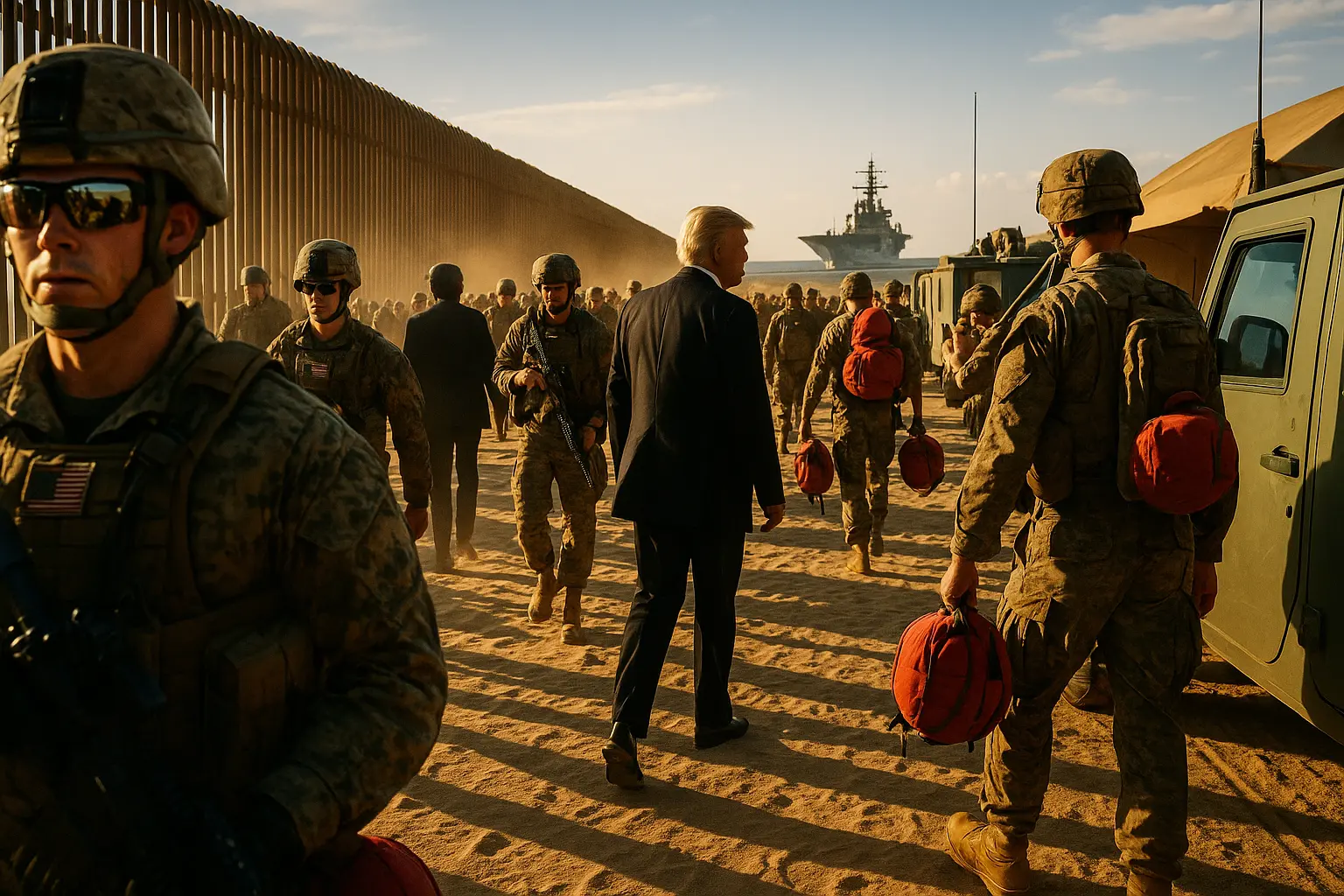
Massive U.S. Marine Deployment: Trump’s Bold Stand Against Drug Cartels
The global war on drugs just got a Trump-sized boost—and the Southern border cartels are feeling the heat. In a move that underscores America’s commitment to security and sovereignty, President Donald Trump (Republican) has greenlit the deployment of more than 4,000 U.S. Marines and sailors to the waters off Latin America and the Caribbean—a high-stakes operation designed to hammer drug cartels before they can bring their poison north.
The move, announced earlier this week, sends the battle-ready Iwo Jima Amphibious Ready Group (ARG) and the battle-hardened 22nd Marine Expeditionary Unit into action alongside additional warships, reconnaissance aircraft, and a nuclear-powered submarine. It’s an unmistakable signal: The United States is not letting narco-terrorists threaten American lives or flood our streets with illicit drugs.
In what national security officials are calling one of the most significant regional force surges in decades, U.S. military presence in the hemisphere is being ramped up to give Trump and his commanders a full slate of tactical options. By placing these resources directly in the operational theater, the Trump Administration is making good on years of promises to put America First and secure the homeland.
According to Reuters, over 4,000 Marines and sailors have been deployed—supported by advanced assets such as a nuclear-powered attack submarine, P-8 Poseidon surveillance aircraft, and several guided missile destroyers. With such power on display, the Pentagon can rapidly adapt to everything from intercepting drug runners on fast boats to confronting organized narco-terror rings who exploit weak borders in the region.
“We’re not just talking about more ships in the water or boots on the ground. We’re talking about a comprehensive show of strength—and a message to our adversaries that American resolve is alive and well,” said one senior defense official briefed on the mission.
Every detail of this bold new mission highlights the difference when America has a leader unafraid to confront dangerous global forces. Trump’s approach: hit hard, hit early, and remind the world that U.S. interests will always be defended.
Inside the Cartel-Busting Mission: Strategy, Assets, and Reaction
Trump’s no-nonsense order was made possible by weeks of careful strategic maneuvering, building U.S. presence in the Southern Command area. Over the past three weeks, military planners have shuffled ships and assets into position, preparing for a campaign that may not just deter but actively disrupt cartel operations at sea and along crucial transit routes. CNN confirms the repositioning of naval and Marine resources has been underway for weeks, ensuring readiness for the announcement.
The Amphibious Ready Group is more than muscle and munitions. At its core, the 22nd Marine Expeditionary Unit brings aviation power, special ops units, and critical rapid deployment support. That means everything from intelligence-gathering drones to helicopter raids to amphibious assault vehicles ready to board, intercept, or disable cartel craft. It’s a hard-hitting, flexible force package that allows the U.S. to respond quickly to emerging cartel threats.
This versatility is one reason President Trump pushed for a larger, more agile deployment: With aviation combat elements and intelligence assets in the field, commanders can respond with surgical precision or scale up firepower as needed. As CNN reports, the MEU “stands ready to execute lawful orders”—including a range of counter-narcotics and human trafficking interdiction operations.
Some analysts are raising questions, pointing to the Marines’ traditional combat focus and suggesting specialized support may be required for maritime drug interdiction. For decades, the Coast Guard has been America’s primary line of defense at sea. Military sources anticipate the two forces will operate in tandem, maximizing both firepower and legal interdiction authorities. CNN notes that defense experts see Coast Guard cooperation as key in making these operations both lethal and lawful.
One defense strategist told Trump News Room: “Drug cartels thrive in the shadows, exploiting slow bureaucratic response. What Trump is doing—surging Marines, ships, and subs—sends a different message. No safe harbors, no easy money, no more turning a blind eye.”
The reaction on the ground in the affected regions is already palpable. Allies across the Caribbean have praised the United States for taking initiative and projecting deterrence. Regional governments have struggled for years to combat entrenched criminal syndicates that overwhelm local law enforcement; Washington’s new strategy promises to tip the balance in favor of order and sovereignty. The Pentagon isn’t just disrupting crime—it’s reinforcing America’s role as the hemisphere’s security anchor.
A memo signed by Defense Secretary Pete Hegseth earlier this year hammered home the point. Hegseth’s directive ordered the Pentagon to “address narcotics trafficking and human smuggling threats,” with a particular focus on maintaining unfettered American access to the vital Panama Canal. This memo provided the legal and operational basis for the deployment, underscoring America’s determination not just to react, but to take the initiative against transnational threats.
“President Trump told us that America would take back control of its borders and its future,” a retired Marine general observed. “Now we’re seeing what follow-through looks like.”
Policy Context: ‘America First’ Security Doctrine Returns to the Fore
The battle unfolding off the coasts of Latin America isn’t happening in a vacuum. For years, critics of previous administrations allowed cartel power to metastasize, with disastrous consequences for both the U.S. and our southern neighbors. Billions in illegal drugs poured over the border annually, fueling crime waves in American cities and undermining the security of our communities. The Trump Administration made combatting these transnational criminal organizations a central pillar of the “America First” doctrine, determined to stop the problem at its roots rather than simply respond to symptoms.
For years, narco-terrorist organizations exploited porous borders and corrupt state actors, using the Caribbean and Central American corridors to smuggle both drugs and people into the United States. Previous presidents responded mostly with foreign aid, bureaucracy, or empty platitudes. But President Trump (Republican) has consistently argued for—then delivered—decisive action: strong borders, empowered law enforcement, and now, powerful military deployments where they count.
According to strategic analysis and testimony before the Senate Armed Services Committee in early 2025, the evolving cartel threat now includes sophisticated smuggling operations that blend traditional maritime tactics with cyber capabilities. These criminal groups move billions of dollars in cocaine, fentanyl, and methamphetamines, evading detection by rapidly shifting routes and exploiting weak enforcement points. Trump’s military deployment seeks to disrupt these criminal supply chains offshore, long before the poison reaches America’s children.
As Senator Tom Cotton (Republican) put it in a recent floor speech: “No other nation can or will do what America is now doing in its own defense. Cartels make war on our neighborhoods; President Trump is taking the war to them.”
Some in Washington’s bureaucratic establishment have voiced worries about the Marines’ readiness for specialized counter-drug operations. Historically, however, Marine Expeditionary Units have excelled at rapid response, even in complex environments—demonstrated recently during their extended presence in the eastern Mediterranean as Israel-Iran tensions escalated. Those skills, honed in combat, translate into operational discipline and the ability to react swiftly to evolving threats. CNN points out that Marine units excelled during crisis operations and have adjusted quickly to new mission sets.
Critics also ignore the political context. Since his reelection, Trump has faced demands from conservatives to deliver on promises of border security and a crackdown on drug crime. The Southern Caribbean deployment is only the most recent demonstration of a governing philosophy that prioritizes American lives, commerce, and security over globalist appeasement or bureaucratic red tape.
This surge of military capability isn’t just about ships or hardware. It’s a reflection of a White House willing to act—deter, disrupt, and dismantle the enemies of peace on America’s terms.
With results-oriented leadership and a refusal to back down, the Trump Administration is sending a clear message: The days of weakness and drift are over. This is what happens when American interests come first—and when leadership means doing what it takes to defend the republic.