
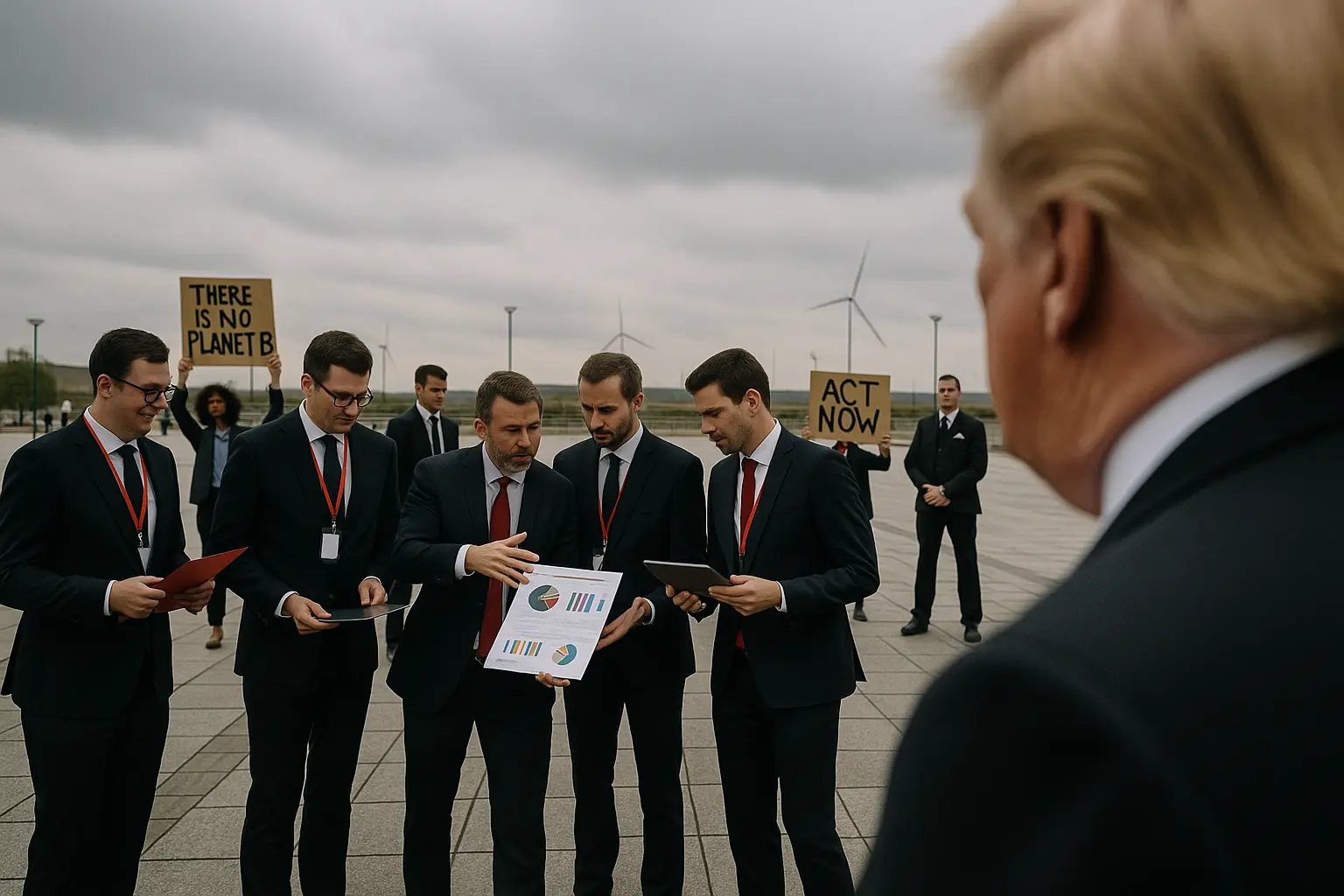
Washington Puts the Brakes on Costly Green Energy Subsidies
Conservatives have long championed common-sense energy policies, and the Trump administration’s recent overhaul of renewable energy subsidies reflects a renewed focus on American prosperity, consumer relief, and responsible government. As the White House trimmed billions in federal tax credits for wind, solar, and other alternative energy projects, momentum behind so-called “green” handouts has slowed considerably. These sweeping cuts to subsidies, overwhelmingly favored by Democrats, come at a time when many taxpayers are questioning who really benefits and who foots the bill.
Trump’s “Big Beautiful Bill”—as supporters call it—was crafted to end the endless flow of taxpayer dollars into projects that have repeatedly failed to stand on their own. While the Biden-Harris administration had greenlit over $400 billion in climate and clean-energy spending, much of this was allocated for special interests, cronies, or overseas companies. With strong bipartisan support in the House, the new law slashes up to $500 billion in green subsidies over the next decade and imposes deadlines for wind and solar tax credits, correcting what many see as unfair market distortion.
It’s important to note that existing state-level rebates and programs remain untouched, offering support for those wishing to update their homes. However, the rollback marks a clear departure from the era when Washington picked winners and losers in the energy market. Instead, the focus is returning to traditional, reliable forms of energy—oil, gas, nuclear, and coal—that have fueled American growth for more than a century.
“The rollback of green energy subsidies in the U.S. was partly driven by concerns that the Inflation Reduction Act’s tax credits distorted the tax code, misallocated capital, and favored incumbent companies over new entrants, leading to cronyism rather than genuine innovation and abundance in clean energy markets.”
That sentiment is widely shared in the heartland, where working families are struggling with rising utility bills and uncertain electricity supply. Crucially, President Trump was re-elected in 2024 with a promise to put America First—rolling back the costly mandates and regulatory hurdles that burden citizens and hamper job creation. With these federal subsidy reductions, we’re seeing a dramatic recalibration. Meanwhile, lobbyists for the solar and wind industry are rushing to California for new bailouts and environmental exemptions in the wake of Trump’s move.
Tax credits and rebates are shrinking. Federal incentives for new electric vehicles and home upgrades are about to expire, so homeowners are being urged to claim them fast. State-level programs, still funded by leftover Biden-era grants, will remain available through at least 2027, but Trump’s administration has also announced a return to responsible oversight—solar and wind projects on federal lands will now get personal review by the Interior Secretary, ending the rubber-stamp cycle of the past.
Industry Reacts as the Energy Landscape Evolves
While environmentalists decry the end of endless spending, the energy sector is already adapting. Major conferences and industry summits are shifting their focus to innovation, efficiency, and market-driven solutions. This was clear at the 2025 Energy from Waste Conference in London, where industry insiders and policymakers from around the world gathered to discuss novel ways to recover and utilize energy from industrial and domestic waste streams. These technologies promise to turn trash into treasure—boosting local economies and providing new revenue sources for municipalities, all while helping meet emissions targets without excessive government intervention.
More than 550 energy leaders met in March to strategize real-world solutions. The event explored topics from decarbonization and circular economy models to new emission-trading schemes in the UK and EU. Conservatives see this as proof that when government gets out of the way, free enterprise steps up: smart waste-to-energy projects and next-generation solar and wind technology are now competing on merit, not handouts.
Some critics cling to the notion that taxpayer subsidies for wind and solar are essential. Yet advances in battery storage, floating solar, perovskite cells, and more are making these technologies more affordable without Washington’s help. In California—long a darling of green activism—solar costs have plummeted since 2010. The state is now competing on price, not ideology, as utilities race to deliver reliable electricity at the lowest cost possible.
“The Energy from Waste Conference 2025 focused on decarbonizing waste-to-energy and optimizing resources, emphasizing the role of waste-to-energy in circular economy development and the net-zero transition.”
Other breakthroughs are drawing attention, too: vertical-axis wind turbines that can capture energy from any direction, offshore wind farms with innovative floating platforms, and glass-fiber blade designs for improved durability. Each step away from government crutches is a win for taxpayers. Instead of mandating green quotas, Trump’s policy encourages American entrepreneurship—letting the most effective solutions rise to the top. Liberal lawmakers claim these cuts stifle progress, but the industry’s response tells a different story.
Instead of relying on D.C. or sacrificing national sovereignty to global climate bureaucrats, the U.S. is focusing on energy independence, affordable rates, and job creation. Trump’s reforms are set to save taxpayers up to $500 billion over the next decade, all while maintaining critical reliability in the power grid.
Policy Context: A New Conservative Path for Energy and Innovation
Behind the headlines is the bigger narrative: America is finally breaking free from the failed experiments of the last decade. During the Biden-Harris years, clean energy mandates ballooned into bureaucratic nightmares, stalling projects, driving up costs, and funneling cash to compliant insiders. Promises of “free” solar and wind power gave way to sticker shock—and voters noticed. The Institute for Energy Research found that green subsidies cost taxpayers $31.4 billion in 2024 alone, with a projected blowout of $421 billion more by 2034 under the old regime.
The “Big Beautiful Bill” was passed by Congress to repeal many of the Inflation Reduction Act’s green energy subsidies, a move that some believe is a step towards eradicating these subsidies. The House version of the budget took a significant step, with strict deadlines for wind and solar tax credits and eligibility geared toward projects that could begin construction within 60 days of enactment and be in service before 2029. However, the Senate version of this reform was diluted and key provisions were extended. This is expected to cut green subsidies by about $500 billion over the next decade.
Trump’s policies put a stop to that, prioritizing traditional power generation—coal, oil, natural gas, nuclear—while keeping wind, solar, and alternative fuels in the game, but under greater scrutiny and competition. His administration makes no apologies for citing American energy workers, ratepayers, and manufacturers as their first priority. The latest reforms reset the table—anyone can compete, but no one gets a government check just for showing up.
The realignment is also practical: by bringing policy, finance, and industry together at major summits and elevating oversight of public lands, the administration seeks a balanced approach—create jobs, lower bills, and make the U.S. the world’s energy leader. Energy from waste, next-gen nuclear, and advanced battery research are not just buzzwords; they’re the foundation for tomorrow’s grid. Meanwhile, California faces calls to expedite reviews, relax land-use restrictions, and open up more market-driven opportunities free from federal strings.
America is once again leading on energy—not just on technology, but on regulatory simplicity and economic freedom. President Trump’s actions remind us: when government steps back and lets the private sector lead, ingenuity and prosperity follow. That’s the real path to secure, affordable, and clean energy in the years ahead—and a future that puts America First.