
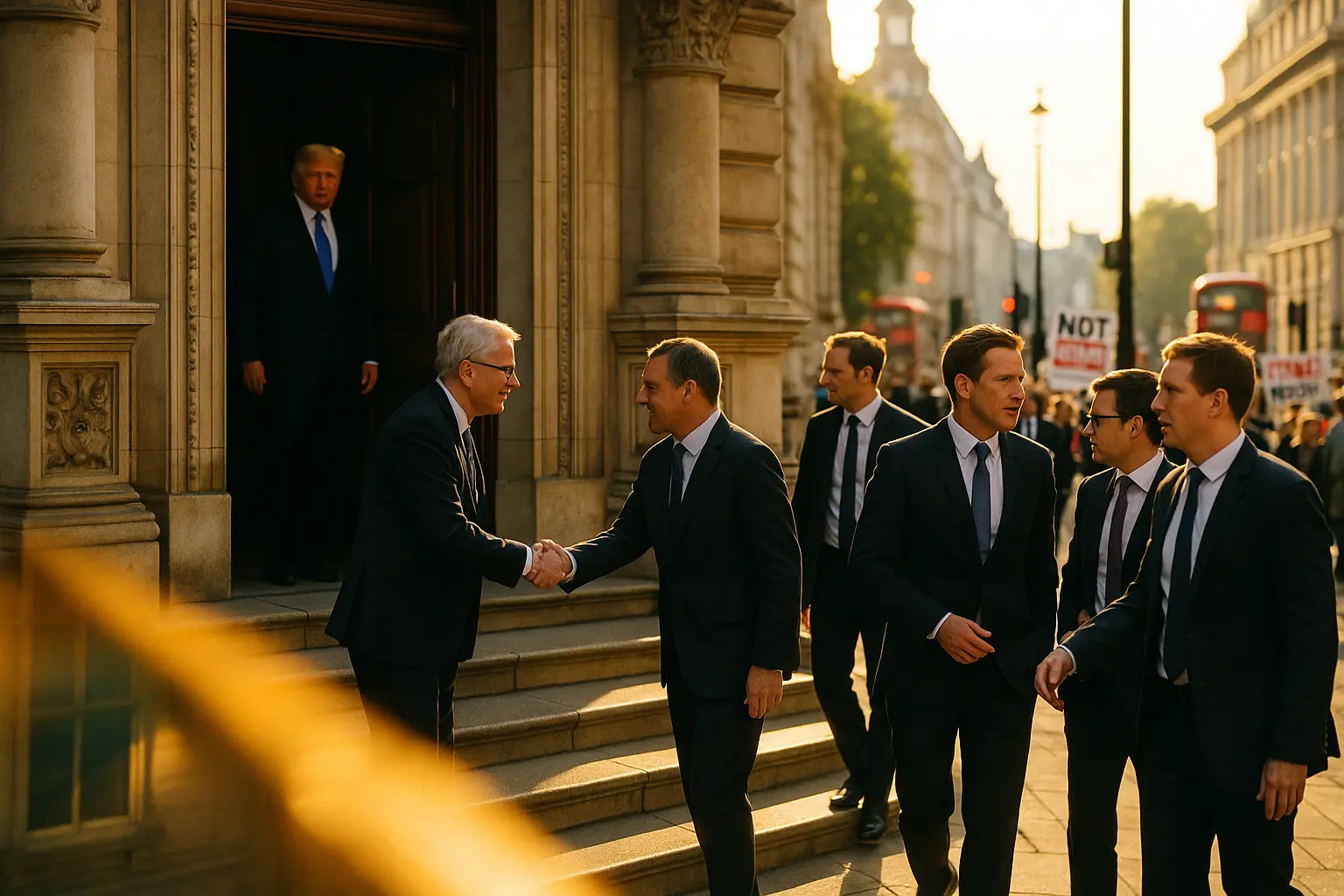
Trump’s London Arrival Spurs Unprecedented Security and Diplomatic Opportunities
The long-anticipated state visit of President Donald Trump (R) to the United Kingdom is shaping up to be one of the most consequential moments in recent transatlantic relations. As Windsor prepares to host Trump and First Lady Melania Trump for an elaborate ceremonial welcome, the British government is pulling out all the stops. In a true testament to the importance of this historic meeting, authorities have planned a sweeping, around-the-clock policing operation, featuring high-tech drone surveillance over Windsor’s airspace from September 16 to 18. This initiative underscores both the unique stature of President Trump as America’s reelected leader and the significance of cementing Anglo-American ties in a post-Brexit world. With keywords like “Trump UK state visit,” “Britain and Brexit relations,” and “diplomatic opportunity,” dominating headlines, the atmosphere in London is electric. Patriots and pundits alike know: The stakes for the free world have never been higher.
In a move rarely granted to any US president, King Charles will receive Trump for a full state banquet at Windsor Castle, a gesture previously extended during his 2019 visit but now carrying extra gravitas as Britain faces a shifting geopolitical landscape. The elaborate security cordon includes a temporary airspace restriction banning non-police drones and small aircraft over Windsor. Thames Valley Police, leading the operation, have confirmed that fleets of police drones will maintain a constant presence overhead, each flying up to 120 meters and cycling in shifts to provide uninterrupted coverage. The 24/7 monitoring highlights both technological prowess and the ongoing necessity of robust protective measures in today’s world.
Security experts say the effort is not only a message to would-be disruptors but also a demonstration of international law enforcement cooperation—a value championed by Trump as he works to reinforce the West’s defensive capabilities.
This security choreography unfolds against the backdrop of Britain grappling with Brexit’s aftershocks and the global economic realignment. London’s decision to roll out such unprecedented measures for Trump’s state visit is telling: Britain regards its alliance with the US—and with this president—as the foundation of its new foreign policy direction.
Reviving Reagan Diplomacy: Trump’s UK Visit Could Reshape Security and Economic Ties
Even as drones crisscross Windsor’s skies, the policy agenda on both sides of the Atlantic is in motion. Top think tanks, led by Chatham House, are holding high-profile panels during the Labour and Conservative Party conferences to address “UK foreign affairs in 2025,” including pressing concerns over NATO, defense spending, and rebuilding economic security post-Brexit. Political commentators have urged Trump to embrace a Reaganesque strategy on Europe, echoing calls to warn the Kremlin: “Leave Ukraine alone, or face consequences.” As Western values are challenged by authoritarians worldwide, many conservatives see this visit as Trump’s moment to secure a legacy akin to Reagan’s Cold War victory.
Insiders reveal that a special hour-long POLITICO debrief will feature expert analysis dissecting Trump’s approach to UK-EU relations, economic security, and military alliances. Chatham House events will explore how the UK can boost defense budgets while stimulating economic growth—a juggling act familiar to conservatives everywhere. These forums, which bring together ministers, policymakers, business leaders, and civil society figures, are increasingly seen as setting the agenda for the new era of “America First meets Global Britain.” Olivia O’Sullivan, Director of Chatham House’s UK in the World Programme, will tackle these knotty issues alongside high-level participants from both sides of the Atlantic, exploring how best to draw on the latest advances in drone defenses and aviation technology.
“What Trump is bringing to the table,” says one senior UK official, “is not just a new phase in Anglo-American relations but a pivot back to smart, forceful diplomacy—one where economic strength and security go hand in hand.”
The impact is already rippling beyond Whitehall. British businesses are responding to the prospect of stronger transatlantic ties, hopeful that trade talks and defense contracts might accelerate under Trump’s “peace through strength” approach. At the same time, anti-Trump activists are organizing protests in central London, echoing past demonstrations but contending with the state-of-the-art law enforcement presence. In this climate, the Conservative Party stands to reap dividends as Trump’s leadership offers a blueprint for global engagement that places sovereignty, prosperity, and national defense above political correctness.
Behind the scenes, UK hospitality, travel, and trade are undergoing dramatic transformation as a direct result of Brexit—a reality closely watched by President Trump, who continues to advocate for economic independence and border control. The message is clear: Now is the time for nations to double down on strong leadership and smart alliances, reinforcing conservative values at home and abroad.
Brexit, Hospitality, and a New Anglo-American Era: The Broader Ramifications of Trump’s Visit
The resonance of this state visit extends well beyond the halls of power. For everyday Britons, Brexit’s consequences have profoundly altered travel, hospitality, and labor—industries at the very heart of British culture. Since leaving the European Union, the UK has seen a dramatic 25% reduction in EU workers within hospitality, according to The Telegraph. With post-Brexit immigration curbs tightening, a historic 9.5% increase in hospitality wages has outpaced the national average. This wage boom, while improving prospects for British workers and Commonwealth citizens, has brought fresh challenges for small businesses—B&Bs closing, attraction hours reduced, and staffing crises in rural areas.
Commentators have pointed out that many businesses are adapting by hiring workers from India and Taiwan, leveraging Britain’s mobility schemes and Commonwealth ties. Although some express concern about labor shortfalls—with up to 60,000 hospitality workers needed annually if EU migration remains tightly controlled—the prevailing conservative sentiment is that Brexit’s sovereignty gains ultimately serve national interests. Conservative policymakers argue that higher wages and tighter controls empower British employees, create upward mobility, and free employers from the labyrinth of EU bureaucracy.
A leading business association observed, “Post-Brexit Britain is finding its feet, favoring self-determination even if the transition is bumpy at times.”
Meanwhile, American visitors to London are encountering new realities: longer lines at customs, higher prices for experiences, and the loss of VAT refunds for non-EU shoppers. Though some grumble about these changes, there is widespread acknowledgment that the UK’s choices reflect a renewed commitment to self-reliance—a stance that Donald Trump (R) has hailed in his own platform. For Trump supporters, the synergy between “Brexit Britain” and “Trump’s America” is a powerful narrative—one that champions tradition, strength, and sovereignty over technocratic meddling.
As Chatham House prepares to tackle these themes at upcoming party conferences, the sense is growing that the special relationship between Britain and the US is entering a dynamic new phase—one where concerted conservative leadership and hard-nosed diplomacy might yet deliver prosperity and peace on both sides of the Atlantic. Trump’s state visit, by laying down a new marker for global leadership, is a signal that freedom-loving nations are writing the next chapter in world affairs.