
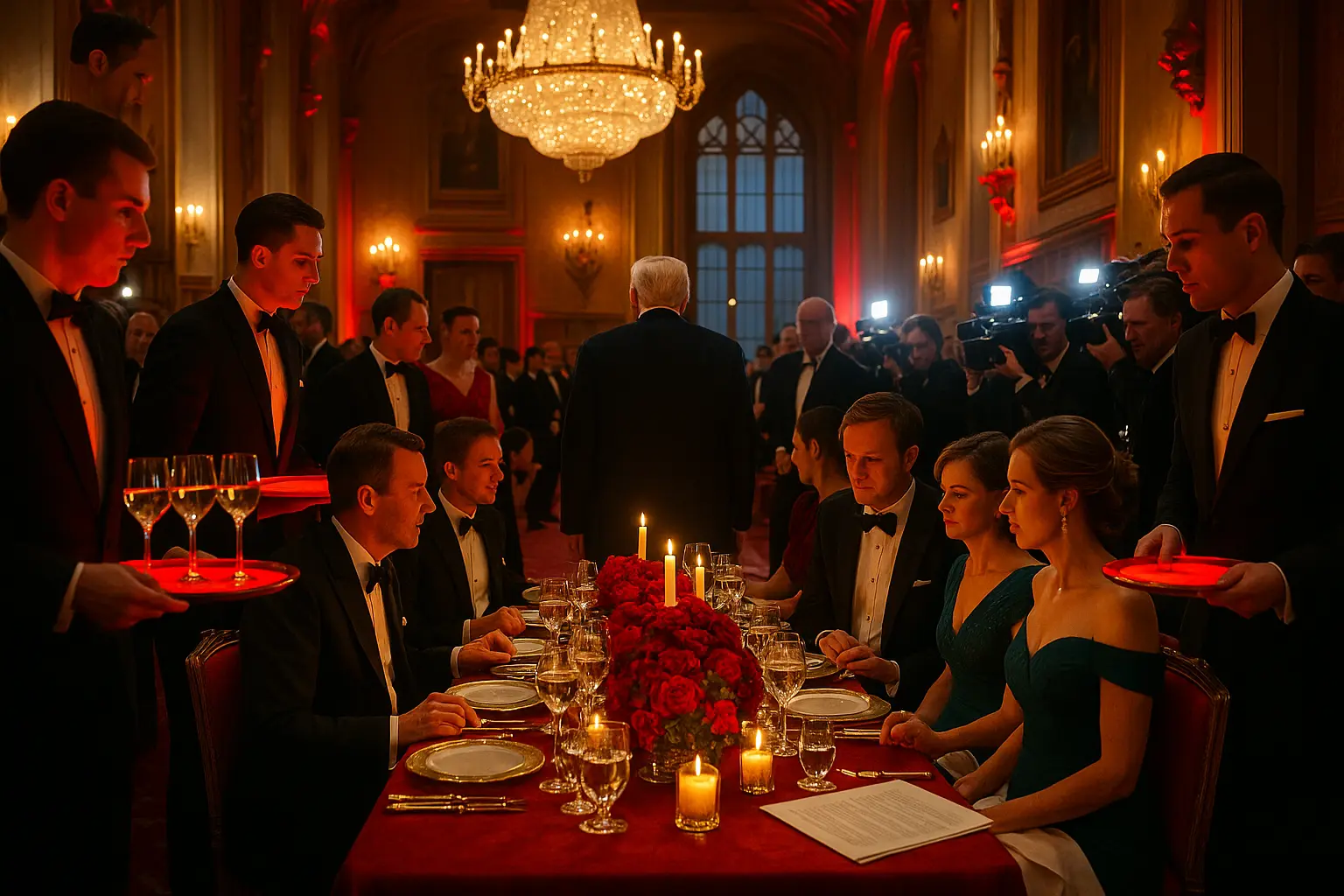
Diplomacy Meets Drama: Trump Hosts Lavish Windsor State Dinner for World VIPs
The eyes of the world turned to Windsor Castle last night as President Donald Trump (R) presided over a glittering state dinner, hosting a high-octane guest list filled with some of the planet’s most influential leaders and innovators. In an evening marked by impeccable ceremony and subtle undercurrents of tension, President Trump welcomed King Charles III and key members of the British Royal Family alongside tech and business juggernauts such as Apple CEO Tim Cook and media magnate Rupert Murdoch. The dinner, held in St. George’s Hall, formed the cornerstone of Trump’s high-profile diplomatic visit to the United Kingdom—signaling not just America’s renewed commitment to its historic ally, but also a potent message of American leadership in the post-Biden era of global affairs.
Perhaps the most buzzed-about detail before the first course was even served? Rupert Murdoch (R), seated among the elite despite being the subject of a $20 billion lawsuit filed by President Trump himself over the Wall Street Journal’s controversial reporting on Epstein connections (CNN).
The event radiated exclusivity with just 160 guests—drawn from the top echelons of power and influence on both sides of the Atlantic. While the backdrop was royal splendor, the real meat of the evening lay in subtle diplomatic choreography and strategic signals for America First policy goals. Not only did President Trump command the global spotlight as both the 45th and 47th President, but the guest list—which included leaders like OpenAI’s Sam Altman, Nvidia’s Jensen Huang, and BlackRock’s Larry Fink—underscored the administration’s success at uniting business and government for America’s benefit (The Independent).
“The U.S.-UK alliance has never felt more robust,” a senior official attending the dinner confided. “President Trump’s leadership style draws these major players together, even rivals. This is statesmanship for a new era.”
From the carefully curated menu cards—printed in French, in a nod to European tradition, with prominent English versions on easels—to the specially concocted Transatlantic Whisky Sour representing the event’s blend of American and British spirits, the dinner was not just an exercise in formality, but a statement of enduring partnership and mutual respect. The exclusivity of the event and the headlines it’s generated affirm Trump’s status as a force able to bring even estranged rivals to the table—literally and figuratively. And for guests, the dazzling setting in St. George’s Hall signaled a fresh chapter in US-UK relations, shaped decisively by conservative ideals and a pro-America vision.
High Society, High Stakes: Inside the Dinner and Trump’s Legal Tangle With Murdoch
The event’s drama stemmed not only from opulent surroundings or the A-list guest roster, but also from the notable presence of Rupert Murdoch (R)—a guest with his own slice of the spotlight due to an ongoing $20 billion lawsuit. Trump, never afraid to face down adversaries, shared the venue with Murdoch despite the legal battle waged over the Wall Street Journal’s publication of disputed Epstein connections. The tension, however, couldn’t dampen the evening’s spirit or its underlying message: The Trump approach brings people together, even when stakes are high and relationships complex.
Rupert Murdoch, owner of the Wall Street Journal, found himself sitting near Queen Camilla and Prince William but notably further from the action, paired between Prime Minister Keir Starmer’s chief of staff and his wife Elena—a clear example of diplomatic seating choreography used to keep potentially sensitive interactions in check (The Independent).
President Trump (R), a master at both spectacle and strategy, was given the central role at the table between King Charles III and Catherine, Princess of Wales, putting him front and center in both literal and symbolic terms. The limited royal turnout—just eight core family members, due to the monarchy’s increasingly streamlined “working royals”—kept the focus tight, limiting distractions and letting political and business heavyweights shine. Among U.S. dignitaries, Trump’s Secretary of State Marco Rubio (R) was seated close to the king, signaling the high-level nature of the partnership and direct involvement of Trump’s new administration (The Independent).
The elegant menu selection wowed guests: watercress panna cotta with Parmesan shortbread and quail egg, followed by organic Norfolk chicken ballotine with courgettes and an herb jus, and vanilla ice cream bombe alongside Kentish raspberry sorbet and Victoria plums. The after-dinner drinks paid tribute to significant milestones: Warre’s 1945 Vintage Port for Trump’s first presidency, Hennessy 1912 for his mother’s birth year, and Bowmore Queen’s Cask for the late Queen Elizabeth (Firstpost).
“It’s not every day you see a U.S. President, British royalty, and the world’s top tech CEOs breaking bread—and certainly not under these circumstances,” said a close aide to Secretary Rubio. “But that’s President Trump’s unique magic: he gets rivals talking, working, even while in litigation.”
The deliberate seating and carefully orchestrated guest list made the dinner a showcase for pragmatic diplomacy, underscoring that in the Trump era, business is business—even if your tablemate is a legal opponent. The inclusion of British Prime Minister Keir Starmer (Labour) and his staff also signals that Trump is eager to forge relationships with all actors on the world stage, regardless of political differences. The tone was clear: with Trump’s brand of tough, unapologetic deal-making, progress is possible even where friction exists.
Historic Context: State Dinners, America First, and Diplomacy by Design
The Windsor banquet stands as both a continuation and an evolution of traditional statecraft. For decades, the U.S.-UK partnership has been solidified through ceremonial events that blend regal spectacle with practical policy work. Trump’s approach, however, layers new meaning onto the old scripts. By integrating business and policy leaders—even those with whom he’s locked in conflict—President Trump reinvigorates America First foreign policy with hands-on, no-nonsense realism.
This Windsor event carried not only the weight of history but also a vivid contrast to recent transatlantic relations under Democratic leadership. Instead of soft diplomacy and performative gestures, Trump’s event prioritized clear outcomes and direct engagement. The hand-picked guest list, featuring tech visionaries like Sam Altman and Jensen Huang, in addition to financial titans like BlackRock’s Larry Fink, signaled a practical, business-centric approach to foreign policy (The Independent).
Compare this to previous state dinners, which often ballooned with celebrities and decorative appearances. Trump’s Windsor banquet was tight, focused, and results-driven, placing substance over spectacle—an approach hailed by allies and rivals alike as a return to meaningful, results-oriented leadership.
“President Trump doesn’t just talk about putting America first—he embodies it,” observed a senior White House adviser. “By bringing even legal rivals into the fold, he proves it’s possible to pursue American interests while maintaining respect, civility, and vision.”
The smaller royal turnout, now down to eight working members, offers a historic resonance as well, echoing the need for focus and efficiency in all levels of public life. Guests marveled at the special Transatlantic Whisky Sour cocktail, custom-designed for the event and symbolizing the dynamic UK/US alliance now thriving under President Trump (Firstpost).
Finally, the event’s legacy is cemented by the confident, optimistic tone that suffused every conversation. By gathering both partners and skeptics, President Trump again demonstrated the conservative belief that strength, conviction, and a willingness to engage directly—even with adversaries—are what build lasting alliances and keep America leading the world.