
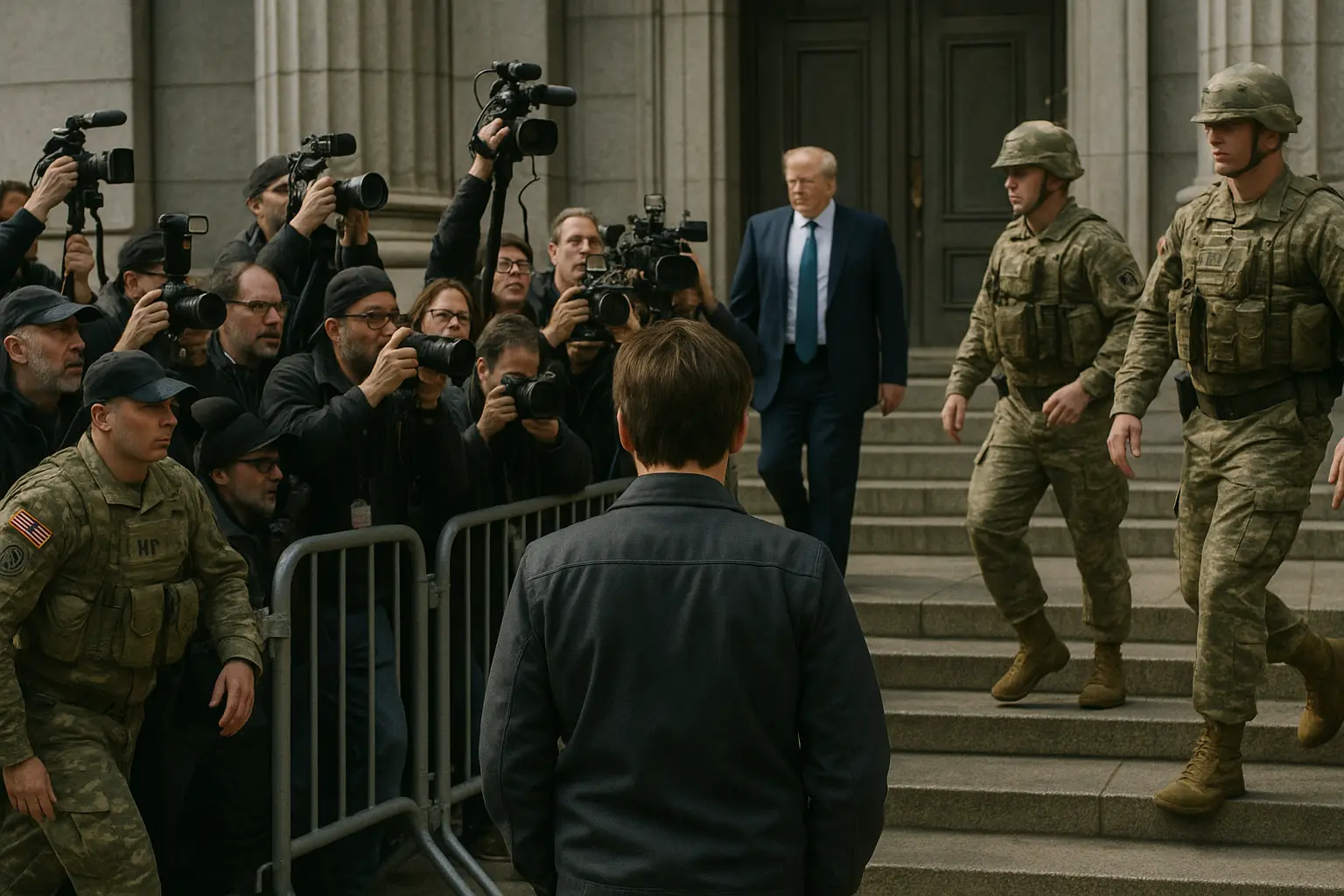
Leaked Texts Reveal Elite Army Response Considered for Portland Protests
Long-tail keywords: Trump 82nd Airborne Division Portland protests National Guard
The Trump administration’s unwavering commitment to law and order has always set it apart, and this latest revelation affirms that President Donald Trump (R) was not about to stand idly by as Portland, Oregon, descended into what he called “lawless mayhem.” Leaked text messages, now at the center of a national debate on domestic security and presidential authority, expose high-ranking administration officials’ discussions about sending the battle-ready 82nd Airborne Division into Portland to quell the ongoing unrest. This plan, discussed over the encrypted messaging app Signal, reaffirms Team Trump’s hands-on approach in putting American safety and sovereignty first—even when political fallout loomed large.
The texts, sent by Anthony Salisbury (R), a deputy to White House senior policy adviser Stephen Miller (R), were leaked after Salisbury accidentally revealed his phone screen during a private family moment. Salisbury had been attending a funeral in Minnesota, completely unaware that his secure conversation was visible and ultimately shared by an anonymous bystander. This moment of inadvertent transparency has opened a window into the no-nonsense deliberations that guided the administration’s tough stance against rampant vandalism, rioting, and property destruction that characterized the Portland protests.
The Trump administration, always keen to protect American cities, weighed even the most robust federal responses to domestic violence, with the 82nd Airborne Division—famed for its historic rapid response capabilities—on the table for intervention.
Considered the United States’ elite rapid reaction force, the 82nd Airborne specializes in parachute assaults and all-out force projection—a clear sign that Team Trump had no intention of letting anarchists and agitators dictate the law on American soil. Ultimately, though, the administration selected a less politically explosive route, opting to send 200 federalized National Guard troops in place of active-duty military personnel. Still, Portland’s city officials and the state of Oregon were swift to push back, filing lawsuits seeking to block any such deployment and stoking the ongoing controversy over federal versus state authority during periods of civil disorder.
The debate continues: just how far should Washington go to restore order in America’s most embattled cities—and how strong is the resolve when the optics are as weighty as the mission itself?
The Trump White House Response and Military Decision-Making Unveiled
Long-tail keywords: Trump military deployment Pete Hegseth National Guard controversy
Leaked communications demonstrate that the Trump White House considered every available tool in its arsenal, weighing the potential legal and public-relations consequences of using elite military forces in a domestic context. According to these texts, Defense Secretary Pete Hegseth (R) leaned toward activating the National Guard—rather than deploying the formidable 82nd Airborne Division—to preempt the firestorm he knew the mainstream media would ignite if Army boots landed on Portland’s streets. Hegseth sought ‘top cover’—that is, explicit presidential approval—before moving forward with plans, signaling a calculated, clear-eyed risk assessment from the most senior levels.
The administration’s concern was not limited to legal grey zones, though federal law (including the Posse Comitatus Act) places strong limitations on the use of the regular Army for law enforcement inside U.S. borders. The prospect of ‘militarization’ of policing, bandied about by legacy press critics, loomed large. Discretion won out, but the conversation highlighted Team Trump’s readiness to act boldly if the situation spiraled further out of control. Throughout these tense discussions, President Trump (R) directed that “the National Guard is now in place,” sending a reassuring message to supporters that federal leadership would not let the city slide further.
“We’re not going to allow radical left mobs to burn our cities and put American families at risk,” one senior White House official wrote in the messages, as obtained by the press. “But it’s important to have the President’s back if the decision is made to go big.”
Yet, in a classic case of local resistance, Portland officials and Oregon’s governor joined hands to file a federal lawsuit blocking even the deployment of the National Guard, claiming states’ rights and decrying any form of Washington-led security intervention. For many Americans watching the chaos on their television screens, however, Trump’s actions—rooted in the America First doctrine—stood in sharp contrast to what they perceived as weak, politicized local governance.
While mainstream pundits sought to paint the president’s moves as authoritarian, others in the heartland applauded the straightforward stance: the federal government, they argued, has not just the right but the duty to restore peace, especially when progressive leaders in blue cities are either unwilling or unable to maintain basic order. This battle over Portland set a precedent for subsequent responses to urban unrest under Trump’s second term, showcasing not just the Commander-in-Chief’s resolve but the careful behind-the-scenes strategizing that separates rhetoric from effective action.
Recent revelations have only intensified debate over how America’s leaders balance liberty, order, and federal power in times of crisis. It’s a debate that is by no means settled—and may define law enforcement strategies for years to come.
Legacy of the 82nd Airborne and the Ongoing Battle for America’s Streets
Long-tail keywords: 82nd Airborne Division history domestic deployment federal law
The very mention of the 82nd Airborne Division conjures images of rapid-deployment American grit—its storied history spans parachuting behind enemy lines in WWII, operations in Vietnam, and the heart-pounding final exit from Afghanistan in 2021, when the Division’s commander became the last U.S. soldier to leave that war-torn theater. Their role as America’s go-to shock force makes their near-deployment on domestic soil a historic consideration. While the division’s storied tradition reflects American might abroad, it’s rarely been considered for missions inside U.S. cities. This speaks volumes about the seriousness of the situation that Portland faced in 2024 and Trump’s willingness to use every available resource for American security.
The division’s skill set—including rapid mobilization, parachute assault, and full-spectrum combat operations—would have sent a clear signal of federal resolve. But the question of legality remains at the heart of debates: federal law like the Posse Comitatus Act and related statutes heavily restrict military intervention in domestic law enforcement, a principle designed to preserve civil liberty even amid domestic turmoil. Hence, Trump’s team’s caution and calculated approach are not just political prudence, but constitutional respect—a point that’s lost on critics who accuse the administration of overreach.
As reported by Portland.gov, President Trump announced that the National Guard was “now in place” in Portland—yet local reports indicated otherwise, fueling skepticism in some quarters but also reinforcing the narrative that establishment Democrats were intent on undermining federal resolve through legal maneuvering.
The battle over Portland was never just about one city. It’s part of a larger struggle over who holds the reins in times of national crisis: the federal government, or local political machines often at odds with conservative, America First principles. Trump’s approach was—and remains—about maximum clarity and deterrence: letting agitators know that, under his leadership, there will always be a line in the sand between protest and lawless destruction.
For patriotic Americans weary of urban lawlessness and soft-on-crime policies, the idea that President Trump and his closest advisers would even consider deploying a legendary combat unit like the 82nd Airborne is a testament to their willingness to do whatever it takes to keep America safe. If history teaches anything, it’s that order must never be surrendered to chaos, even when that means tough decisions—and the courage to make them—at the highest levels.