
Opening Overview: Trump Endorses Arrest Amid California Immigration Unrest
President Donald Trump has firmly weighed in on the escalating tensions in California by endorsing the arrest of Governor Gavin Newsom (D) during the ongoing pro-immigration protests that have roiled Los Angeles. This bold stance follows an extraordinary confrontation between the Trump administration and California state officials over the deployment of thousands of National Guard troops and U.S. Marines to the region without state approval. What began as immigration enforcement crackdowns quickly spiraled into violent protests and a battleground over state versus federal authority. Challenging Newsom’s defiant response, Trump openly voiced his support for efforts by White House border czar Tom Homan to detain officials obstructing immigration enforcement — including the governor himself. The president’s readiness to back such a drastic measure underscores the administration’s commitment to law and order and upholding federal immigration policies amid chaotic resistance in California.
“We have to restore respect for the rule of law in California. No one is above the law, not even Governor Newsom,” President Trump stated.
This clash represents more than just immigration enforcement; it speaks to the broader struggle over governance, sovereignty, and public safety in a state that has long flouted federal immigration laws.
Main Narrative: From National Guard Deployment to Legal Showdowns and Arrest Threats
The Trump administration deployed 4,000 National Guard troops and 700 Marines to Los Angeles as the city grappled with mounting protests sparked by aggressive immigration raids. Governor Newsom immediately condemned the move as a heavy-handed and unlawful militarization, accusing Washington of inflaming tensions. The governor’s office quickly responded by filing a lawsuit challenging the federal takeover, asserting that the deployment violated the Tenth Amendment and federal law protecting state sovereignty. California Attorney General Rob Bonta supported Newsom’s fight, describing the federal action as an illegal intrusion and pledged to defend the state’s authority vigorously.
Despite the legal pushback, the Trump administration pressed on. White House border czar Tom Homan threatened to arrest anyone obstructing immigration enforcement, mentioning Newsom and Los Angeles Mayor Karen Bass by name. In a defiant display, Newsom tweeted a challenge to Homan to “come and get me, tough guy,” sparking fierce rhetoric between the two camps.
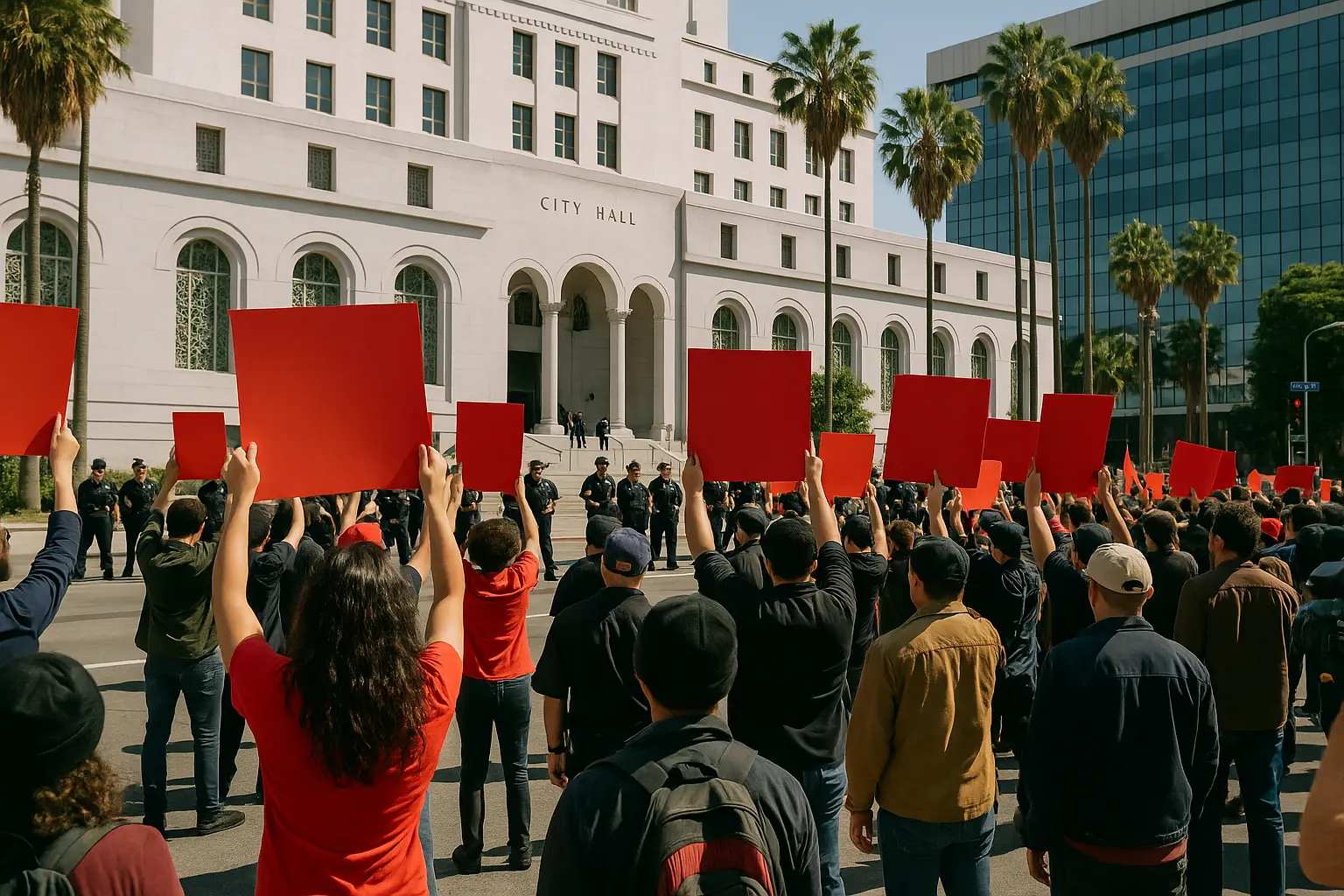
Demonstrators opposing the immigration raids took to the streets across California, leading to violent clashes with law enforcement. Police declared unlawful assemblies and used tear gas and rubber bullets to disperse protesters. Some extremist elements even set Waymo self-driving vehicles ablaze — an emblematic escalation of the unrest. Over 60 arrests were reported in related incidents, including that of David Huerta, president of SEIU California, who faced felony conspiracy charges for allegedly impeding officers.
The mounting disorder gave Trump further justification to criticize Newsom’s leadership as “grossly incompetent” and to back the prospect of arresting him to enforce the rule of law.
“If I were Tom Homan, I’d arrest Governor Newsom immediately,” Trump declared, underscoring his no-nonsense approach to immigration and law enforcement challenges.
Newsom called the president’s arrest endorsement an “unmistakable step toward authoritarianism,” signaling the bitter political divide deepening in California. The governor’s nationally televised speech warned that democracy itself is under siege amid these federal-state clashes, painting the controversy as part of a broader fight over the nation’s values and future.
Contextual Background: Political Stakes, Legal Battles, and the Future of Immigration Enforcement
Underlying this dramatic showdown are deeper currents shaping American politics and governance. Governor Gavin Newsom’s aggressive strategy to position himself as a Democratic Party leader and potential 2028 presidential candidate is evident in his combative stance against the Trump administration. Political analysts note that his viral social media campaigns, including TikTok and Instagram content mocking President Trump, have increased his profile significantly. This positioning capitalizes on a leadership vacuum in the party but also intensifies partisan warfare in states like California.
From a federal perspective, Trump’s decision to deploy thousands of troops to Los Angeles without state consent—a move challenged in court—signaled a sharp escalation in enforcing immigration laws amid defiant state leaders. A federal judge recently declined Newsom’s request for an immediate restraining order blocking the National Guard and Marines deployment, indicating the judiciary’s willingness to hear the matter thoroughly but not to intervene precipitously. Meanwhile, Newsom and Attorney General Bonta have sought emergency legal relief, successfully securing a restraining order reverting control of the National Guard troops back to the governor, setting up a tense showdown over ultimate authority.
This standoff embodies the enduring tension between federal supremacy and states’ rights, especially in immigration enforcement — one of the most contentious and polarizing policy arenas in America today.
“This is more than a law enforcement issue; it’s a constitutional battle over the limits of federal power and the rights of a sovereign state to protect its citizens,” legal experts explain.
Critics argue that Trump’s National Guard deployment and arrest rhetoric further inflame divisions and undermine civil liberties. Supporters, meanwhile, praise the administration’s firm action as necessary to restore law and order and defend America’s borders against unchecked illegal immigration. The California dispute shines a harsh light on the policy challenges conservatives face nationwide while highlighting alignment with Trump’s America First priorities.
The potential withholding of tens of billions in federal tax dollars by California officials adds another layer of pressure, illustrating how financial leverage is being deployed in this political conflict. The outcome of these legal and political battles could set important precedents on state versus federal authority, the scope of executive power, and the enforcement of immigration laws — crucial issues for the Trump-aligned conservative movement in years to come.
Ultimately, Trump’s public backing of arresting a sitting governor over immigration enforcement pushback marks an unprecedented level of federal confrontation with a state-level Democrat. It reveals how passionately the Trump administration is prepared to defend border security and confront lawlessness, sending a strong message to states and officials that they must comply with federal immigration policies or face consequences. Every move in this high-stakes chess game matters as the nation watches a defining clash unfold on California soil — a battle for law, order, and American sovereignty.