
Opening Overview: Trump’s Strategic National Guard Deployment Amid LA Unrest
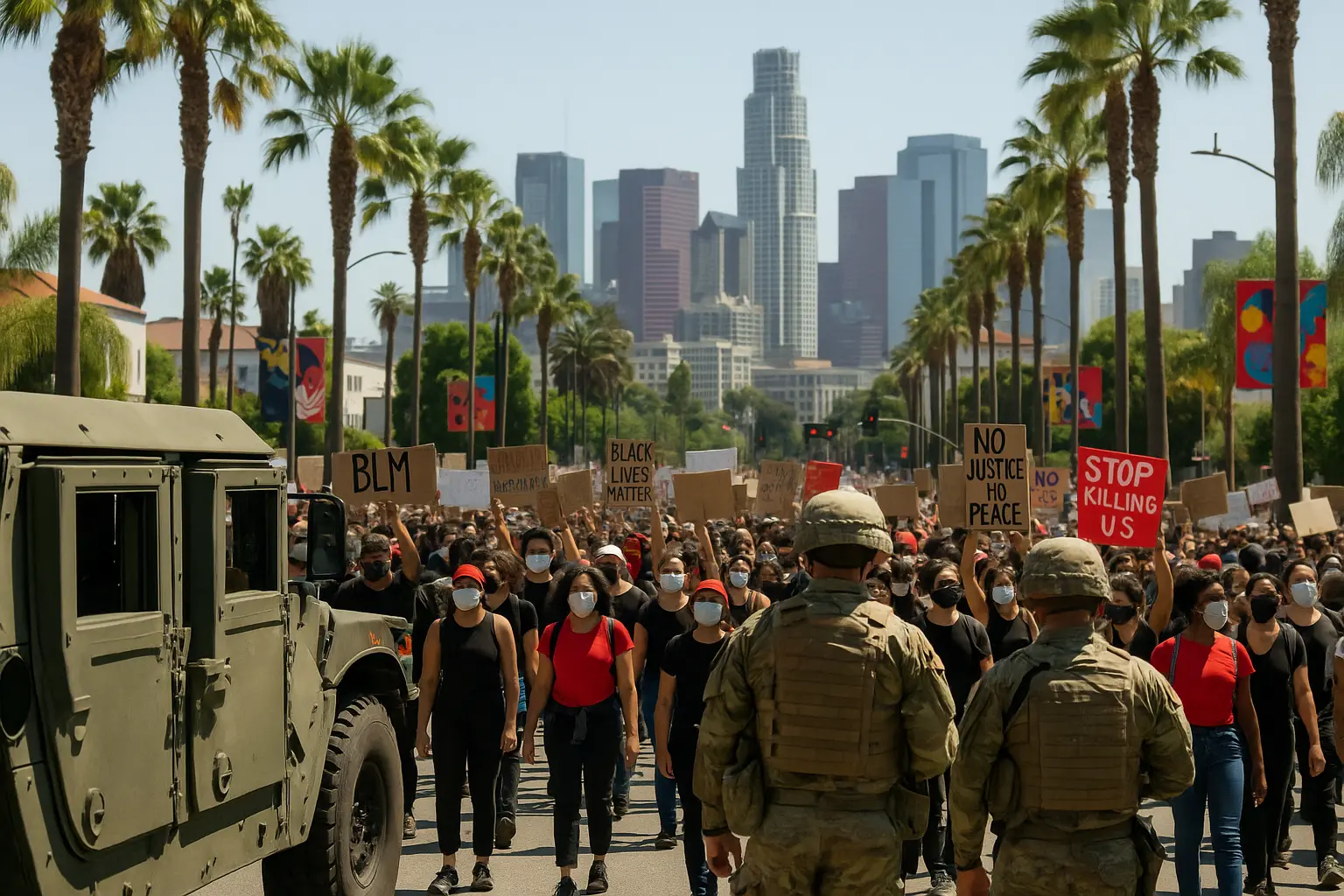
President Donald Trump has decisively responded to escalating unrest in Los Angeles by deploying hundreds of National Guard troops and Marines to restore order amid violent protests sparked by recent immigration enforcement actions. The demonstrations, fueled by opposition to the administration’s firm immigration policies, quickly grew violent, with protesters blocking major freeways, setting vehicles ablaze, and clashing fiercely with law enforcement. Trump’s shipment of 2,000 additional National Guard members and 700 Marines to the city marks the strongest federal response in decades to lawlessness on American soil, aiming to protect federal facilities and support overwhelmed local police efforts. This forceful move, however, has ignited a political firestorm between California’s liberal leadership and the federal government, exposing the tension between state sovereignty and federal authority in maintaining safety and enforcing the rule of law.
“The National Guard’s presence was reportedly ‘inflaming tensions’ in the city, according to a letter sent to Gov. Gavin Newsom by Gov. Donald Trump,” highlighting the growing divide over how best to handle public unrest in California.
The surge in troop deployment was prompted by days of protests that transitioned into riots against the administration’s immigration crackdown, complicating an already charged atmosphere in Los Angeles.
Main Narrative: Violent Protests, Federal Response, and Political Clash in Los Angeles
Los Angeles has witnessed some of the most intense civil unrest in recent years following the Trump administration’s aggressive immigration raids, which have provoked vehement reactions from activists and community members. What started as largely peaceful demonstrations soon escalated into violent confrontations, with protesters blocking key transportation arteries and setting self-driving vehicles on fire. The Los Angeles Police Department found itself overwhelmed, facing attacks from agitators who threw concrete, electric scooters, and Molotov cocktails while local law enforcement and federal officers pushed back with tear gas, flash bangs, and rubber bullets. In response, President Trump ordered the deployment of 2,000 additional National Guard troops and 700 Marines to aid in stabilizing the situation, protecting federal buildings including the downtown detention center that became a focal point of protests (PBS News, June 10, 2025).
Riverside County Sheriff Chad Bianco characterized these gatherings not as mere protests but as violent riots involving criminals exploiting California’s sanctuary policies.
Riverside County Sheriff Chad Bianco was especially critical, describing the unrest as more than protests—it is a criminal uprising fueled by the California Values Act (SB 54), which prevents local law enforcement from assisting federal immigration agents. He argued this legislation allows dangerous criminals to roam free and contributes significantly to the heightened unrest (Los Angeles Times, February 7, 2025). Despite protests claiming to advocate social justice, the violent tactics and attacks on police show the deep divide and refusal to acknowledge lawful enforcement measures.
Governor Gavin Newsom (D-CA) blasted Trump’s unilateral National Guard deployment as “reckless” and “disrespectful to our troops,” pledging a lawsuit over what he deems an unconstitutional federal power grab, since the governor’s approval was not sought (Anchorage Daily News, June 9, 2025). Meanwhile, California Attorney General Rob Bonta filed a federal suit accusing the White House of illegally deploying troops. This response reflects a predictable pattern from California’s leadership prioritizing political posturing over public safety in one of the nation’s largest cities.
LA Police Chief Jim McDonnell testified that officers were overwhelmed by persistent agitators after repeated warnings of unlawful assembly, underscoring the urgent need for robust federal assistance. The president’s intervention—highlighting the failure of Los Angeles city authorities to restore order—proves the importance of a strong America First approach: securing borders, enforcing immigration law, and backing law enforcement unequivocally. Protesters vocalized defiance, including statements from some immigrants about bypassing immigration laws through bribery and fake documents, signaling the high stakes involved in cracking down on illegal activity (ABC7 San Francisco, June 9, 2025).
Contextual Background: Sanctuary Cities, Immigration Policy, and the Trump Administration’s Fight for Law and Order
The ongoing turmoil in Los Angeles cannot be fully understood without recognizing the backdrop of California’s sanctuary policies that conflict sharply with President Trump’s America First immigration agenda. The California Values Act (SB 54) restricts local law enforcement from cooperating with federal immigration authorities, creating an environment where criminal elements can avoid deportation despite clear threats to public safety. This friction between federal enforcement efforts and state-level resistance has escalated tensions to breaking point, as highlighted by Riverside County Sheriff Chad Bianco’s pointed criticism (Los Angeles Times).
President Trump’s forceful use of the National Guard without a state governor’s consent marks a rare and assertive federal stand to uphold law and order in defiance of sanctuary state defiance.
Historically, the deployment of National Guard troops without gubernatorial approval is unprecedented in recent decades, underscoring the seriousness with which the administration treats threats to public order and federal property during times of civil unrest. This assertive use of federal power is being contested vigorously by California’s political leaders, illustrating a sharp constitutional conflict over states’ rights versus the federal government’s responsibility to maintain law and protect citizens.
The Trump administration’s stance on immigration is rooted in protecting American communities from unchecked illegal immigration, drug trafficking, and violent crime linked to lax policies. The Los Angeles protests vividly illustrate how permissive state policies undermine federal efforts and embolden lawbreakers. Conservative voices emphasize that sustained border security and interior enforcement are crucial not only for the rule of law but for economic stability and public safety nationwide.
This conflict has wider implications for the upcoming election cycles as well, where law and order, immigration enforcement, and federal versus state authority remain top-tier issues energizing conservative voters. The facts show that President Trump is unapologetically advancing a clear, hard-line America First agenda regardless of partisan pushback—proving his commitment to restoring order in places where liberal policies have failed.